
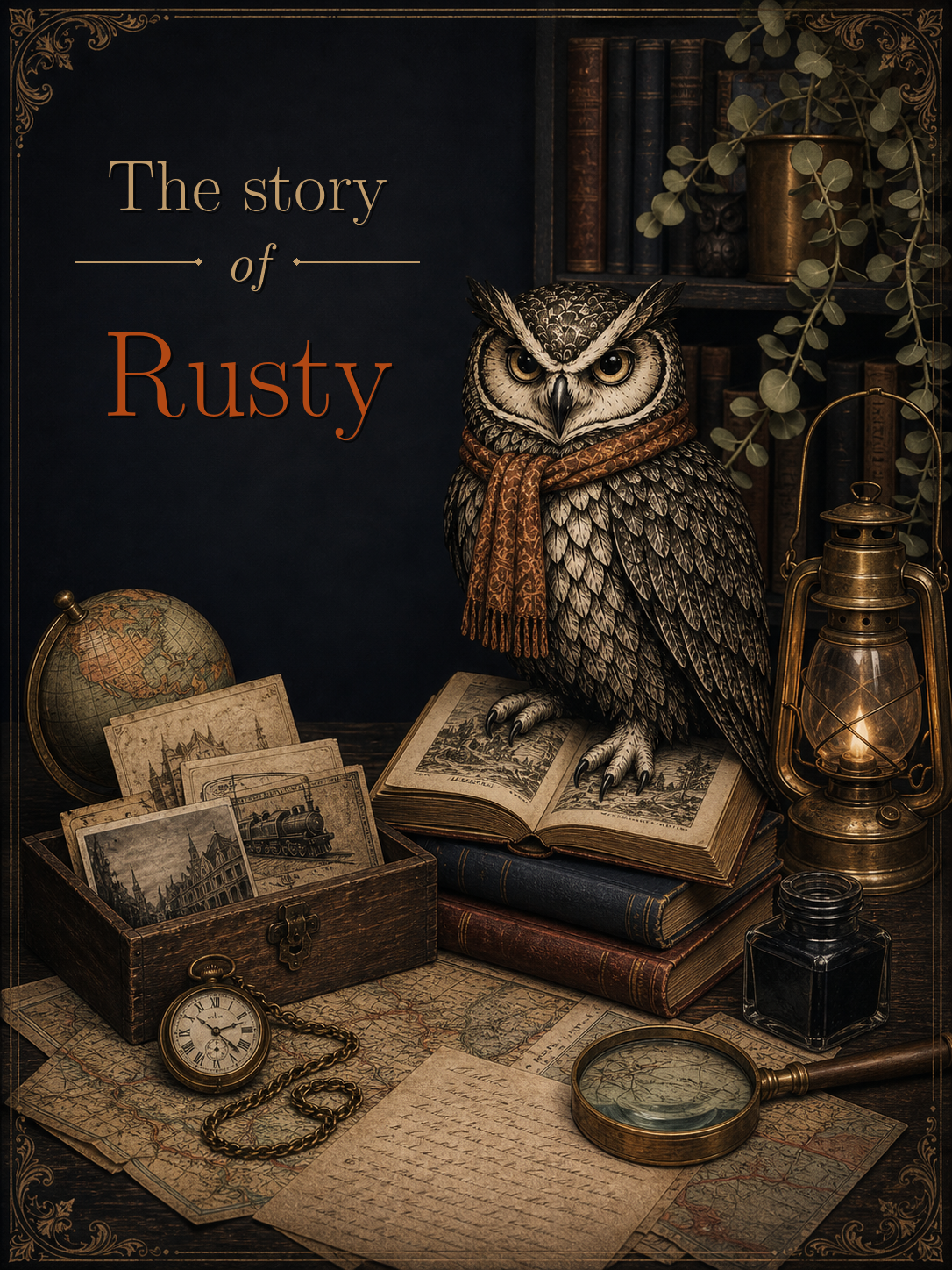
There is an old owl called Rusty who has always had a fondness for things that other people overlook.
Not treasure in the usual sense. He has little interest in gold or jewels. Rusty collects pieces of the past.
A postcard sent from a seaside town a hundred summers ago. A railway ticket folded carefully into a coat pocket. A map marked with roads that have since disappeared. A handwritten letter whose writer could never have imagined that someone might still be reading their words generations later.
These are Rusty’s treasures.
After dusk
His full name is RUSTY PECHA — pecha being the Bengali word for owl — and, as you might expect of an owl, most of his collecting is done when the world has grown quiet.
After dusk, Rusty sets out in search of forgotten things. He visits dusty bookshelves, old desk drawers and boxes that have not been opened for years. He peers beneath bundles of papers at market stalls and investigates old trunks in attics. Wherever something curious has survived, Rusty seems to have a remarkable habit of finding it.
He does not judge an object by how grand it looks. Sometimes the most ordinary piece of paper tells the most extraordinary story.
The ordinary becomes a clue
A receipt might reveal what someone bought for their home in 1892. A theatre programme can take us back to an evening when an audience settled into their seats more than a century ago. An old advertisement tells us what people desired, feared or dreamed about. Even a hurried note in the margin of a book can leave behind the faintest trace of a person otherwise lost to history.
Rusty understands something important about these things: they were never made to become history. They were simply part of somebody’s life. That is precisely why he collects them.
Over the years, his collection has grown into a wonderfully untidy archive of maps, prints, postcards, documents, photographs, advertisements, booklets and all manner of curious ephemera. Some pieces are beautiful. Some are strange. Some are historically important. And some appear completely ordinary until you look a little closer.
Rusty always looks closer.
The beginning of an investigation
Occasionally he discovers a maker’s mark hidden in a corner, an unfamiliar name in faded handwriting, an old watermark visible only when the paper catches the light, or some tiny detail that begins an entirely new investigation. Those are his favourite discoveries.
For Rusty, collecting is only the beginning. He wants to know where an object came from, who made it, who owned it and what story it has managed to carry through the years.
And eventually, when the time is right, Rusty allows some of his treasures to leave the collection. He rather likes the thought that an old map, postcard or document might begin another chapter somewhere new — carefully looked after by somebody who noticed the same small spark of history that first caught his eye.
A cabinet of curiosities in written form
He keeps a record of the especially interesting discoveries. Those stories belong here, in the RUSTY PECHA Journal: a cabinet of curiosities in written form, where unusual objects can be investigated, forgotten histories uncovered and wonderfully peculiar survivors celebrated.
There will always be another box to open. Another piece of handwriting to decipher. Another forgotten journey to retrace. Another story hiding in an ordinary scrap of paper.
And somewhere, as evening falls, Rusty will be looking for it.
Keep curious. Look closer.