
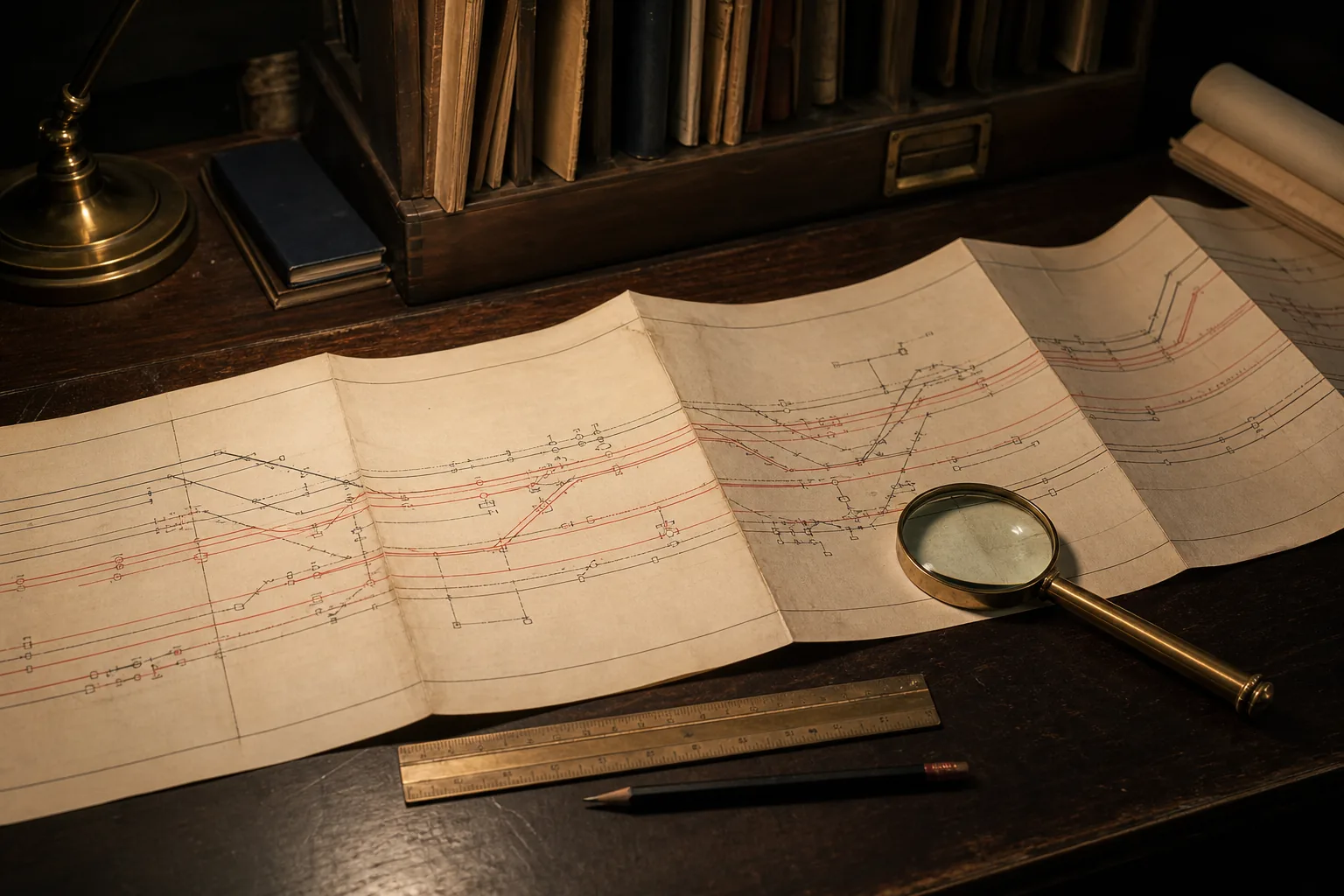
The first impression offered by this 1984 London Underground Traffic Circular is one of scale. Folded, it is the sort of official paper that could easily disappear into a drawer. Opened out, it becomes an object of a quite different order: a signalling plan which runs to some 235 centimetres, continuing across the table in sections. I was drawn to it before I understood it. The paper has the authority of something made for a serious purpose, yet much of what it says is initially closed to an untrained reader.
That is partly why I asked an engineer friend to look at it with me. I did not expect a lesson in how to read every mark, and I have no wish to pretend that I can now do so. What he gave me was a better way of looking: not a key that made the sheet suddenly simple, but a sense of the questions it was designed to answer. Once I began to see those questions, the diagram stopped being an impressive but impenetrable pattern of black lines. It became a record of how a stretch of railway was expected to behave.
A public Underground map begins with the passenger. It offers a station name, a coloured line and the promise that one may travel from one place to another. This plan begins elsewhere. It is concerned with the railway itself: which line a train is on, where it may change course, what must be clear before it moves, and where a particular alteration begins or ends. My friend’s first caution was useful: it is not a map of London in the usual sense. It is a working drawing, and it gives importance to matters that a passenger is never meant to notice.
There is a particular pleasure in unfolding a technical sheet of this size. It does not yield itself all at once. One has to move along it, pause, follow a line, return to a junction and try again. I found that the act of handling it became part of the reading. The folds slow one down. They make it difficult to see the whole system in a single glance, which is perhaps appropriate for a document concerned with a railway that was itself made from connected but separate sections.
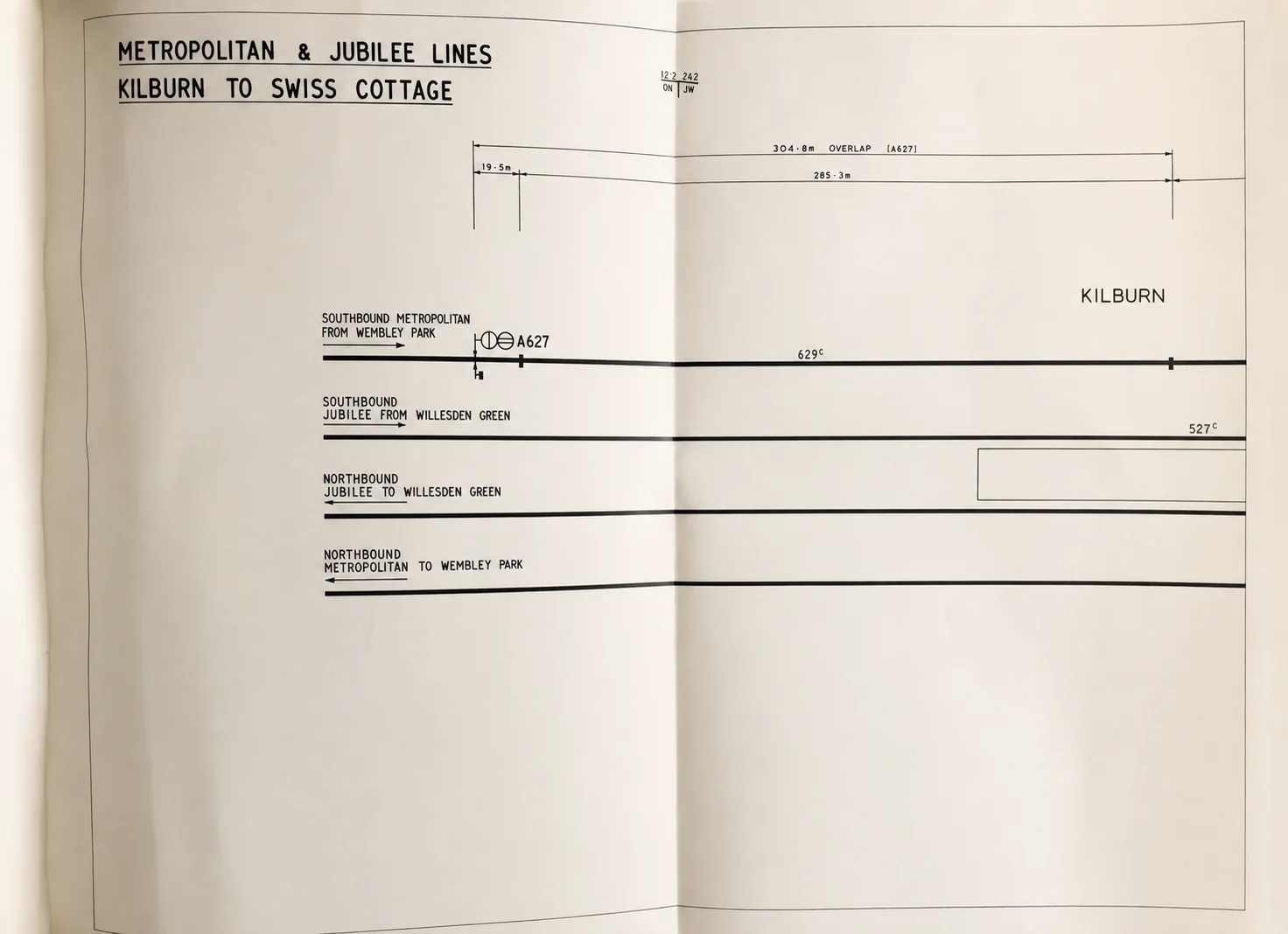
The first of these views helped me grasp the basic grammar. The large words establish the area — Metropolitan and Jubilee lines, Kilburn to Swiss Cottage — while the parallel horizontal lines are the running lines set out in their operational relationship. The direction labels are more revealing than they first appear. They do not describe an abstract route through the city; they identify the actual movements for which the line must be arranged. A passenger sees a train heading north or south. The drawing is concerned with exactly which road it occupies and what lies ahead of it.
My friend pointed out that the strings of letters and numbers are not there to make the diagram look technical. They are references to specific pieces of the working railway: signals, track sections, points and associated equipment. I can recognise some of the words, but I cannot honestly decode every identifier. That limitation is part of the appeal. It makes clear that this was never a document designed to be admired from a distance. It assumes a reader who already has a working knowledge of the line, and who needs precise information rather than a general impression.
The word circular can sound dry, but it is important here. A circular was a means of communicating a change or an instruction to people who needed to act upon it. The 1984 supplement concerns revised signalling arrangements around Finchley Road, and its purpose was practical: to make clear what would be different when the new arrangement came into use. There is no attempt to explain why the Underground matters to London. That did not need explaining. The concern was that staff should understand the altered railway well enough for trains to move safely through it.
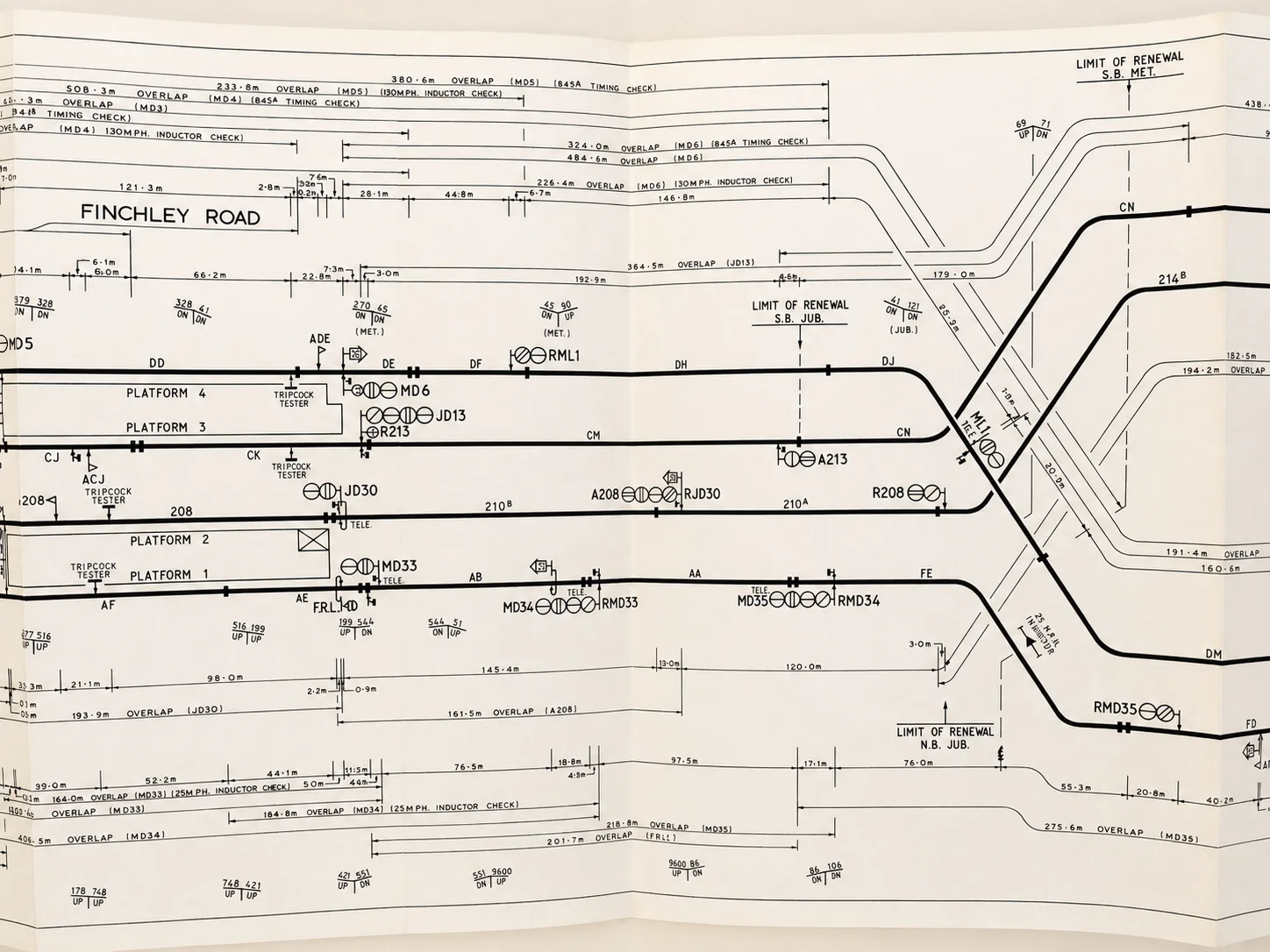
The Finchley Road detail was where the conversation became most helpful. At first I saw a crowded piece of drawing: platforms, codes, parallel lines and a knot of routes to the right. My friend encouraged me to begin with the places where one line may become another. Those are the points and crossovers — the movable sections of track which direct a train through a junction. Once that was explained, the heavy black routes ceased to be decorative geometry. They were choices made physical: routes that could be set, held, protected or kept apart.
That also made the relationship between signals and points easier to understand in broad terms. A signal does not simply give a driver permission to go; it belongs to a wider arrangement that has to know whether the route ahead is available and whether the points are in the required position. My friend described this as a system of checks rather than a single command. I found that idea unexpectedly moving. The orderly drawing is not merely about where trains go. It is about preventing incompatible movements from being created in the first place.
The measurements and the repeated word overlap are another reminder that the plan is drawn around safety rather than appearance. I was told to think of an overlap as the protected margin beyond a stop signal: space allowed for the railway to remain safe if a train does not stop exactly where one hopes it will. I do not claim to understand the exact calculation on this particular plan, but the principle changed the way I saw the empty-looking areas of the drawing. They are not empty. They are part of the distance, time and precaution built into a working railway.
The long rows of smaller numbers and marks have a similar effect. Some refer to signals or track-circuit sections; some give distances or identify equipment. A track circuit, in the broadest terms, helps the signalling system know whether a section of railway is occupied or clear. Again, I cannot read this plan line by line as a signaller or engineer would. What I could understand after our conversation was that these printed fragments allow a large and complicated place to be broken down into particular, checkable parts. The railway becomes legible by being named so exactly.
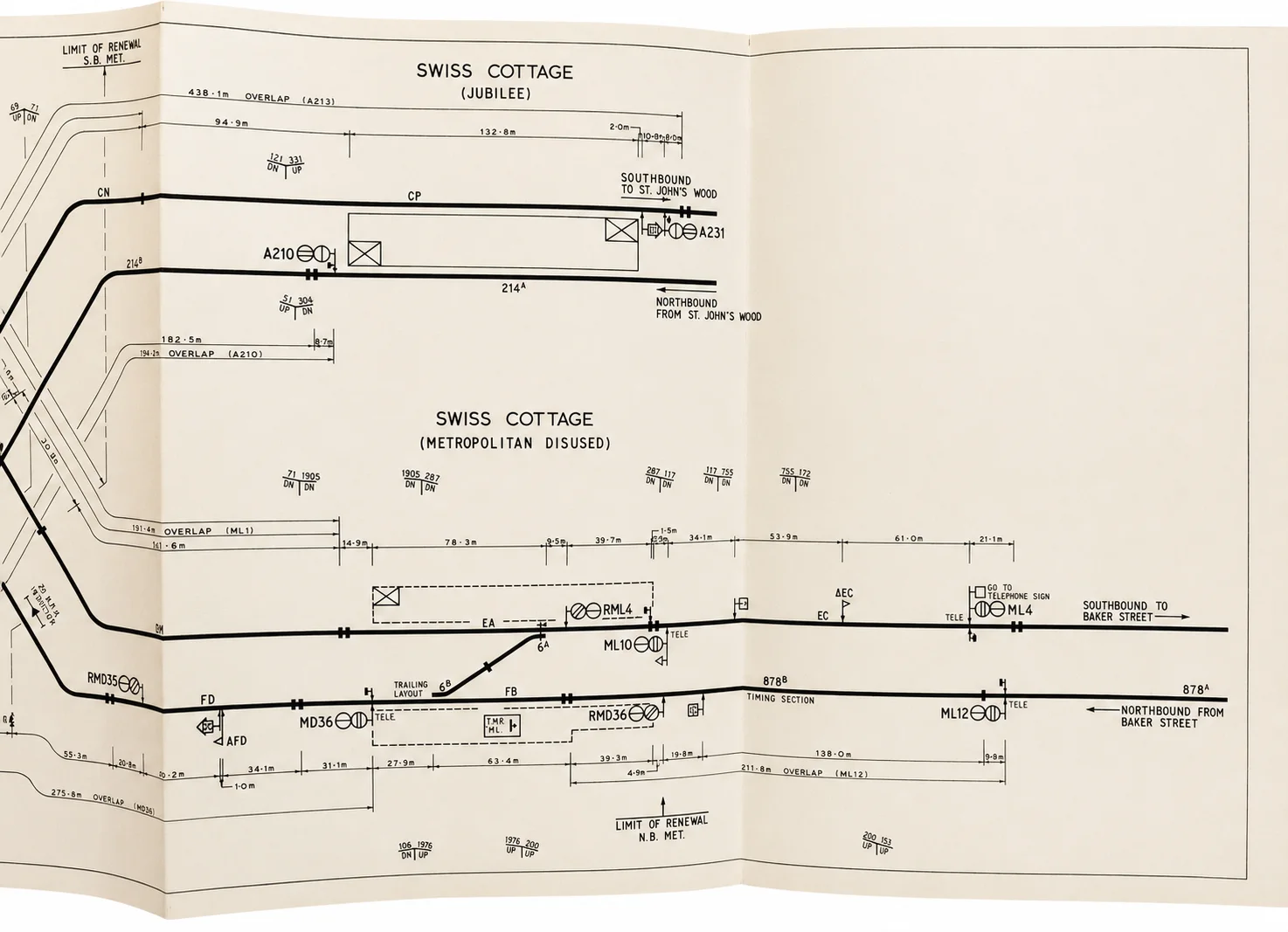
The Swiss Cottage portion has a quieter quality. There is more paper around the lines, but it is not a less exact part of the plan. The words “limit of renewal” appear at the edges of the revised work, which my friend explained as a boundary between what the scheme was changing and what lay beyond it. It is a modest phrase, but it contains an entire engineering decision. The Underground may look permanent from the platform, yet it is constantly being renewed in pieces, with each alteration carefully joined to the railway that was already there.
There is a small phrase on the sheet that I found especially arresting: “Metropolitan disused”. It is easy for a non-specialist to mistake such a note for a piece of railway history in miniature. My friend’s advice was not to overread it. On a plan like this, every word is there for a working reason before it becomes interesting to a collector. That restraint is worth preserving. Still, the note suggests how several times can inhabit a single engineering drawing: an earlier arrangement, the one in use in 1984, and the change being prepared for the future.
I came away from the conversation with fewer certainties than I had expected, but with a much stronger sense of what I was looking at. I no longer see the diagram as a puzzle that must be solved in full before it can be appreciated. It is enough to understand something of its scale and discipline: that each line, reference and measured gap belonged to a system intended to keep an immense and ageing railway moving without allowing conflicting movements to occur.
That is why these staff papers interest me more than a familiar Underground poster. A poster asks to be seen. This circular asks to be used. Its language is concise because the reader was expected to bring knowledge to it already. Behind the shorthand are individual people — signallers, engineers, station staff and others — whose work depended on the plan being exact. When everything went correctly, that work became invisible to the passenger. The ordinary journey was the result.
The physical condition of the document matters too. Its folds and light handling marks are not merely defects. A plan this long was made to be opened, consulted, folded again and carried through a working environment. The paper still holds the memory of those actions. It is not a clean reproduction of an idea; it is the object through which an idea had to pass in order to become practical.
Looking at it now, I think the most compelling thing is the difference between the tidy public image of the Tube and the dense, patient order beneath it. The familiar diagram on a platform reduces London to coloured lines and station names. The plan replaces the public map’s coloured simplicity with the routes, overlaps, signals and equipment used to operate the railway.
That is the lasting appeal of these papers for me. They do not ask to be admired, but they reward attention. I am still only beginning to read them. Yet after talking them through with someone who sees railways differently, I can understand why such a sheet was worth keeping. Unfolded across a table, it briefly lets one look behind the public face of the Tube and into the quieter, technical world that kept it moving.
Bibliographical note
This piece draws on an original 1984 London Underground Traffic Circular No. 23 and its folding signalling diagram. My interpretation is deliberately that of a collector and non-specialist, informed by a conversation with an engineer friend rather than presented as a line-by-line technical reading. For general context, Transport for London’s safety documentation explains the role of signalling control systems in the safe operation of the Underground; Network Rail’s explanation of signals and points and its note on track circuits are useful general introductions to the principles mentioned here.