
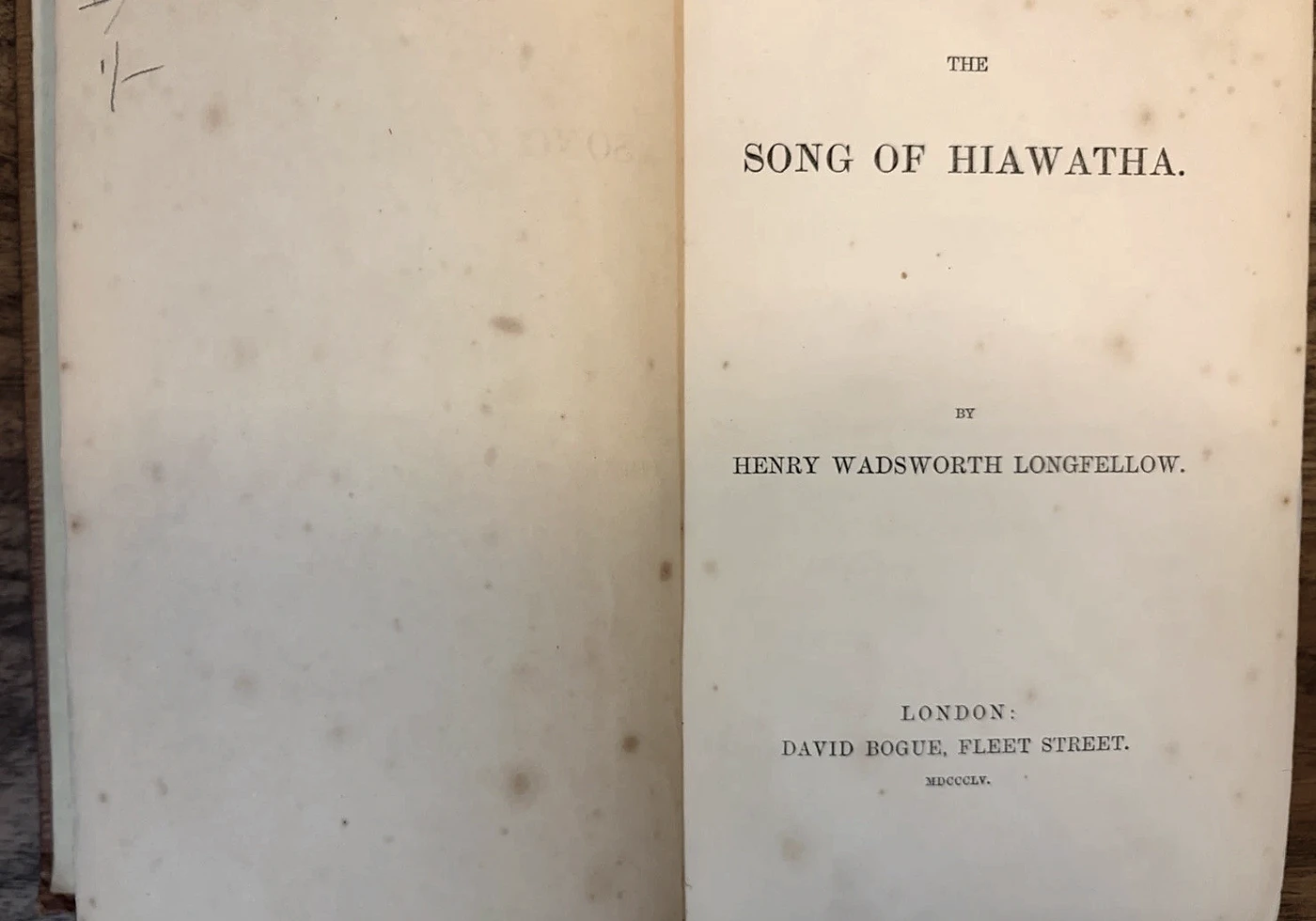
The publication chronology is striking. David Bogue issued two London editions of The Song of Hiawatha on 1 November 1855; the first American edition followed in Boston on 10 November. This copy is complete as issued, with an extent of iv, 316, 24 pages: the poem is followed by a separately paginated 24-page publisher’s catalogue.
The title page names Henry Wadsworth Longfellow, David Bogue of Fleet Street, and 1855. Bogue (1807–1856) took over the bookselling business of Charles Tilt at 86 Fleet Street in 1843. His publishing name on this page turns the book into a specifically London event, not merely an American success that happened to cross the Atlantic later.

This copy belongs to the first London issue. It retains the reading “Dove as if he were a beaver” on page 96, later changed to “Dived”, and three lines on page 100 beginning “He the terror of the fishes”. The first American issue also retained “Dove”, but omitted the three lines on page 100. The points are small, but they locate this copy within the earliest printed history of the poem.


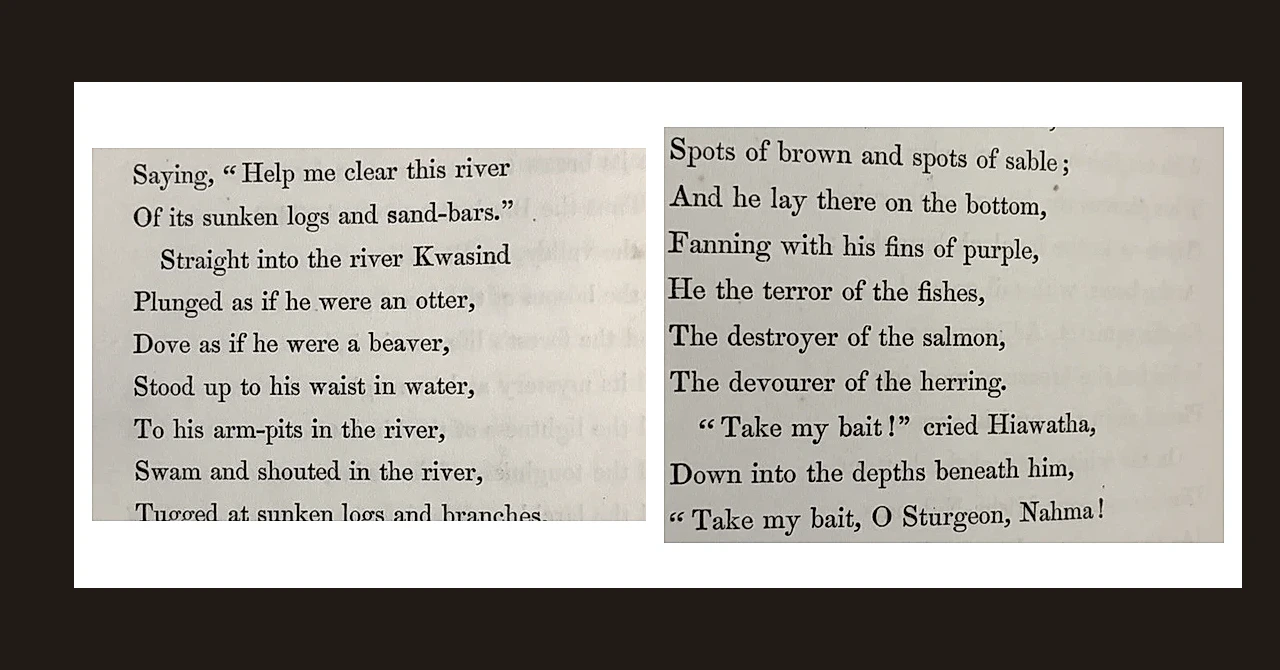
Bogue offered the poem in two formats: this 316-page cloth volume and a simultaneous 176-page edition in wrappers.
The name on the title page
Longfellow’s poem gives its hero a name that does not belong to the figure whose stories supplied much of the plot. The narrative is principally shaped from Anishinaabe traditions of Manabozho or Nanabozho, a cultural hero and trickster. Hiawatha, by contrast, is a distinct Haudenosaunee leader associated with the Haudenosaunee (Iroquois) Confederacy. Longfellow’s conflation was not a harmless flourish: it joined a name, a people and a body of stories that do not simply stand in for one another.
That correction changes how the book is read. Longfellow knew the Mississauga Ojibwe writer George Copway personally and was influenced by him, while drawing principally on Henry Rowe Schoolcraft’s publications. Gerald Vizenor, the Anishinaabe writer and scholar, describes the loss more sharply: Longfellow turned Nanabozho’s complex trickster tradition into an isolated, sentimental hero. The poem’s insistent, readily memorised trochaic tetrameter helped it travel; its version of Indigenous life travelled with it.
Marks left by readers
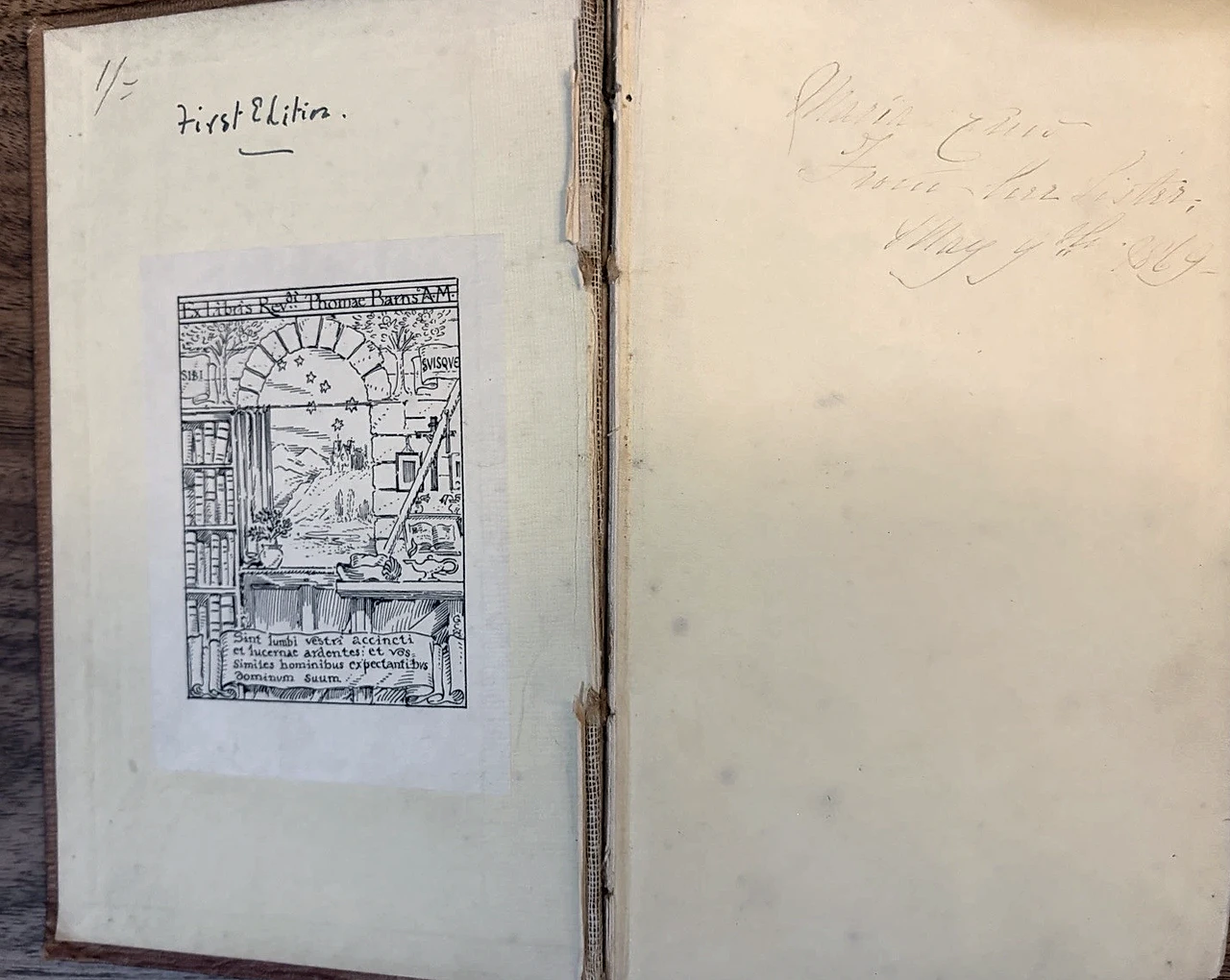
The front opening has its own quieter history. It carries a pictorial bookplate, a handwritten “First Edition” note and a faint ownership inscription dated May 1859. The name cannot be read securely enough to support a provenance claim, but the inscription places the copy in private hands by that date.
The same opening shows the split front inner hinge and exposed sewing. The photographs document its present structure, but do not establish when the damage occurred or whether earlier repairs were attempted.
A poem sold as a book
Across its editions, Hiawatha sold 50,000 copies by 1860 and generated translations, musical settings and dramatic performances. The figure describes the work’s wider reach, not the size of Bogue’s London issue.
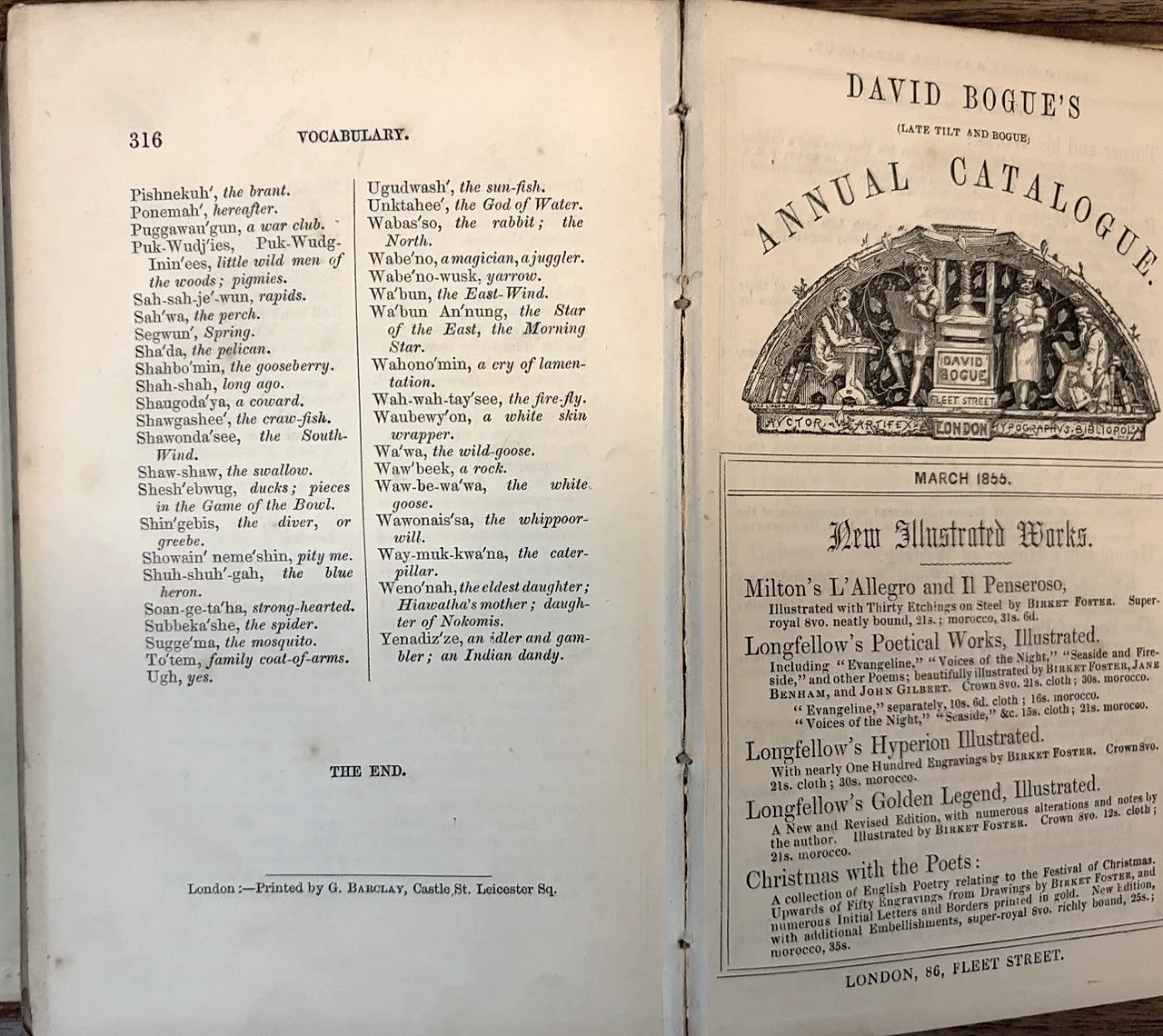
The physical clues are unusually eloquent. The title-page verso carries G. Barclay’s Castle Street, Leicester Square printer’s imprint. At the other end, a terminal “Vocabulary” is followed by a David Bogue catalogue dated March 1855. That date belongs to the catalogue, not the book. Its presence shows the poem and Bogue’s wider list bound into the same surviving volume.


The poem is followed not by silence, but by more books to order. Illustrated works, drawing manuals, travel and fiction fill the pages that follow. The catalogue proves something simpler, and more concrete: a reader arriving at the end was immediately offered another route through Bogue’s publishing world.
That proximity gives the book a particular kind of value as evidence. The poem’s American setting and its London manufacture are not separate stories here; printer, publisher and catalogue occupy the same object. Literary reputation depends not only on writing, but on the people and systems that set type, choose formats, bind copies and place a list of further titles in the reader’s hand.
Reading the surviving copy
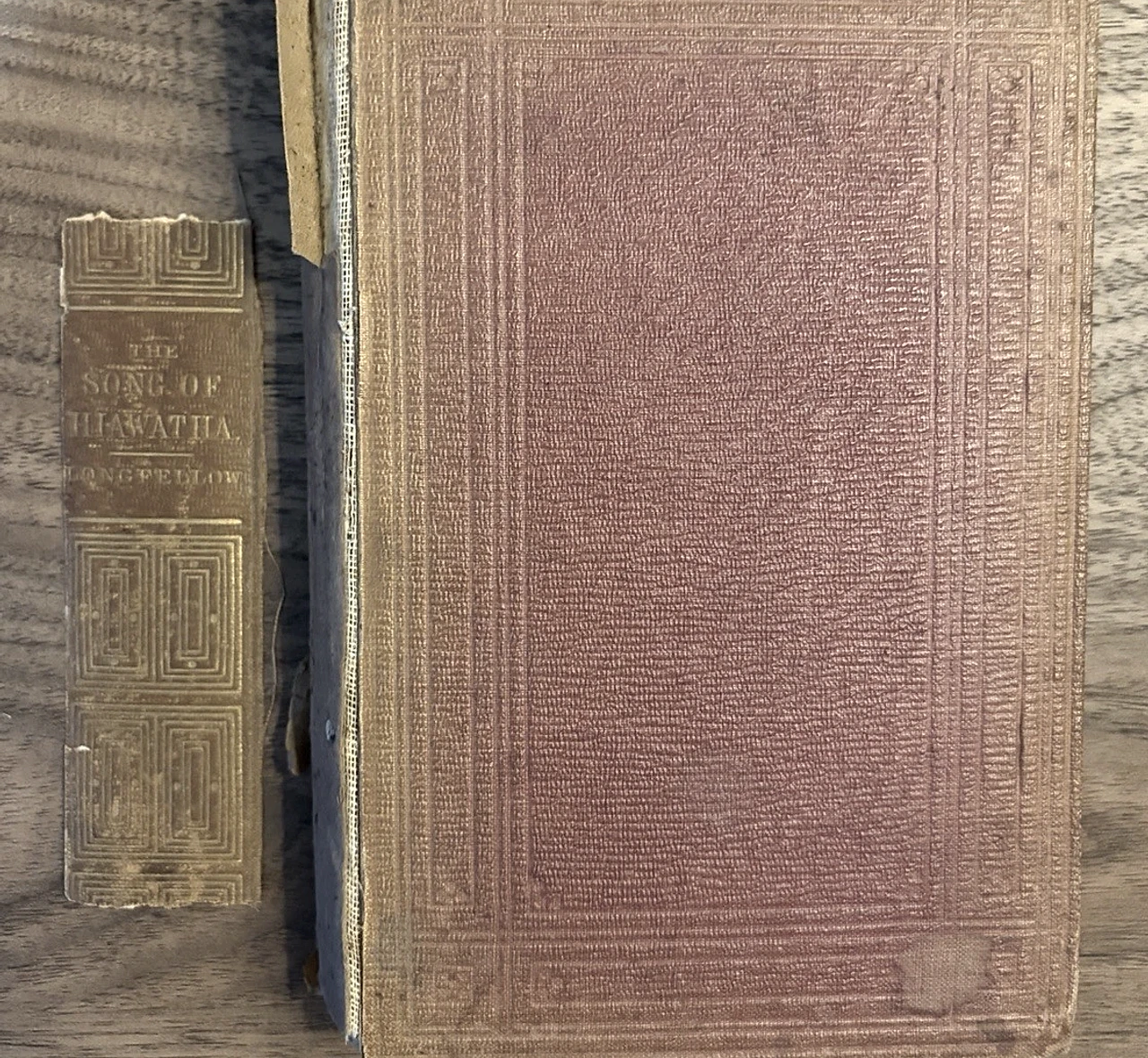
The copy is complete as issued but heavily worn. The cloth-covered front board is rubbed, the gilt-lettered backstrip detached, and the front inner hinge split enough to expose the sewing; foxing is visible on the endpapers. These defects require exact description, not romanticisation.
What remains is a compact sequence of evidence: London publisher, printer, terminal “Vocabulary” and opening catalogue, all preserved in the same object.
In one damaged volume, Longfellow’s fame, Bogue’s London launch, the remaking of Anishinaabe stories and the poem’s contested legacy remain materially joined.
References
- Longfellow, Henry Wadsworth. The Song of Hiawatha. London: David Bogue, 1855.
- Morgan Library & Museum. “The Song of Hiawatha / by Henry Wadsworth Longfellow.” PML 137529. Publication chronology, alternate London form, recorded extent and printer’s imprint.
- Christie’s. “The Song of Hiawatha, London, David Bogue, 1855.” First London issue; the three page-100 lines omitted from the American edition.
- Potter & Potter Auctions. “The Song of Hiawatha, Boston, 1855.” First American issue retaining “Dove” on page 96; BAL 12111.
- National Park Service. “Hiawatha.” Longfellow House–Washington’s Headquarters National Historic Site. The Manabozho/Hiawatha distinction and Longfellow’s sources.
- Parks Canada. “Kahgegagahbowh (George Copway).” Copway’s Mississauga Anishinaabe identity and literary career.
- Vizenor, Gerald. The People Named the Chippewa: Narrative Histories. Minneapolis: University of Minnesota Press, 1984, p. 4.
- Science Museum Group. “David Bogue.” Bogue’s Fleet Street business and succession to Charles Tilt.
- Poetry Foundation. “Henry Wadsworth Longfellow.” Sales, reception and adaptation history.