
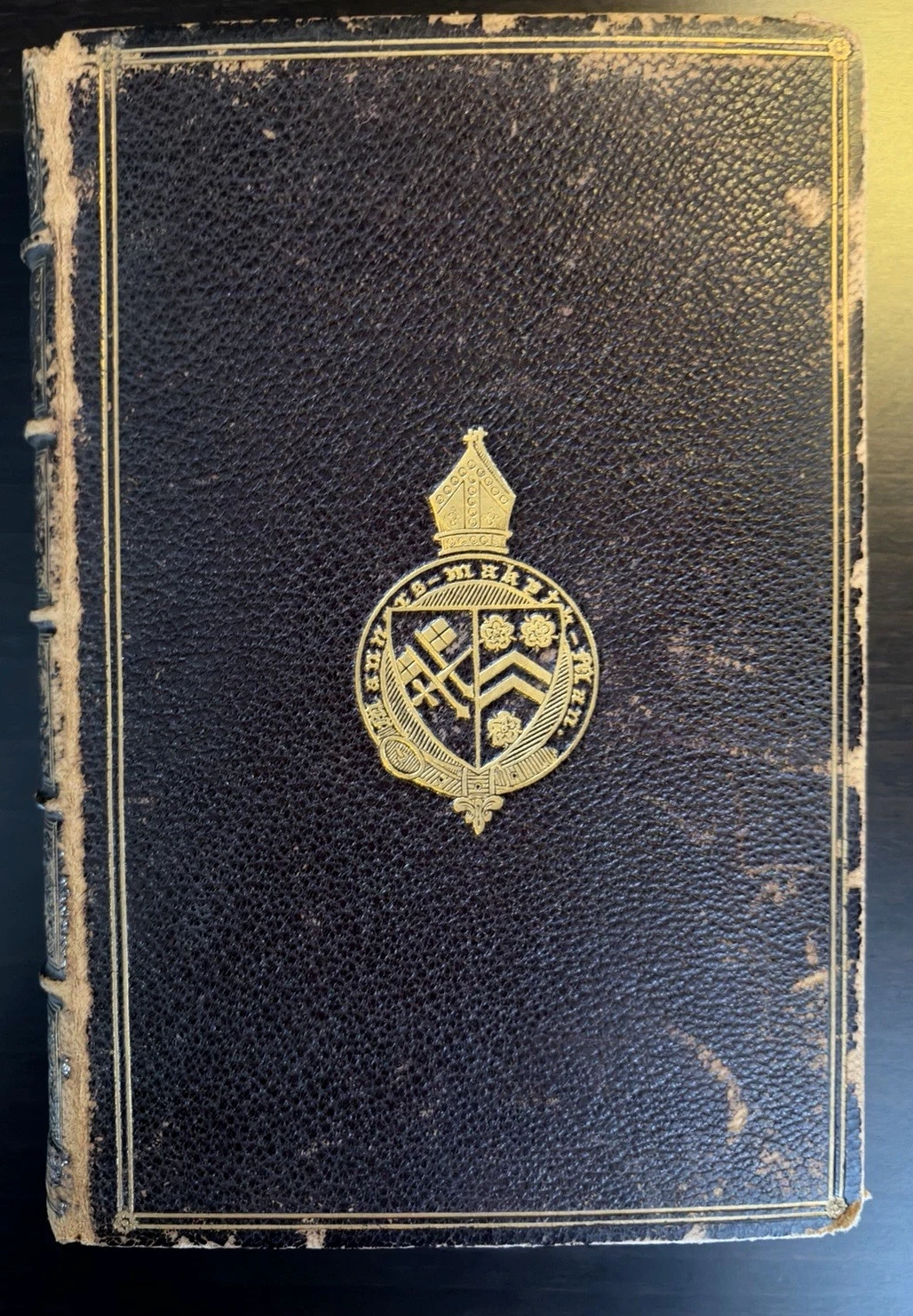
There is a temptation, when looking at an old book, to treat the binding as a frame around the real object. The poems begin once the cover has been opened; the leather performs its decorative duty and then disappears. This copy of Robert Browning’s Selections from the Poetical Works makes that separation difficult. Its dark leather, gilt rules, raised bands and Winchester College device are not an introduction to the book. They are its first piece of evidence.
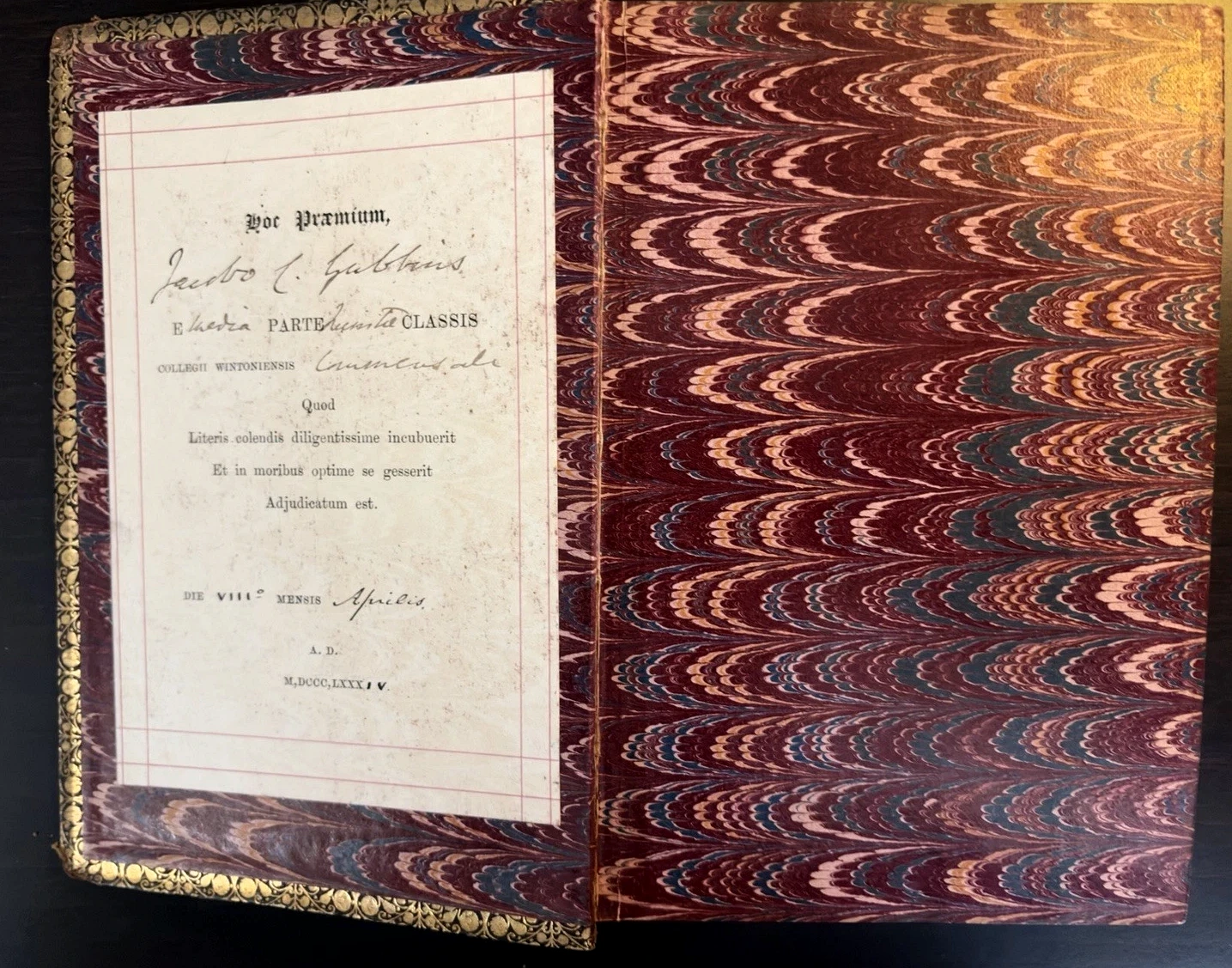
I have written about the prize label inside this volume, but the binding deserves a different kind of attention. A prize book is not only a record of an award. It is also a practical object that has been carried, opened, closed, put down and picked up again. The surface tells us about that life without giving us permission to invent it.
Ornament is information
The central device on the front board identifies Winchester College before the title page identifies Browning. The gilt borders establish a formal edge; the raised spine bands divide the book into a sequence of engineered sections. Even before I know what the volume contains, I understand that it was made to look deliberate.
That is what makes decorative bindings useful to a collector. Ornament is not an alternative to description. It is a form of description. A crest, border or arrangement of bands can tell us who wanted the book to be seen, how it was expected to function, and what kind of occasion it may have marked.
The surface records handling
The leather is rubbed at the joints, corners and spine. In places the gilt is still sharp; in others the surface has softened. I would not describe this as damage that simply detracts from the object. It is a record of the binding doing its work.
My partner, who is an engineer, is good at separating a designed system from the marks left by its operation. Talking about the binding made me look more carefully at the places where wear is concentrated. A joint is not merely a line in a photograph: it is the part that has flexed. A corner is not only missing leather: it is the point most exposed when a book is moved.
Repair without invention
The photographs show rubbing, softened edges, marks and unevenness, but they do not allow me to identify every intervention. A repaired joint, a replaced corner and a surface that has simply worn away can look similar in a small image. It is better to describe what is visible than to turn condition into a confident conservation history.
What can be said is that the book has survived with its identifying features intact. The gilt device remains readable, the boards still hold their shape, and the prize label has stayed with the volume. Repair, where it has occurred, is not a break in the story. It is one of the ways the story continued.
Looking before judging
When I look at this binding now, I see a sequence: a school identity impressed into leather, a printed book placed inside it, a prize label completed by hand, then decades of ordinary handling. The object’s authority comes from the agreement between those parts, not from any single claim about it.
A binding is not silent. It speaks in edges, joints, gilt and repair—provided we give it time to say what it actually knows.
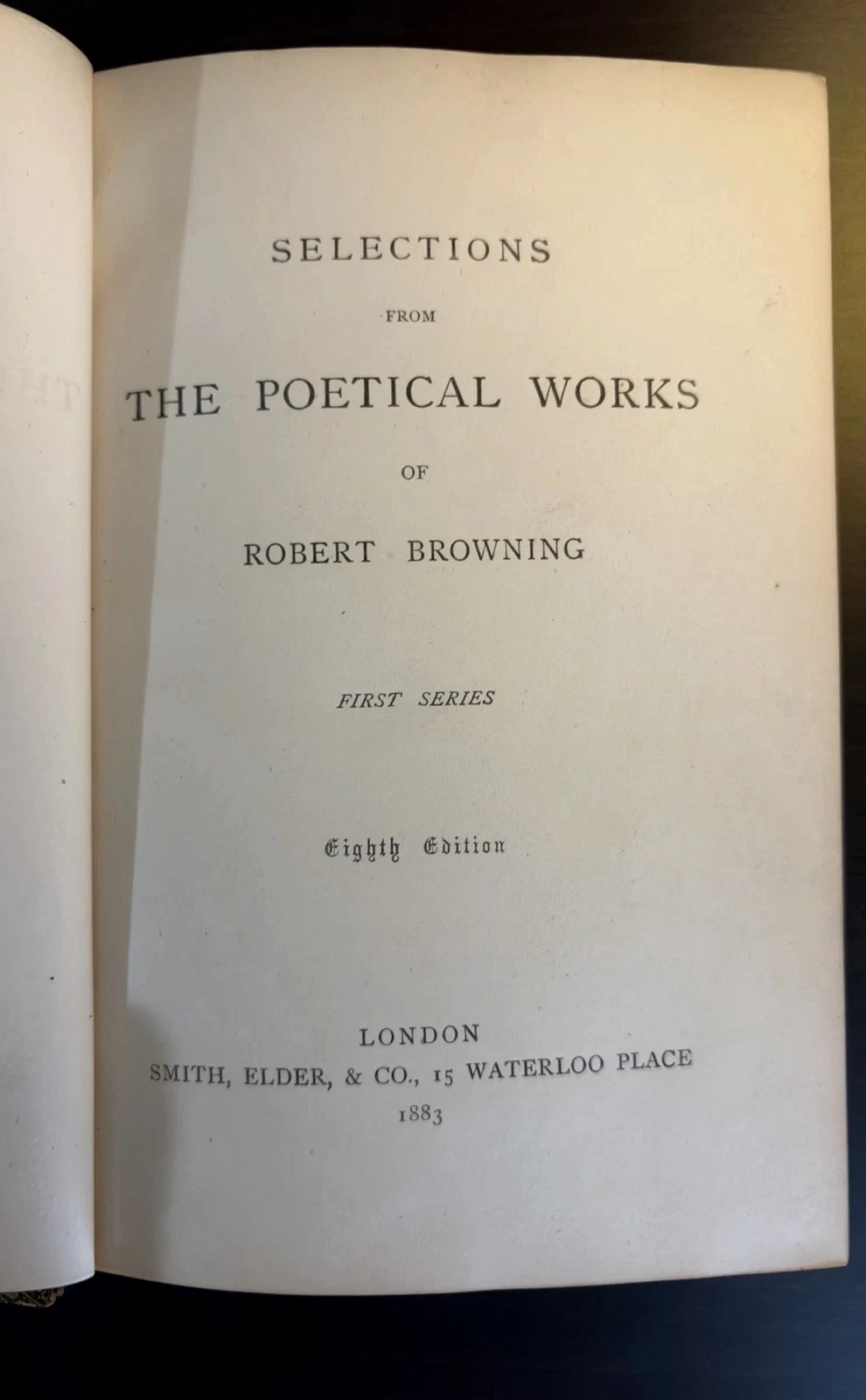
Source note: This editorial is based on the photographed copy of Selections from the Poetical Works of Robert Browning, First Series, Eighth Edition, Smith, Elder & Co., London, 1883, with a Winchester College prize label dated 1885. Condition descriptions are limited to visible evidence. The item is listed as 1883 Robert Browning Poetical Works Winchester College Prize Leather Binding.