
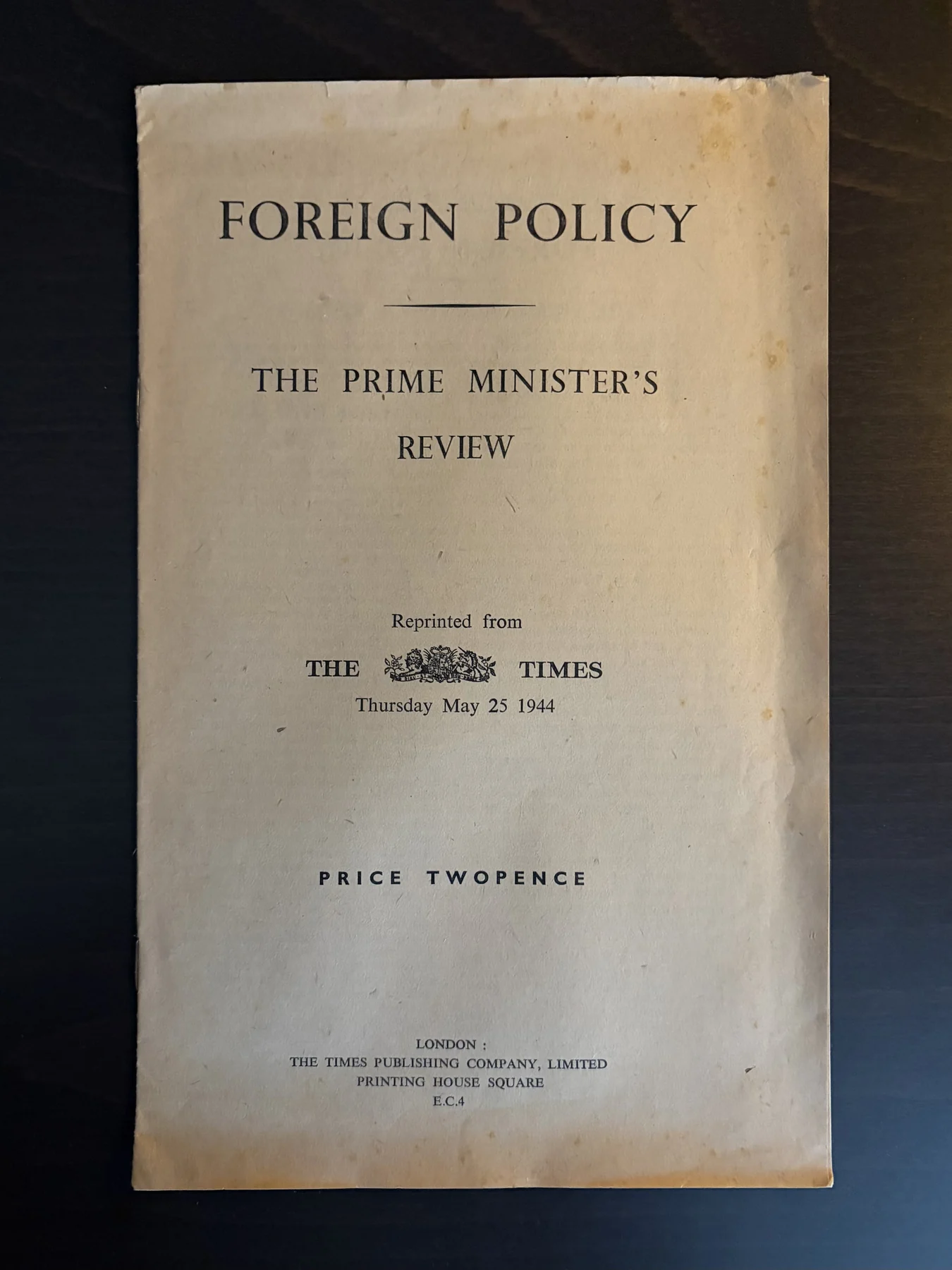
This twelve-page pamphlet carries Churchill’s May 1944 foreign-policy review in a cheap, portable form. The cover names it simply: Foreign Policy — The Prime Minister’s Review. Beneath the title sits the date, Thursday 25 May 1944, and beneath that a price: twopence. It is a modest format for a parliamentary survey made in the final year of the war, but that modesty is part of its force.
I was drawn first to the contrast. The words are formal and expansive; the object itself is thin, lightly browned and a little fragile at the edges. It was designed to carry the business of alliances, reconstruction and the post-war settlement beyond the newspaper page. Seventy years later, the creases and handling make that movement from public declaration to private reading unusually easy to imagine.
A speech made portable
The pamphlet identifies itself as a reprint from The Times. Its opening pages preserve the shape of the report rather than smoothing it into a later, more literary text: narrow columns, interleaved headings, the occasional “Cheers,” and the repeated presence of the House. The page has the density of a daily paper, yet it has been given covers and a price of its own. It is not simply newsprint; it is public argument prepared to travel.
The date matters. The review appeared less than a fortnight before the Normandy landings, at a moment when the immediate military position and the future settlement could not easily be separated. The printed headings lead the reader through relations with Turkey and Spain, the position in Italy, the Atlantic Charter and the question of a world organisation for peace. They do not turn the speech into a neat summary. Instead, they reveal its scale: policy as a chain of connected places, obligations and contingencies.
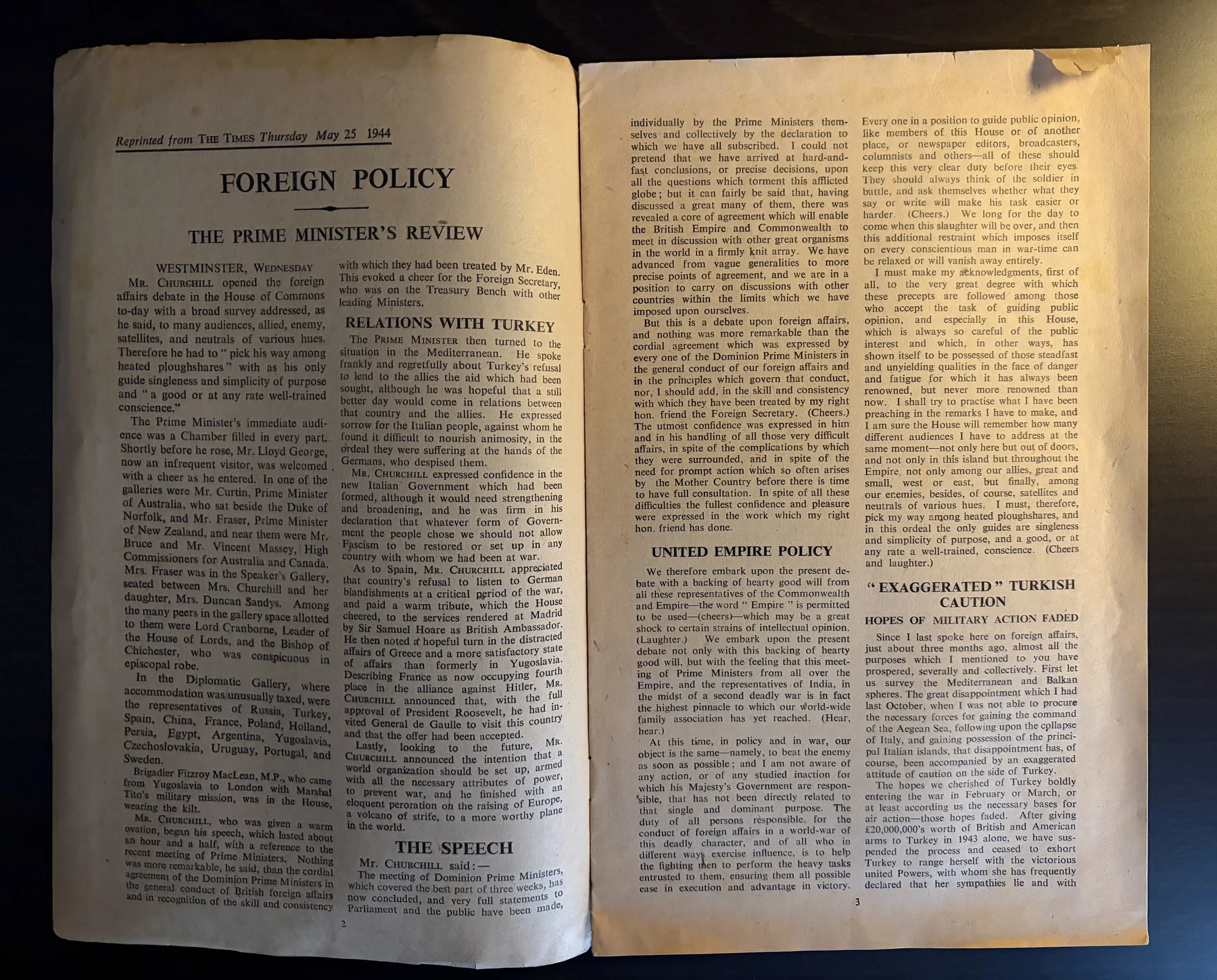
That is what makes the pamphlet more interesting to me than a detached text. It asks us to read not only what was said, but how it was presented. The bold headings act as small signposts; the crowded columns make the reader work. The material form does not simplify foreign affairs. It gives the reader a way into their complexity.
Headings, pauses and argument
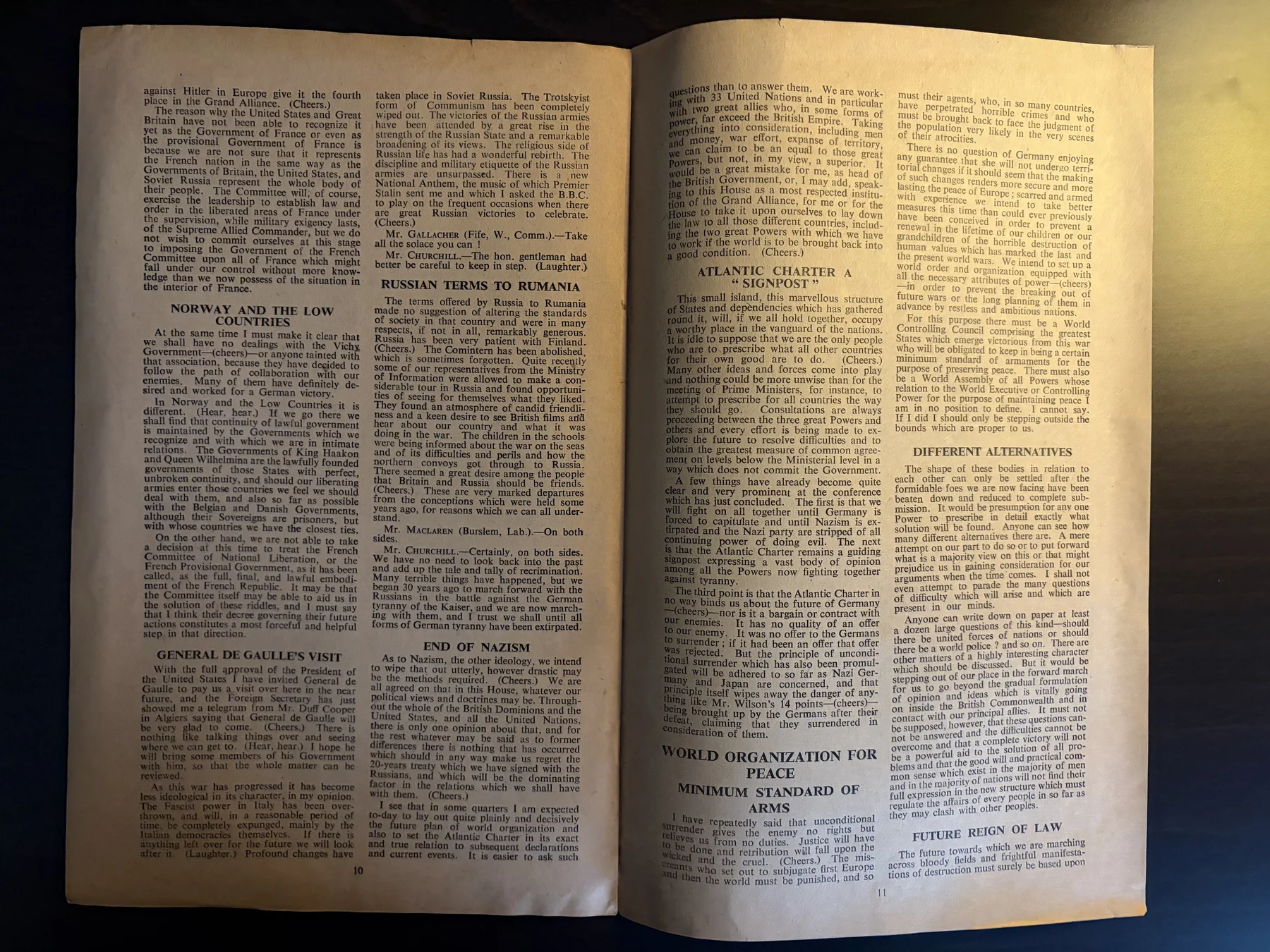
The later pages are particularly revealing. “Fate of Italy”, “Relations with Spain”, “Russian Terms to Rumania” and “Atlantic Charter a ‘Signpost’” appear as a sequence of printed thresholds. Each heading promises a separate subject, but the eye quickly sees that none of them stands alone. Military progress, diplomacy and the language of peace keep crossing one another on the page.
I like the physical honesty of that arrangement. There is no retrospective diagram telling us what mattered most. There are simply columns of print, headings placed where the report required them, and paper whose folds show that it was read as an object rather than preserved as a monument. It is a useful corrective to the smoothness with which wartime politics can later be remembered.
Its value lies in the meeting of a great public voice with a small, inexpensive and handled printed form.
What the pamphlet keeps
Political documents can tempt us into grand claims. This copy cannot tell us who bought it, how it was first read or what a particular reader made of its arguments. It can, however, preserve the conditions of its circulation: the publisher’s imprint, the two-pence price, the date, the typography and the traces of handling. Those details are not secondary to the history. They are part of the way history reached people.
For me, this is the pleasure of wartime ephemera at its best. It brings an enormous subject back to a human scale. One can hold a moment of public language in the hand, see where the paper has softened, and recognise that even the largest political ideas had to be set in type, folded, sold and carried away.
A first journey to auction
There is a quiet thrill in seeing this pamphlet move into a specialist sale. It is the first object from RUSTY PECHA to be consigned to a major auction house, and that feels like an important next stage for a piece whose own story is about the movement of words from one audience to another. I am pleased that it will be considered in the context of books and works on paper, where its printed form can be read alongside its historical subject.
The copy has been consigned to Chiswick Auctions’ Books & Works on Paper sale, scheduled for Thursday 1 October 2026 at 11:00. The catalogue entry and lot number are not yet available; when Chiswick publishes them, I will add the direct link here. For now, the sale calendar is the best place to keep an eye on it.
Collector’s note
With a political pamphlet, start with the edition and the route by which the text reached print. Look for the printed date, publisher, price, title-page wording and any signs that a newspaper report has been issued separately. Then read the object’s condition as evidence of use: folds, staples, browning and small edge losses can all be relevant, but should be described rather than exaggerated. The strength of a copy like this lies in the fact that its historical ambition and its ordinary paper form remain inseparable.
Bibliographical note
This editorial considers Foreign Policy: The Prime Minister’s Review, a 12-page pamphlet reprinted from The Times for Thursday 25 May 1944 and published by The Times Publishing Company, Printing House Square, London. Statements about the object’s format, wording, condition and consignment are based on the copy shown and the Chiswick Auctions consignment receipt. Auction details are subject to the auction house’s published catalogue.