
I am often drawn first to the documents that were never meant to be saved. A legal sheet has none of the deliberate charm of a book illustration or a poster. It was written because something had to be recorded: money owed, money received, an obligation acknowledged, a formality made sufficiently visible to be relied on later. Once that business was over, the paper had done its work. That so much of it survives three centuries later is the quiet surprise.
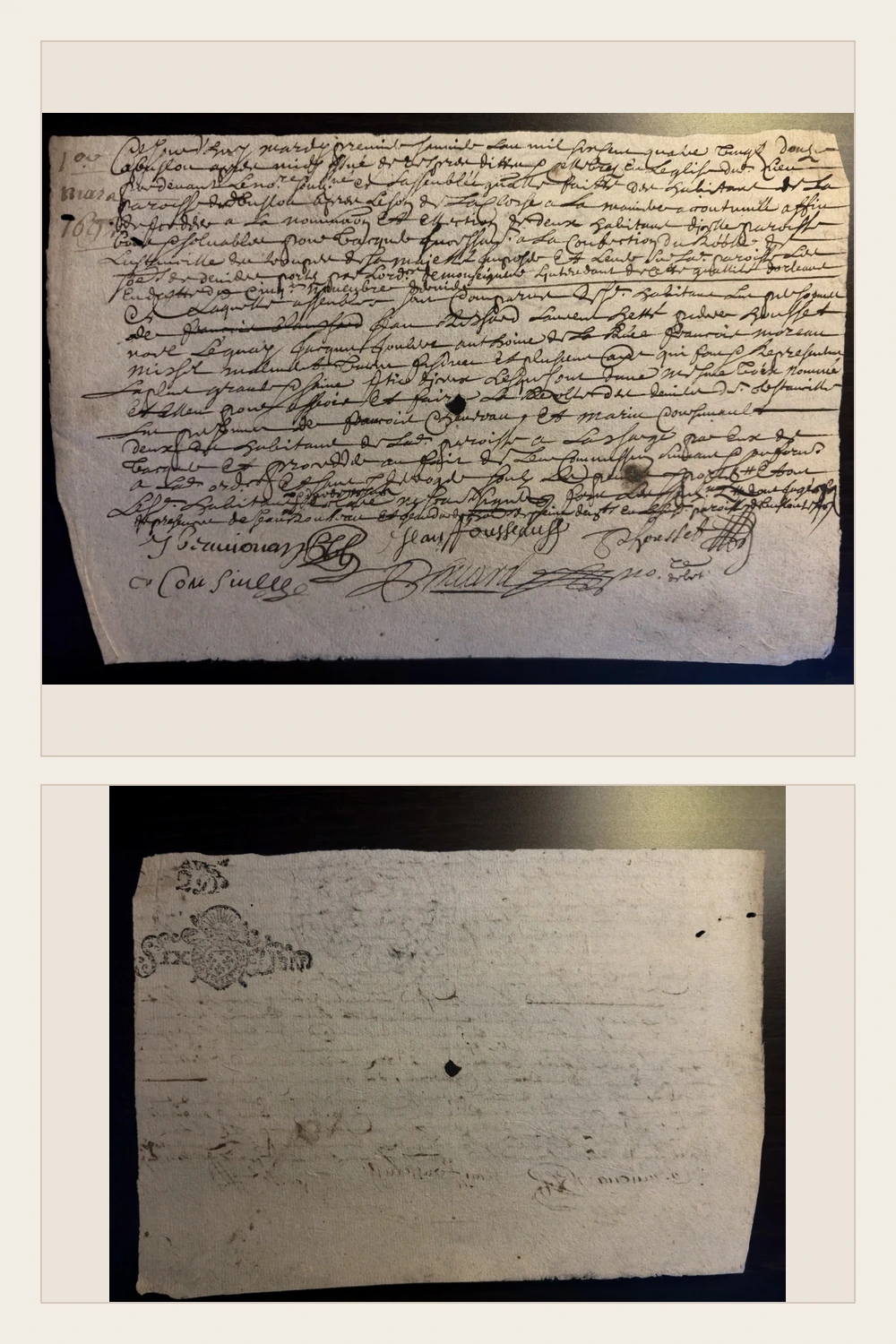
The small group here dates from 1659 to 1692. They are French manuscripts, written in hands which at first seem to rush past the eye. I can pick out dates, headings, the rhythm of the lines and the emphatic signatures at the foot; I cannot honestly claim to translate every formula. That limitation is part of the appeal. These are not puzzles to be solved by force. They are records that ask to be looked at carefully, beginning with what the paper itself will allow us to say.
A document begins with its limits
With old legal paper, it is tempting to turn a listing title into a complete history. I think it is better to start more modestly. A date written at the head of the sheet is good evidence. A name that can be made out is useful. The folds, the ink, the layout, a mark in the paper and the number of hands on the page are all things one can actually see. Beyond that, there are degrees of confidence rather than certainties.
The 1692 sheet makes the point particularly well. The listing identifies it as a signed document on stamped paper, and the photograph of the reverse shows a small printed device at the upper left. That is enough to make the material form worth noticing. It is not enough, from a photograph alone, to identify the exact fiscal use of the paper or to reconstruct every step of the transaction. The difference matters. A document becomes more interesting, not less, when one leaves room for what it has not yet disclosed.
An obligation written down
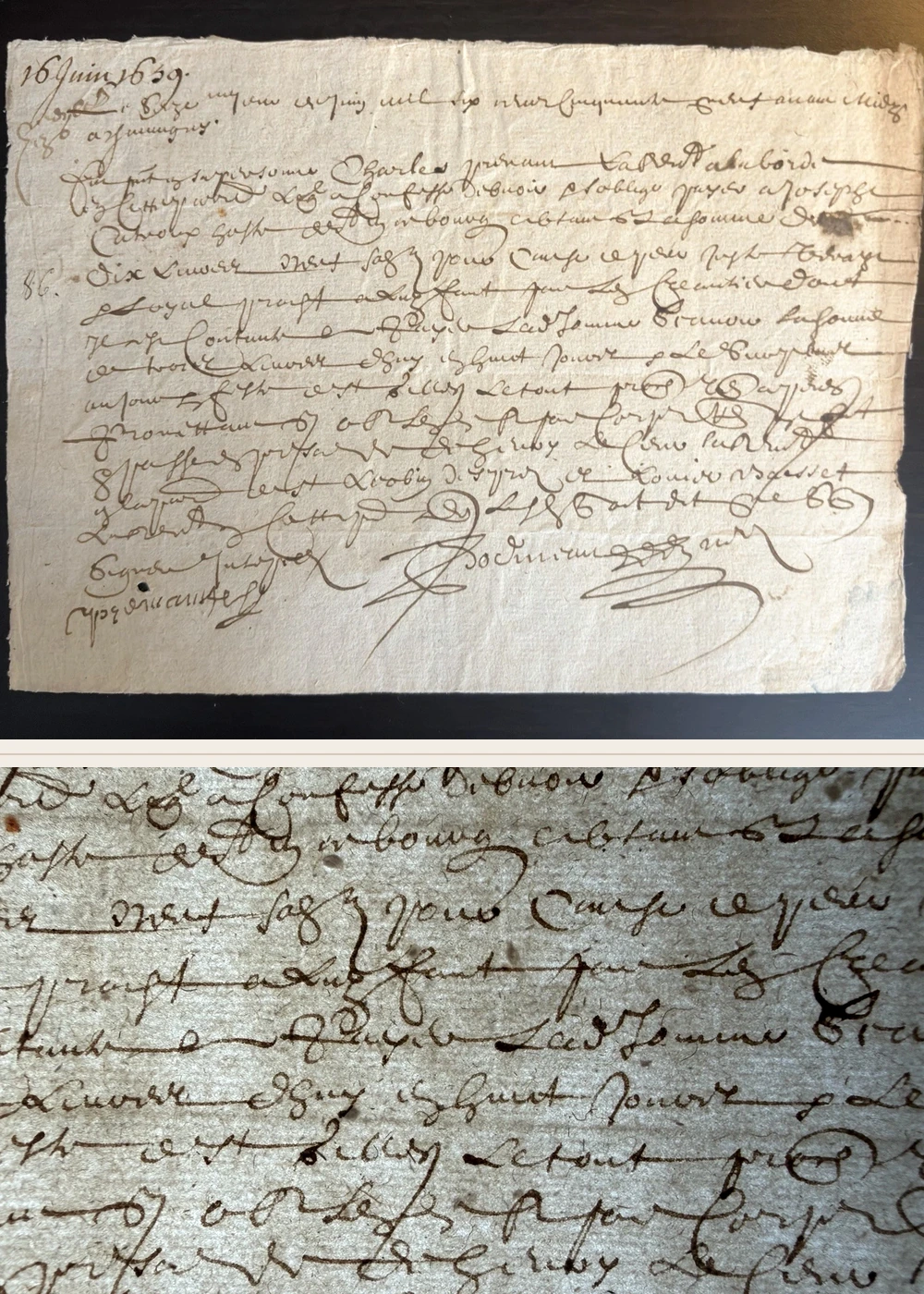
The debt obligation dated 16 June 1659 is the piece that first made me slow down. The date sits plainly at the upper edge. Below it, the writing becomes denser and more formal, carrying the reader through a sequence of clauses before releasing into a set of signatures. The listing associates the document with Charles Prudhomme; that is a useful point of entry, but it is the physical arrangement that gives the sheet its force. Somebody had to make the obligation legible enough to stand beyond the moment in which it was made.
“Je soussigné” — “I, the undersigned.”
“16 Juin 1659.”
Those are the fragments I can read with confidence from the opening: a conventional declaration of the person making the statement, followed by the date. They are hardly dramatic words in themselves. Yet that is exactly what I like about them. The sheet begins not with a flourish but with a person putting himself on the line. Everything that follows is meant to be attached to that small assertion of identity.
There is a particular pleasure in the way the writing changes pace. The main text moves steadily across the sheet; the lower portion seems to gather people around it. Signatures, flourishes and marks are not decoration. They are the visible edge of authority, or at least of participation. Even without a complete transcription, one can see that this is a document made to carry an agreement forward in time.
When a payment has been acknowledged
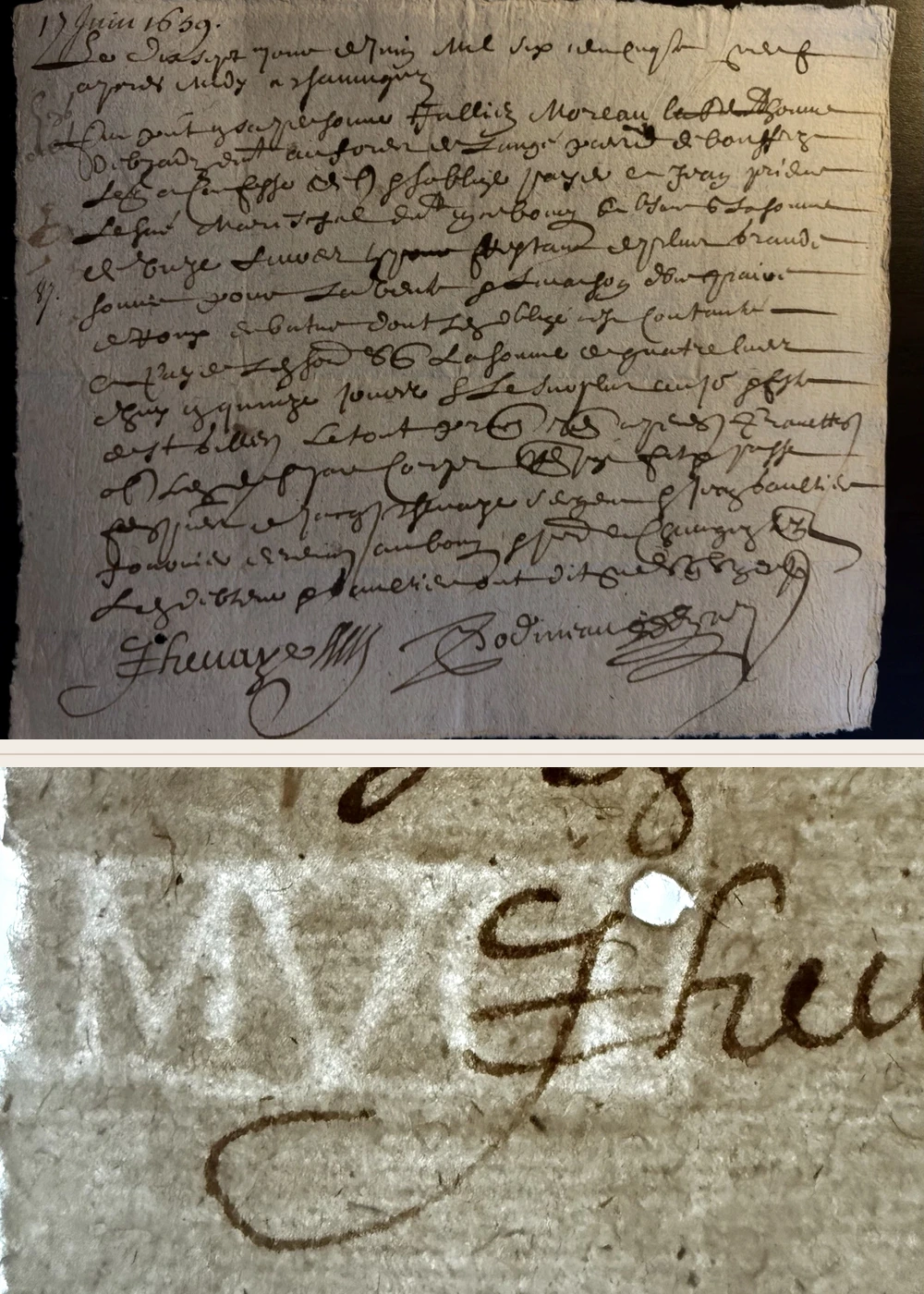
The second 1659 sheet is listed as a quittance: a receipt or acknowledgement that something has been settled. That is a modest function, but it is precisely the sort of function that makes the page worth keeping. A receipt fixes a moment in which an obligation changes state. The paper records not an intention, but the claim that a payment or settlement has been recognised.
“17 Juin 1659.”
Here the date is the clearest direct quotation I am prepared to take from the page. It is only one day later than the obligation above. Whether the two papers ever met in the same room is not something the photographs can establish, but the closeness of the dates gives the pair an unexpectedly human rhythm: one day a promise or liability is set down, the next a settlement is recorded.
Again, I am careful not to ask more of the handwriting than I can support. The date at the head, the orderly body of text, the worn fold lines and the emphatic names or signatures at the foot are enough to make the document feel specific. It is easy to call such a sheet ‘ordinary’ because it was made for an ordinary act. Yet ordinary acts are where history most often leaves its usable traces: not grand proclamations, but the paper someone needed to retain after the money had changed hands.
What I look for before I read too far
These documents have made me return to a simple sequence. First the date, if it is plainly written. Then the kind of paper and the overall form of the sheet. Then the hand or hands: where the main text stops, where a signature begins, where a later note may have entered the page. After that, the marks made by use — folds, holes, stains, a stamp or device, an address-like note on a reverse. Only then do I begin to ask what the text might tell us about people, place or purpose.
It is not a glamorous method, but it avoids the confident inventions that old documents can invite. A mark that looks official may need further research. A surname that seems familiar may be another name entirely. A phrase that appears readable in one light can alter when the photograph is enlarged. The safest reading begins with visible facts and leaves uncertain names, marks and formulas open for further research.
What the paper kept
What stays with me is that each of these sheets is both fragile and stubborn. The transactions they record have long since passed out of reach. The people who signed them are no longer available to explain a word of it. But the paper still holds a date, a hand, an official-looking device, a crease from being folded and the deliberate flourish of a name. Those are small things, until they are all that remain.
Bibliographical note
This editorial is based on four original French documents listed by RUSTY PECHA: a 1659 debt obligation associated in the listing with Charles Prudhomme, a 1659 French legal receipt or quittance, a 1692 signed manuscript on stamped paper, and a 1659 Louis XIV-era quittance. I have treated the listing descriptions as starting points and kept the interpretation above to details visible in the photographs, with uncertainty stated where it remains.
For wider archival context, FranceArchives records quittance as a document type in its notarial records, while the Bibliothèque nationale de France explains how marks and stamps can act as evidence of a document’s identity or provenance. These references are context only; they do not identify every mark on these particular sheets.