
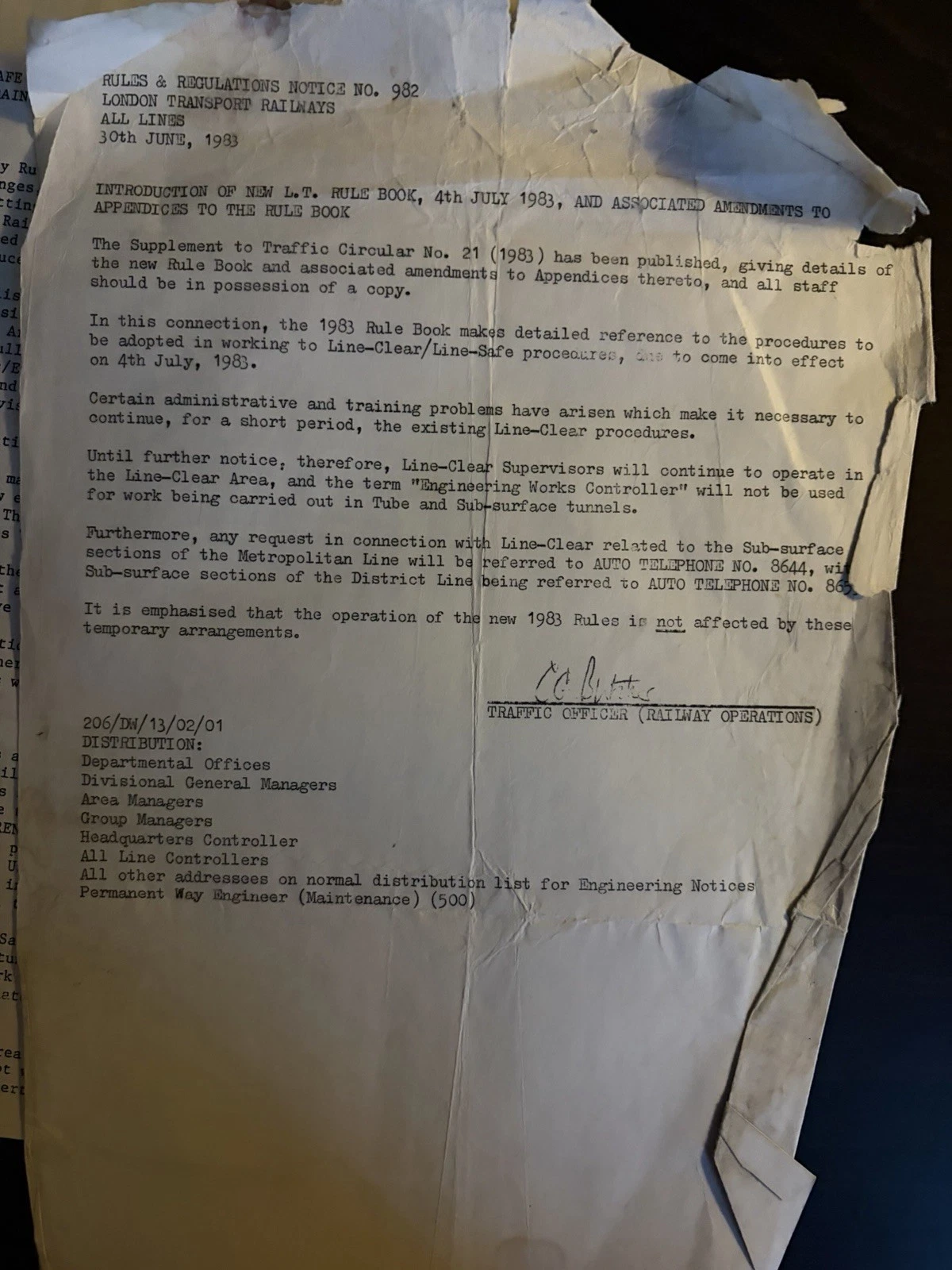
Four days before London Transport’s 1983 Railway Rule Book was due to begin, Rules & Regulations Notice No. 982 made an admission that a rule book could not make for itself. The new code was to take effect on 4 July, but “administrative and training problems” meant that the existing Line-Clear procedure had to continue for a short period. The book could start; its new working arrangement was not yet ready everywhere.
That tension explains the complete surviving group: four Rules & Regulations Notices, two Traffic Circular supplements, replacement diagrams and a fold-out map. Together they answer a more useful historical question than “what did Line-Safe mean?” How did London Transport make a new procedure safe enough to use in the hours when engineers, controllers, trains, traction current and worksites had to coexist?
A rule for the hours after traffic
Rules & Regulations Notice No. 1017, dated 9 February 1984, says what Line-Safe was for. The 1983 Rule Book had introduced it for engineering work in open sections after the close of traffic. Its stated aims were to improve safety standards and simplify Engineering Department procedures. The language is practical: traction current was to provide the basic safeguard; trains were not to operate outside their Specified Area of work; current was not to be restored until an engineer’s staff confirmed that it was safe.
That was not an abstract safety policy. It was an operating arrangement for a live electric railway at night. The accompanying First Supplement to Traffic Circular No. 39 calls the period Engineering Hours, replacing the older term “Non-Traffic Hours”. It explains that the procedure had to be read with the 1983 Rule Book and with other instructions. Its emphatic instruction is directed at anyone who might work on or about the track: a full understanding of the relevant rules was essential.
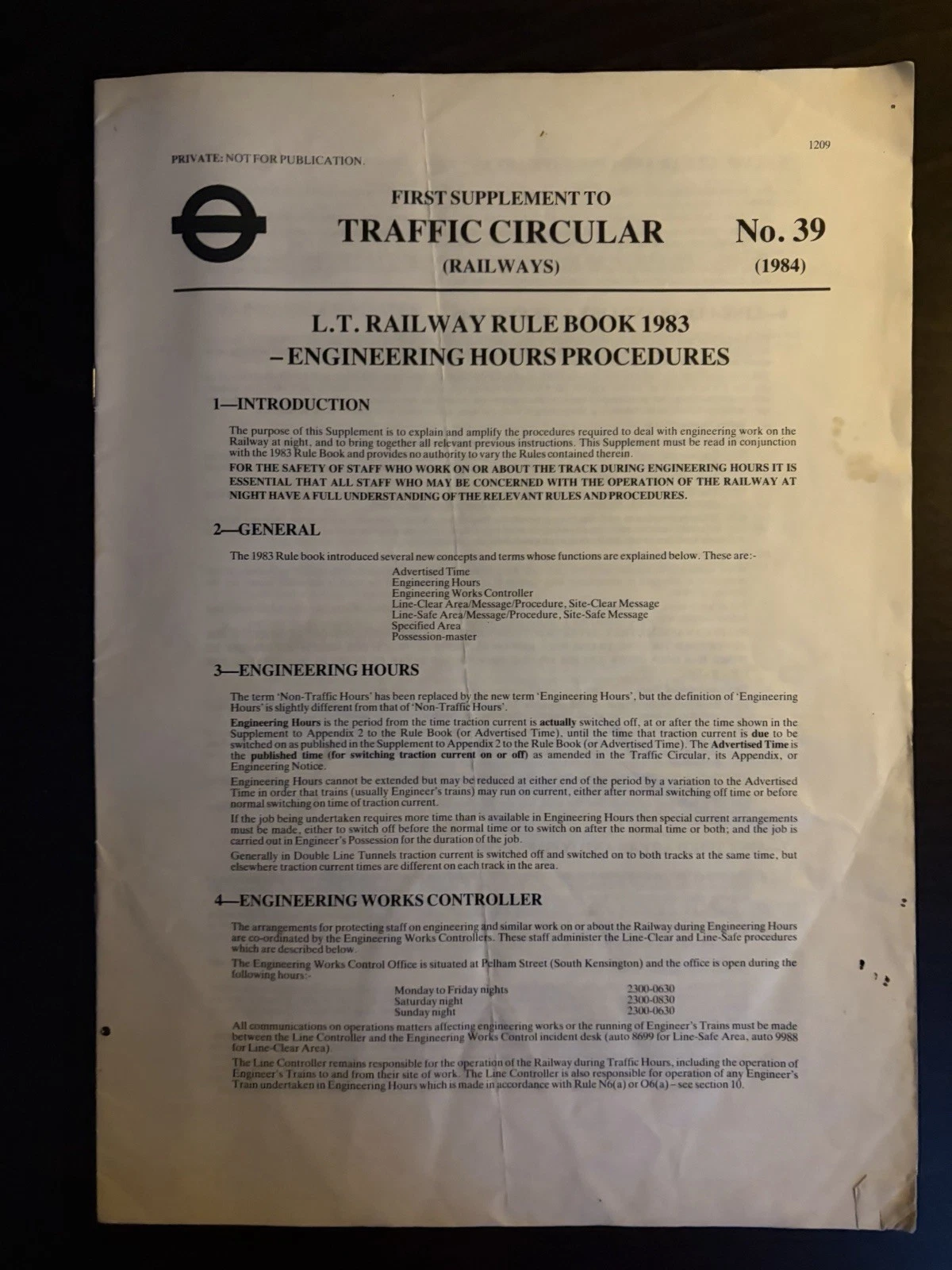
The supplement names the people who had to make that arrangement work: the Line Controller, Engineering Works Controller, signalmen, Train Regulators, station supervisors, train crew and engineers. Its organisation matters. The Line Controller retained responsibility for the railway during traffic hours; the Engineering Works Controller coordinated protection arrangements during Engineering Hours. A rule became operational only when those responsibilities could be understood together.
A start that retained the old procedure
Notice 982 is the first visible intervention in that translation. It announces the 4 July 1983 introduction and associated appendices, but deliberately preserves existing Line-Clear arrangements. Line-Clear Supervisors would continue in the Line-Clear Area; “Engineering Works Controller” would not yet be used for the relevant work in Tube and sub-surface tunnels. The notice even gives temporary telephone routing for parts of the Metropolitan and District lines. Formal change was being kept separate from an incomplete handover of words, duties and contacts.
Notice 1017 shows why that caution persisted into the following year. It says that many staff with responsibility for the new engineering rules were still unclear about important aspects, particularly engineers’ trains and Specified Areas. The response was neither to abandon the procedure nor to pretend it was self-explanatory. The notice republishes the descriptions and tells staff to familiarise themselves with them. It also says that full integration of Line-Clear Supervisors’ and Engineering Works Controllers’ duties would not occur until the end of March 1984.
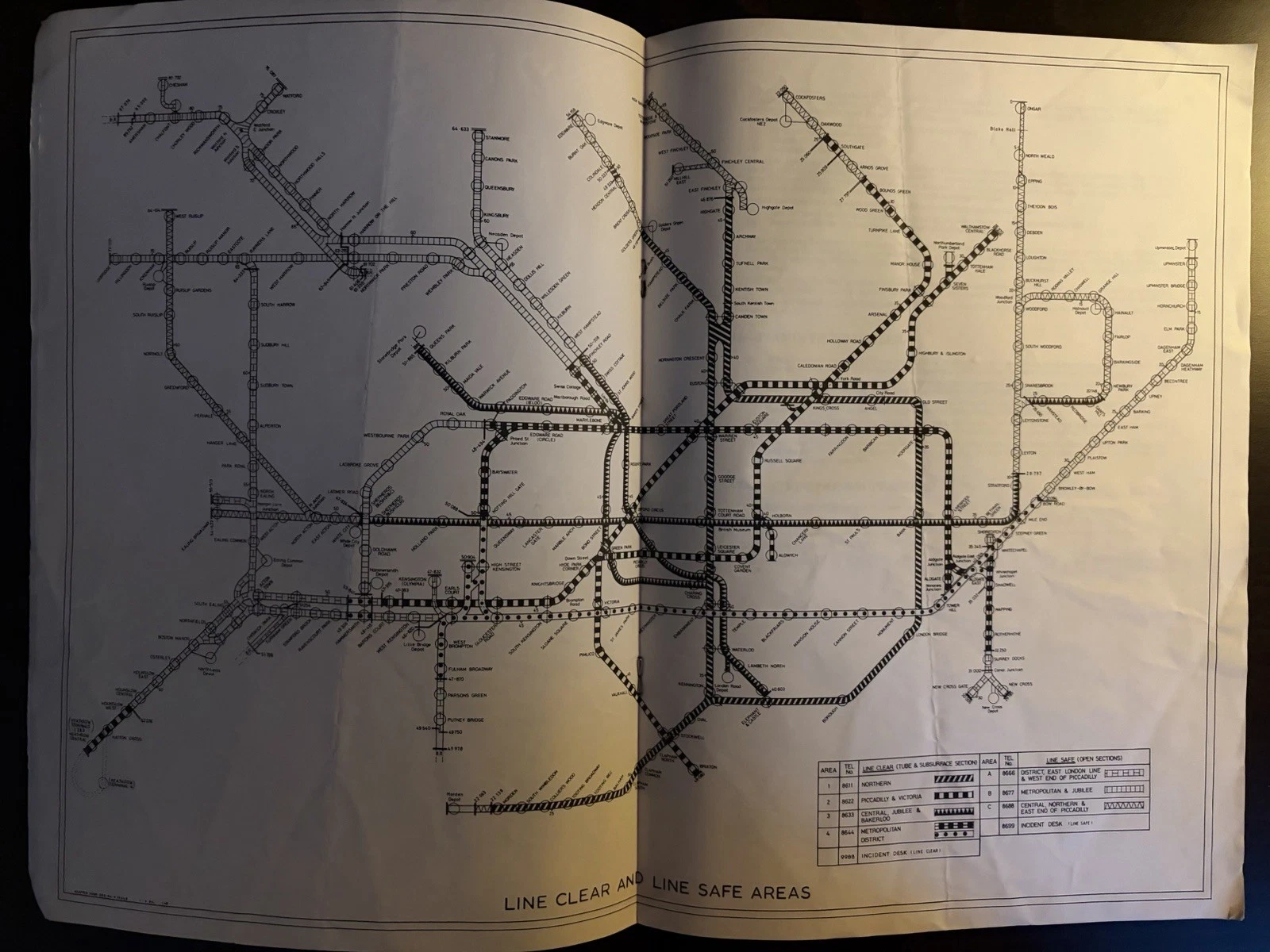
The distinction between Line-Clear and Line-Safe was therefore not a simple before-and-after story. Notice 1017 calls the Line-Clear procedure basically unchanged. In tunnel sections it remained the way of protecting staff working during Engineering Hours; Line-Safe supplied a new arrangement in open sections. The fold-out diagram makes that division geographic, marking Line-Clear tube and sub-surface areas and Line-Safe open-section areas across the railway.
Who could move, and where?
The two February and January notices put the same problem at a smaller scale. Rules & Regulations Notice No. 1014, dated 23 January 1984, is headed “Working of Engineer’s Trains” and supersedes Notice No. 1013. It begins with a prohibition: after traction current is switched off, movement of an engineer’s train or mechanised vehicle is not permitted except under specific rules. It then names the exceptional chains of authority: a Line Controller, after confirmation from an Engineering Works Controller; a Man-in-Charge inside a Specified Area; or a Possession-master inside a possession.
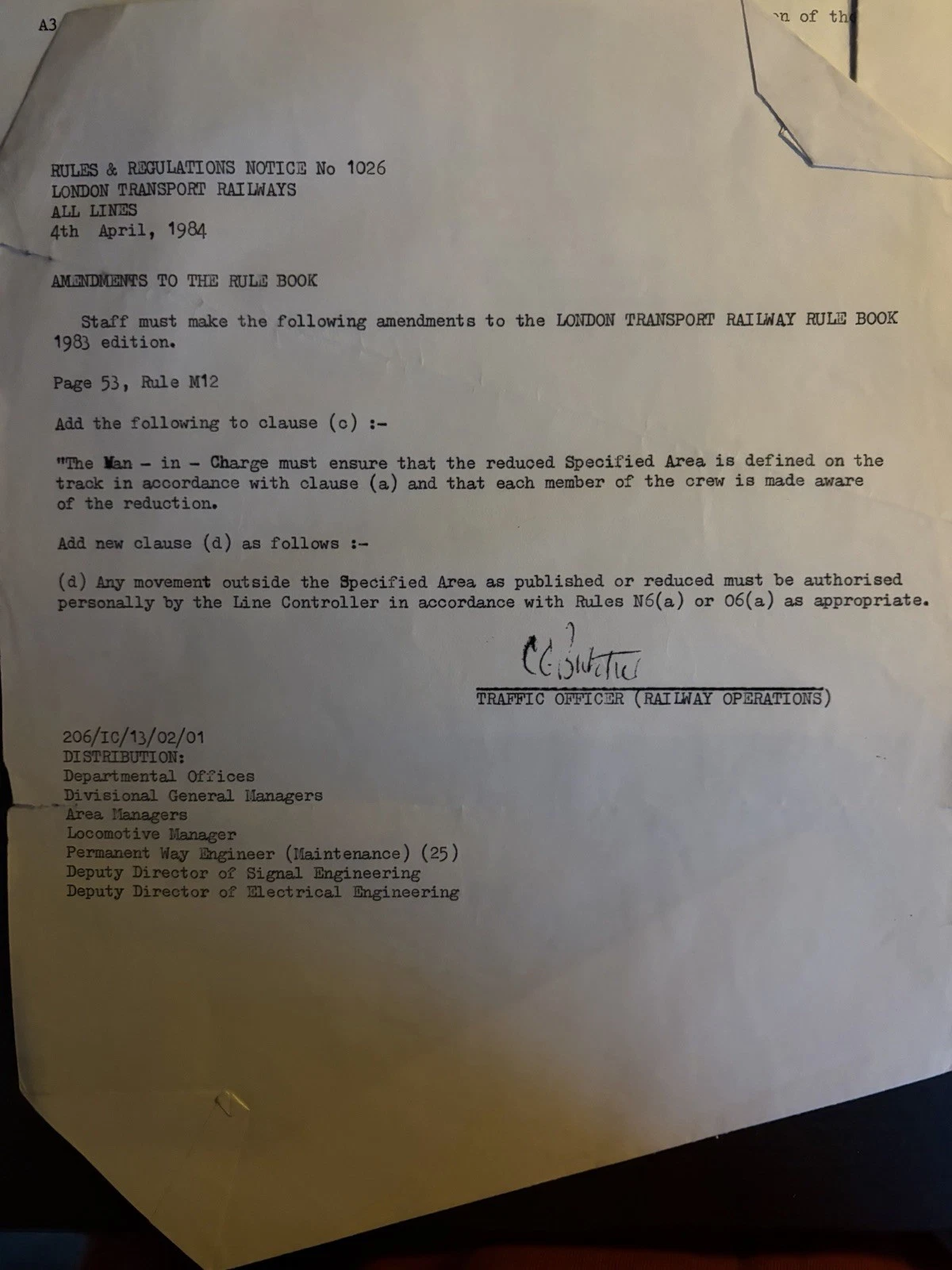
Rules & Regulations Notice No. 1026, dated 4 April, tightens Rule M12 again. A reduced Specified Area had to be defined on the track, each crew member made aware of the reduction, and any movement outside the published or reduced area personally authorised by the Line Controller. These amendments are not administrative afterthoughts. They identify the points where a general safety rule met a moving train, a crew, a marked boundary and an individual decision.
Pages had to change as well
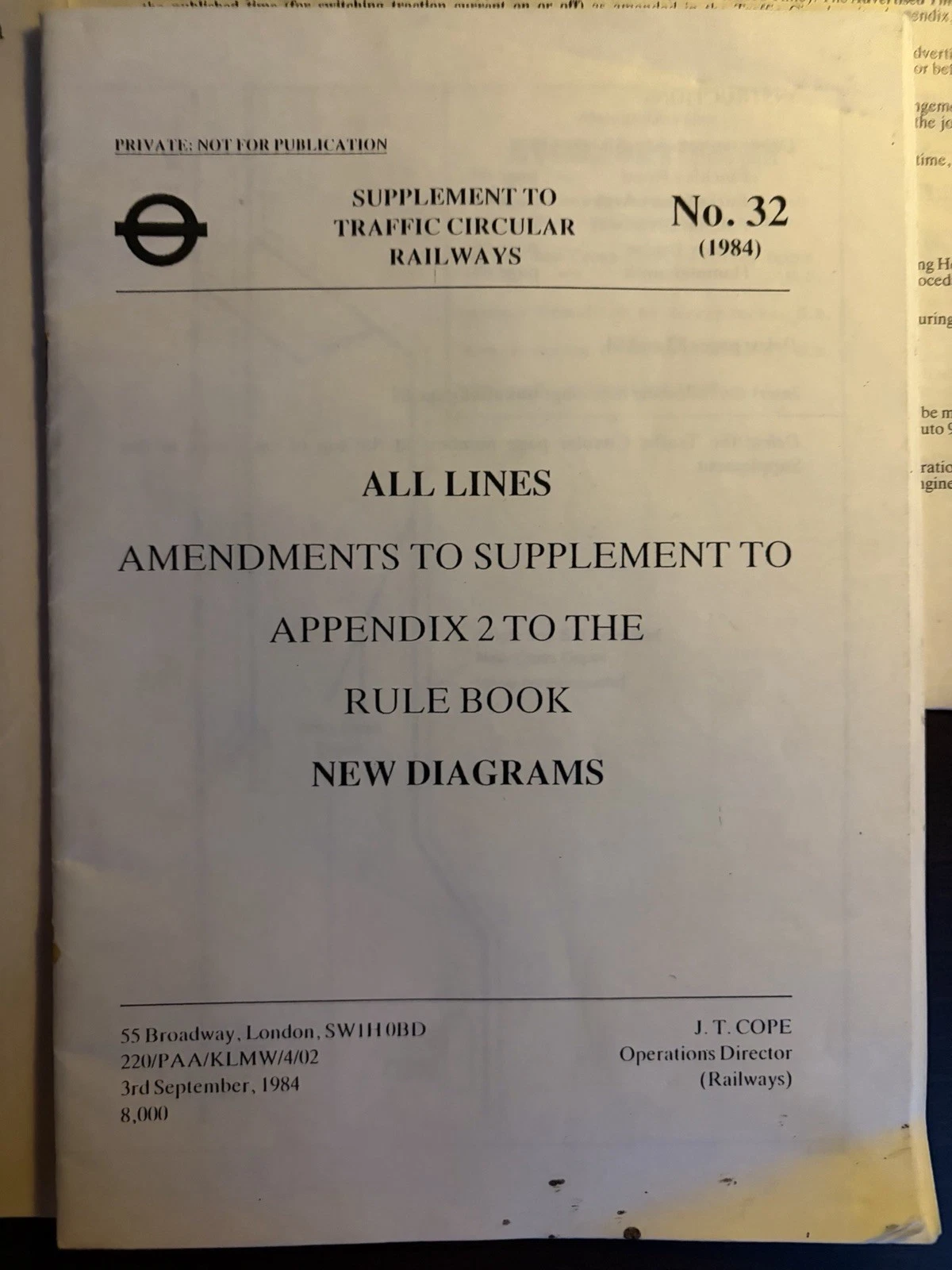
The Traffic Circular supplements show the material side of the same process. The First Supplement to Traffic Circular No. 39 brought the procedures together under the Rule Book’s Engineering Hours heading. The September Supplement to Traffic Circular No. 32 then instructs its readers to delete named diagrams and pages, insert new diagrams after page 82, and remove the circular page numbers at the top of the supplement. One of the replacement diagrams covers New Cross and New Cross Gate; the separate Line Clear / Line Safe diagram serves a different purpose. Both make precise locations visible to people who needed to act on them.
Traffic Circular No. 32 was signed by J. T. Cope, Operations Director (Railways), and is marked “8,000”. The figure is a reminder that a rule did not reach its users by being written once. It had to be distributed in the right version, inserted into the right appendix and read against the local diagram. That is why an amendment, a replacement page and a map belong to the same history as a notice.
What survives in the sequence
These notices matter because they retain that work. The Rule Book’s date is only the beginning of their story. Notice 982 records a delayed handover; Notices 1014 and 1017 specify duties and understanding; Notice 1026 corrects a boundary; the Traffic Circular supplements make procedures and diagrams current. In that small sequence, safety is not simply a principle printed on a page. It is a shared, repeatable arrangement between people who need to know which rule, which area and which authority applies before the night’s work can begin.
Sources
The contemporary Rules & Regulations Notices, Traffic Circular supplements and diagrams are the primary evidence for the implementation sequence. Fowler and Edwards’s study of London Transport, 1977–87 identifies the period’s London Transport annual-report and archive record, used here only for its wider institutional setting.