
I am always interested in the moment when a performance leaves the theatre and becomes a piece of paper. A voice disappears as soon as it is heard; a printed page waits. It can reduce a large, expensive evening to a title, a portrait, a list of scenes or an advertisement placed at the back. That reduction is not a weakness. It is the beginning of a different kind of record.
This booklet, Grand Opera Stories, was made for Oscar Hammerstein’s London Opera House at Kingsway in about 1911. It is not a score and it is not quite a conventional theatre programme. Instead, it offers short accounts of operas, pictures of performers and the surrounding commercial language of a night out. Its ambition is wonderfully clear: bring a whole repertoire close enough to carry in one hand.
A repertoire arranged for the reader
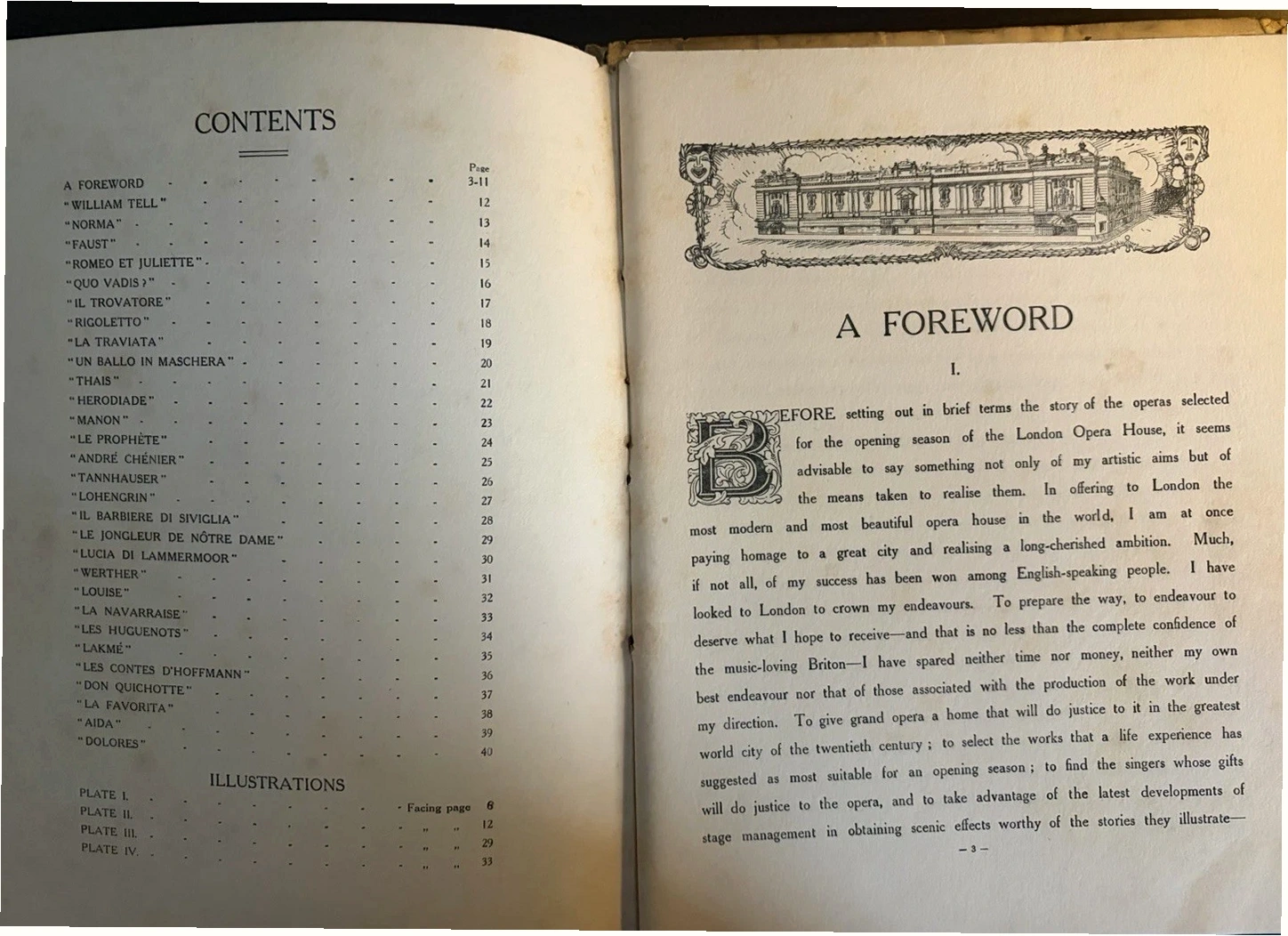
The contents page is the first thing I would linger over. It names William Tell, Norma, Faust, Romeo et Juliette, Aida, Lakmé, Lohengrin, Lucia di Lammermoor and many others. The list is not simply an index. It is a promise that the reader can move between stories without needing to know the theatre’s full season in advance.
The foreword gives that promise a more practical shape. Opera is treated as something that can be introduced, summarised and carried home. I find that especially revealing because it sits between two kinds of experience: the live performance, with its orchestra and bodies in space, and the private act of reading. The booklet makes opera manageable without pretending that it is small.
The word “stories” matters here. A reader who did not know every plot could still approach the repertoire through narrative. The booklet is therefore a cultural threshold: it gives a newcomer enough structure to recognise what is happening, while giving a regular audience member a compact reminder of familiar works.
Portraits make a company visible
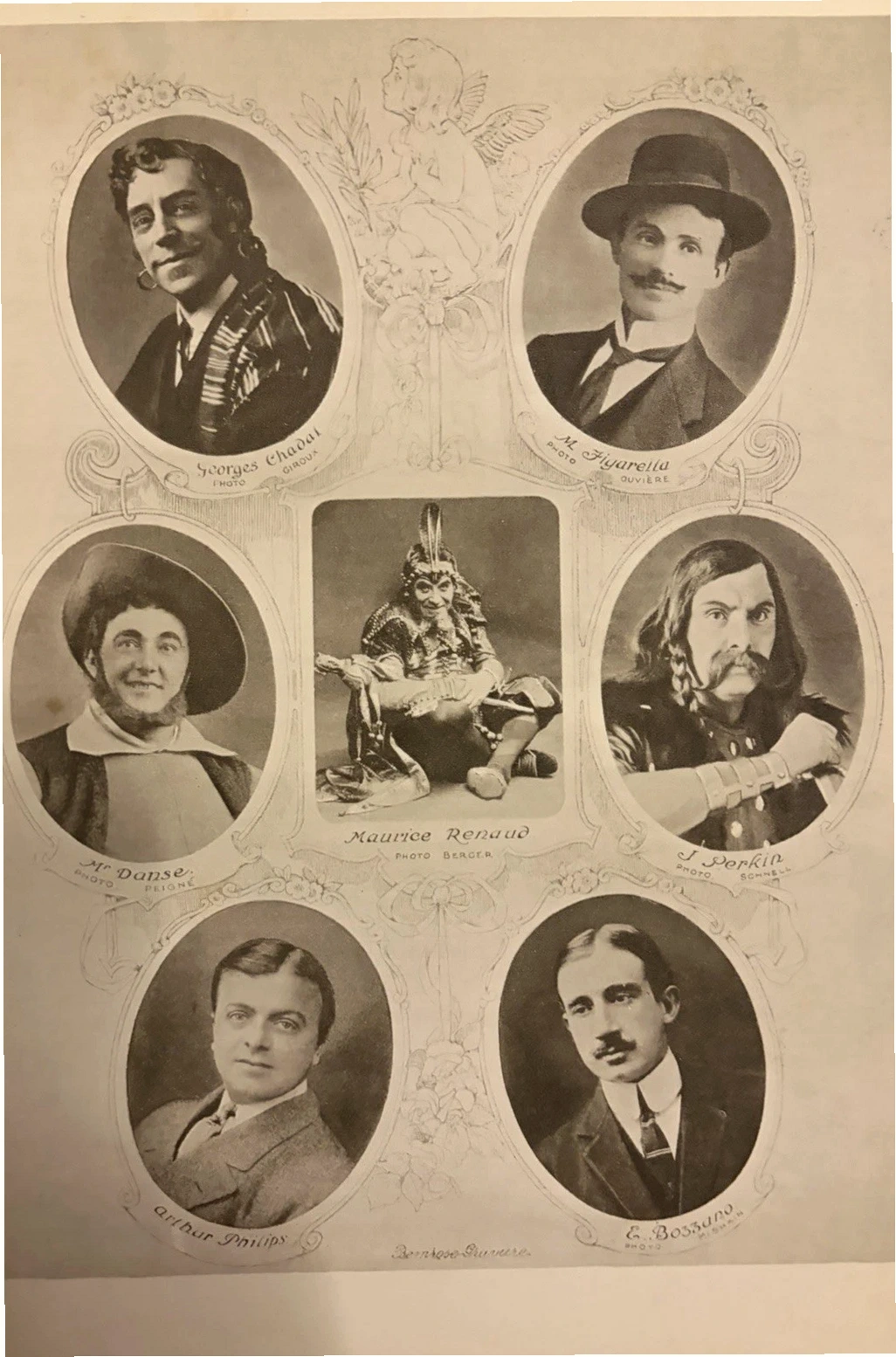
Opera is often discussed through composers and works, but these pages insist on performers. The faces are arranged so that the reader sees a network rather than a solitary star. It is a useful reminder that a theatre is built from many kinds of labour, even when public attention settles on a few names.
I also like the tension between the portraits and the surrounding ornament. The frames and flourishes make the page feel ceremonial, while the photographs remain evidence of real people. The result is both formal and intimate: someone has tried to make a group of performers memorable before the reader has heard them sing.
Where art meets the city
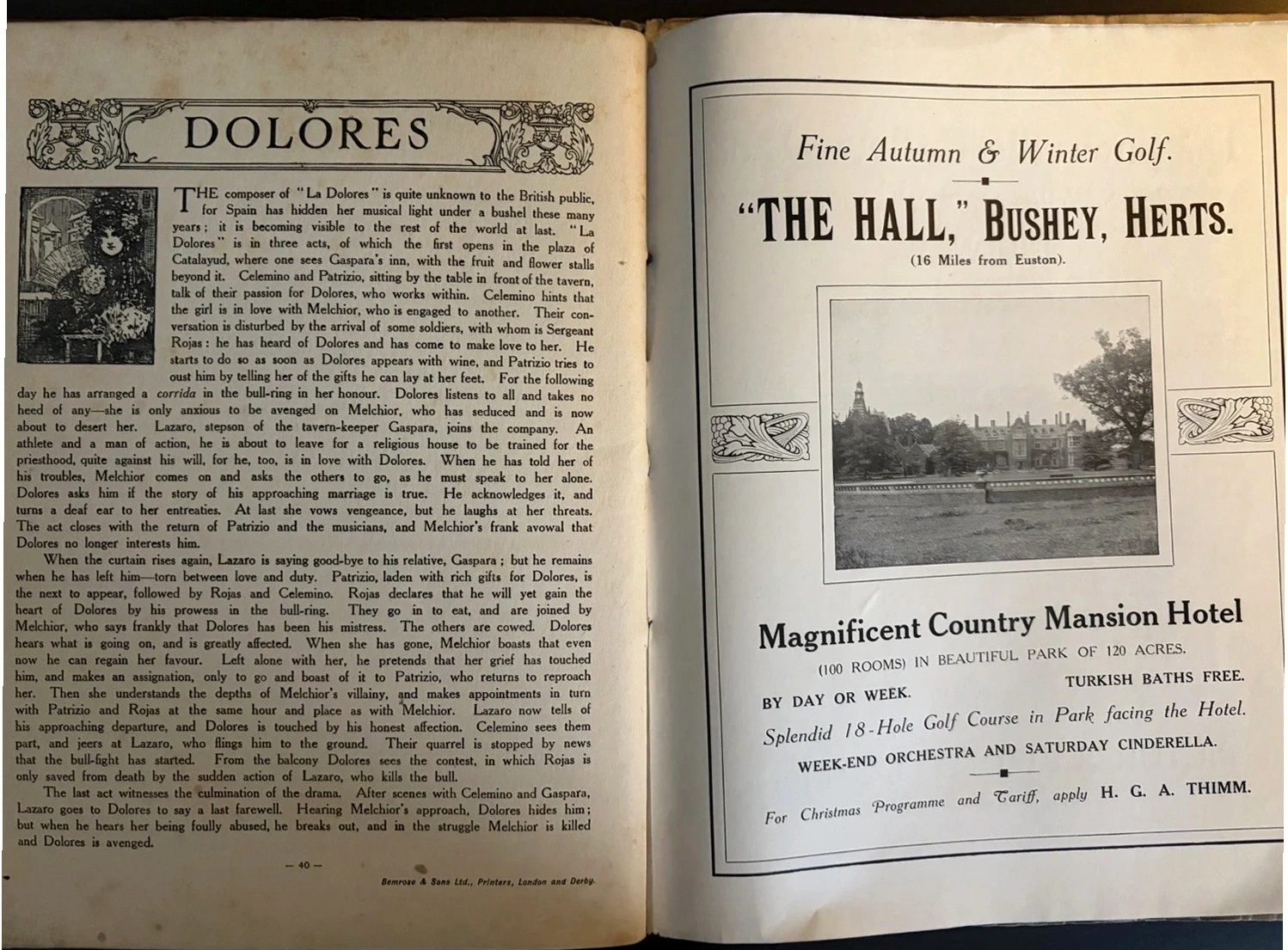
The booklet’s opera summaries are interleaved with advertisements, and this is where its social history becomes particularly legible. A page describing Dolores opens beside an advertisement for a country hotel. Another spread carries the promise of a comfortable commercial world beyond the theatre. These are not accidental interruptions. They locate opera within travel, hospitality, food and the wider habits of an evening out.
The rear wrapper carries a bright Schweppes Table Waters advertisement. Its survival is useful because it refuses to separate culture from commerce. The booklet was not made for an archive; it was made to circulate, attract attention and perhaps encourage another purchase. Its advertisements tell us what kind of reader the publisher imagined: someone moving through a city of theatres, hotels and refreshments.
What remains after the music
What survives here is not an opera but a structure for remembering one. The stories stand in for performance, the portraits stand in for voices, and the advertisements stand in for the city that made the evening possible. Each layer is incomplete on its own. Together they form a surprisingly rich account of how opera was presented to a public.
I find that balance compelling. The booklet does not ask us to admire opera from a distance. It invites us to browse, compare, recognise a face, pause at an advertisement and imagine the route from Kingsway to home. The performance has vanished, but the paper still knows how the evening was supposed to feel.
Source note: This draft is based on the photographed copy of Grand Opera Stories, published for Oscar Hammerstein’s London Opera House, Kingsway, circa 1911. The description distinguishes visible printed evidence from interpretation; the item’s current availability may change. The photographed booklet can be inspected here.