
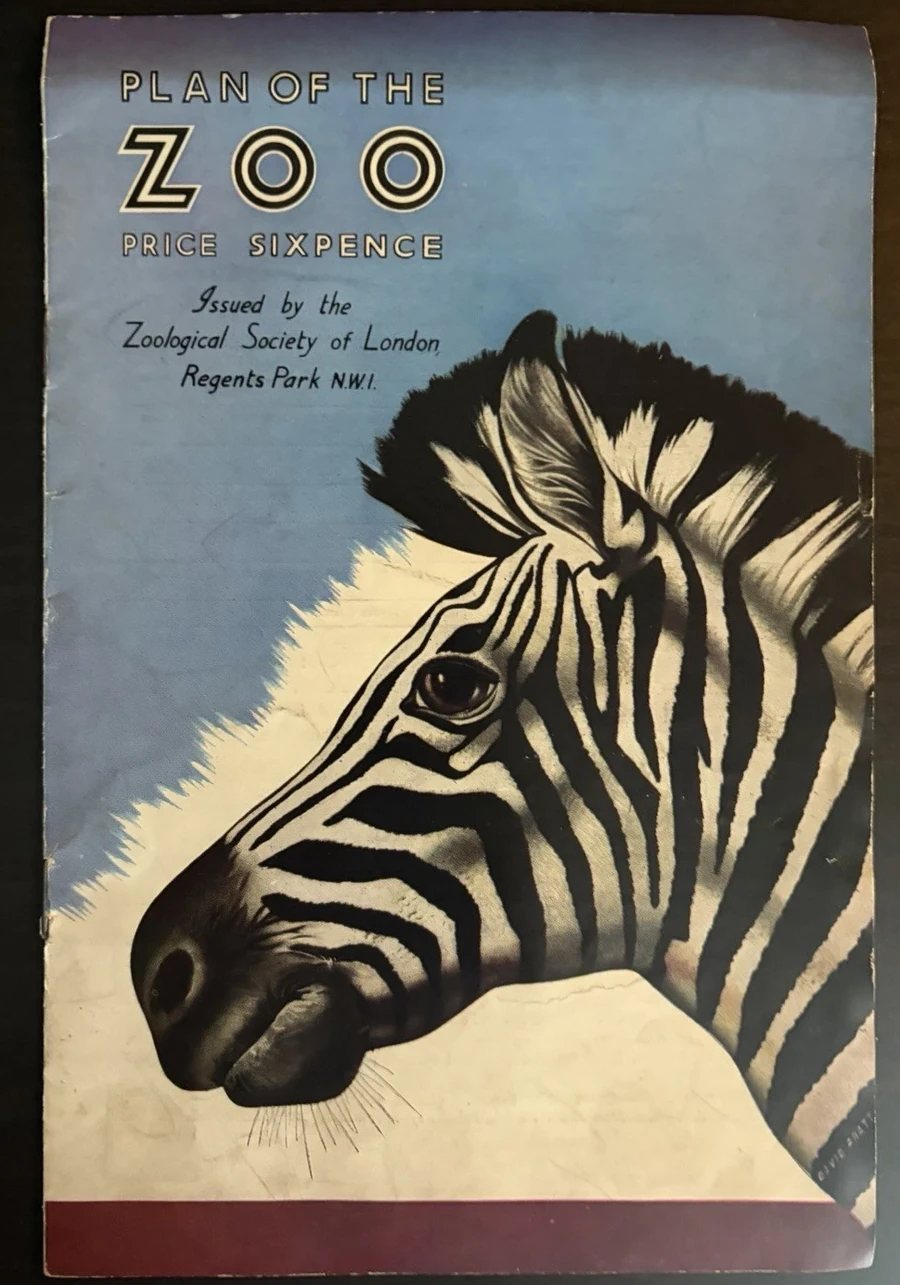
A zebra fills the fold. Its muzzle reaches the lower edge, one dark eye meets the visitor and the stripes carry most of the work normally assigned to ornament. “Plan of the Zoo” occupies the blue above it. Price Sixpence and the credit to the Zoological Society of London are quieter, but they complete the invitation: an animal first, then a place that can be entered and understood.
Opening the leaflet changes its scale. The bold cover gives way to sixty-five numbered locations, three public approaches, Regent’s Canal, paths, ponds, restaurants and animal houses. Another face supplies admission charges, seasonal hours and a timetable of feedings. This was a practical guide to navigating the zoo, timing feedings and finding visitor services.
The listing places this copy at about 1951. No printed year is visible in the photographs, so I would keep that date approximate. ZSL identifies the zebra cover as a design by J. P. Sayer from circa 1949; a separately catalogued 1951 edition of the Society’s guide provides useful date context without proving the issue of this particular sheet. Around 1950 is the honest description.
Sixpence before the turnstile
The price is part of the cover rather than an afterthought in a corner. Sixpence bought a way of carrying the gardens before walking through them. The plan could answer immediate questions—where the nearest entrance stood, whether the aquarium cost extra, which path led towards the lions—but it also let the visitor imagine an afternoon in advance.
Sayer’s zebra makes that practical purpose desirable. There is no enclosure behind the animal and no crowd to reduce it to a spectacle. The head has been isolated, enlarged and arranged with the title as a piece of graphic design. Folded shut, the booklet can be recognised from several feet away. Its deepest black belongs equally to the printed letters and the stripes.
The pale blue has rubbed at the edges; the corners are softened and the lower border is marked. Those are not reasons to crop the object into false perfection. They show where the cover met hands, pockets and surfaces while continuing to do its first job.
Sixty-five stops, no prescribed route
The plan is more restrained: blue lines on cream paper, numbered circles and a key divided across the left margin. Regent’s Canal crosses the upper half. Outer Circle runs diagonally below it; Broad Walk and Regent’s Park make a firm eastern boundary. The zoo becomes intelligible through the neighbouring city as much as through its internal paths.

The numbering does not dictate a tour. No bright line marches the visitor from one exhibit to the next. Instead, the key offers a set of choices. One might begin at the Monkey House, turn towards the Reptile House, cross to the Mappin Terraces, or use the canal-side route towards seals, giraffes and hippos. The map provides order without pretending that every family will move alike.
Public necessities share the sequence with the animals. Number 4 is the zoo shop and pushchairs; number 5 is first aid and lost children. Cafeterias, restaurants, telephone boxes, gates and offices enter the same graphic language as aviaries and ponds. Their inclusion reveals the institution behind the collection: not merely somewhere animals were displayed, but a large visitor site that had to receive, feed, direct and occasionally reunite people.

Buildings become part of the menagerie
Some entries name a species; others name a structure that had already acquired its own identity. The Mappin Terraces occupy a broad crescent at number 17. The Penguin Pond is number 29, drawn as a small oval beside its tea pavilion. That compact symbol represents the celebrated concrete pool designed by Berthold Lubetkin’s Tecton practice with Ove Arup and completed in 1934.
The plan does not single it out typographically. Modern architectural history may recognise the pool as an experiment in reinforced concrete, but the contemporary visitor key places it between the Lion House and the Tropical Bird House. Design and animal display are made parts of one itinerary. A structure could be modern, famous and still function on the page as somewhere to reach before feeding time.
The afternoon is ruled by clocks
Geography alone could not organise the visit. Penguins were fed at 12.30 and 4 in summer; pelicans at 2.30; eagles at 3.30 except on Wednesdays. Lions and tigers, sea-lions and seals each had seasonal times. The chimpanzees’ tea party was scheduled for 4.30 in summer months, except Sundays and subject to weather. A timetable of animals turns the plan into a sequence of appointments.
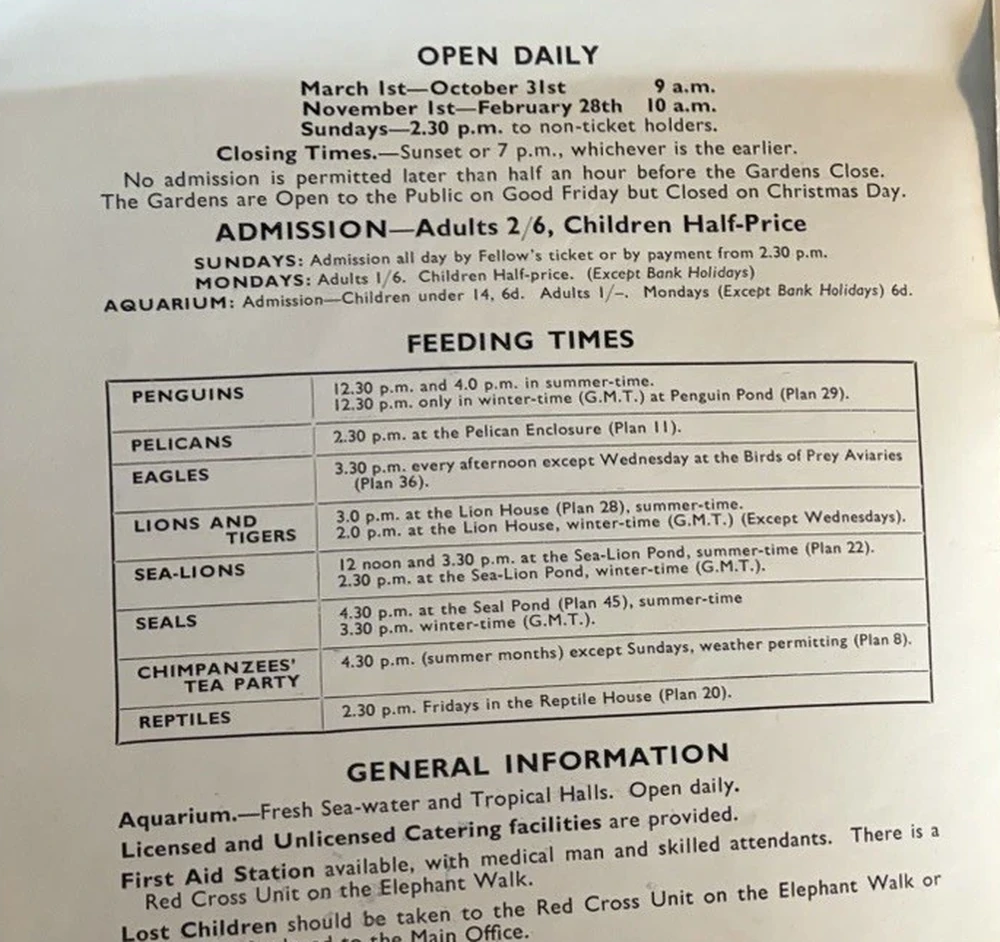
Below the timetable, general information deals with the less memorable parts of a public day: catering, first aid, lost children, pushchairs, telephones, left luggage and prohibited dogs. Read beside the map, these details suggest two simultaneous versions of the zoo. One is a collection of animals; the other is a managed flow of visitors with coats, children, meals, questions and a fixed closing hour.
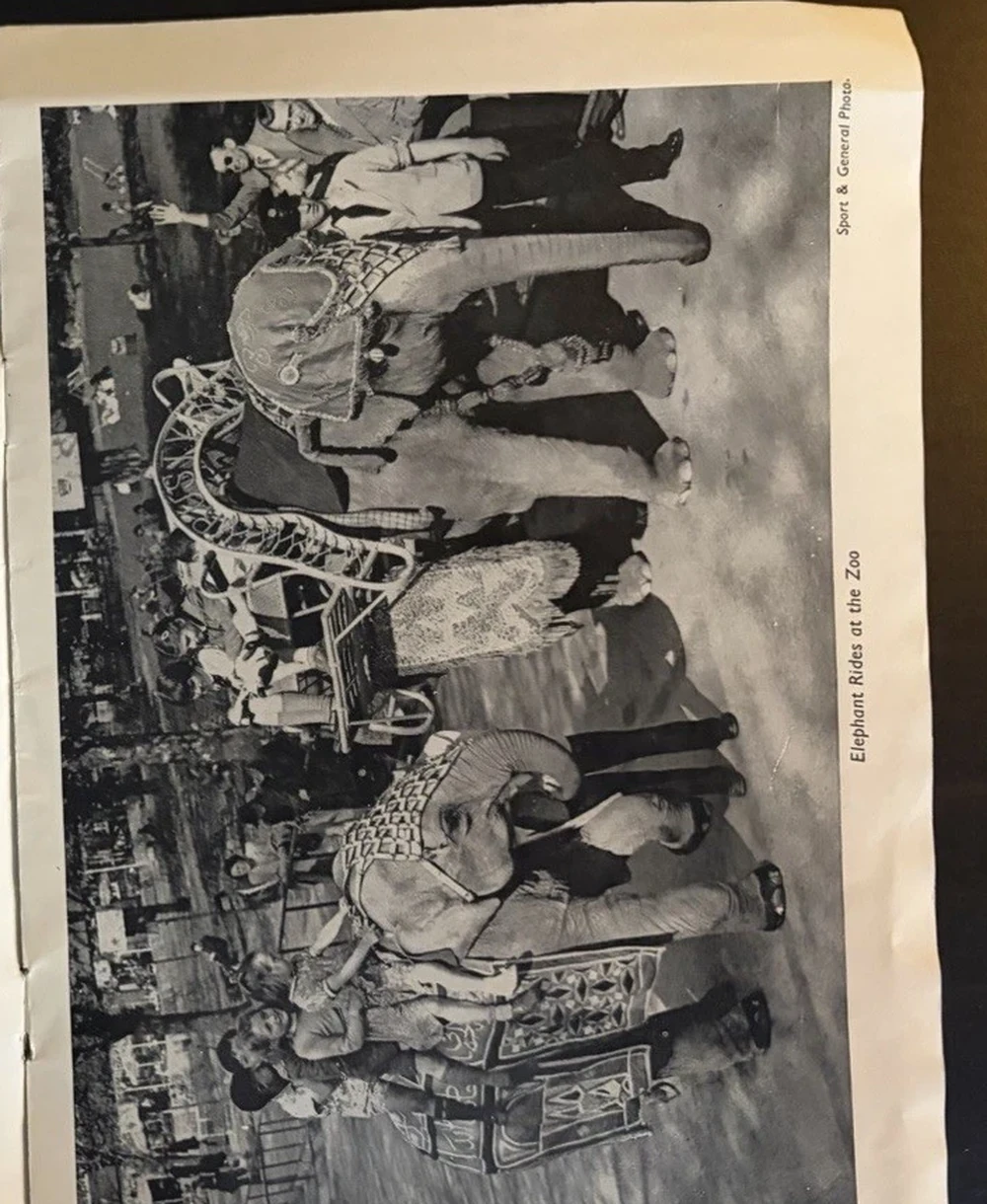
The elephant-rides photograph belongs to the same management of attention. Children and adults are shown seated on decorated elephants while onlookers gather nearby. It needs treating as historical evidence, not as a neutral model for the present. The leaflet presents animal performance and riding as ordinary visitor attractions. Its lack of hesitation says something about the institution’s assumptions and the public experience being sold at the time.

A history written on the reverse
The final panel turns backwards. Under the heading “The Zoological Gardens in 1850”, a blue vignette shows a crowded entrance and the text compresses more than a century of institutional memory into a few paragraphs. The Society’s foundation, the arrival of animals from the Tower menagerie, giraffes, a hippopotamus, a takin and the giant panda Ming are assembled as milestones.
This is the zoo describing its own lineage. The claims deserve to be identified as period editorial copy rather than silently promoted to independent history. Their selection is revealing even before each statement is checked: acquisition, rarity, first appearance and visitor numbers are used to tell a story of progress. The word “1850” gives that story a picturesque centre while later dates carry it towards the leaflet’s present.

Creases across the gardens
The surviving copy has rubbing, short edge tears, worn corners and fatigue along the folds. One dark vertical break cuts through the northern part of the plan; another weakened intersection opens near the lower centre. They interrupt a design whose success depended upon being repeatedly opened and reduced.
That damage establishes no named owner or particular visit. It does show how the leaflet was constructed to move between states: zebra on the outside, whole zoo on the table, timetable folded into the hand. The same creases that made those changes possible now prevent the mapped garden from lying perfectly flat.
To read a visitor plan, follow three systems separately: the physical site—entrances, paths and boundaries; the numbered attractions; then the timetable and services. Where they meet, the intended day appears. Finish with the printer’s line and the folds, which may say more about the individual issue than the picture on its cover.
The zebra remains the most immediate image, but it is no longer the whole story once the sheet has been opened. Behind that eye lies a canal-divided site, sixty-five choices, timed performances, cups of tea, telephone boxes and a carefully edited institutional past. Sixpence bought more than directions. It bought a temporary order for a complicated day.
Bibliographical note
The copy examined here is a London Zoo folding plan listed as circa 1951, issued by the Zoological Society of London and printed by Ebenezer Baylis of Worcester and London. Object description, wording, numbers and condition observations come from the photographed copy. Because no year is visible in those photographs, its date remains approximate.
ZSL identifies the zebra cover as J. P. Sayer’s design, circa 1949, and its archives guide describes holdings of zoo guides, leaflets, maps and plans. The Yale Center for British Art catalogues a related Sayer and Ebenezer Baylis folded zoo map at about 1947; the Open British National Bibliography records a 1951 ZSL guide edition. These comparisons support the range used here but do not identify this sheet’s exact issue. Historic England dates the Lubetkin and Tecton Penguin Pool to 1934.