
I am drawn to old theatre programmes because they do not quite know what they are supposed to become. At first they are practical things: a guide to the evening, a place to find the cast, the starting time, perhaps an advertisement worth reading while the lights go down. Afterwards, they survive as small souvenirs. Much later, when the performance is long over, they can offer a more intimate record of theatre than a grand poster or a formal history. They preserve not only a title and a star name, but the occasion on which people came together and agreed that this particular evening mattered enough to take home.
The small group of programmes here caught my eye for that reason. They range from the Phoenix Theatre in London to a 1930 amateur production in Ipswich and a Vienna cabaret. Nothing makes them a single archive. What joins them is their modest confidence. Each was made for a specific audience at a specific address; each carries information that would have felt ordinary at the time. Looking at them now, that ordinary information becomes the point.
A programme begins before the performance
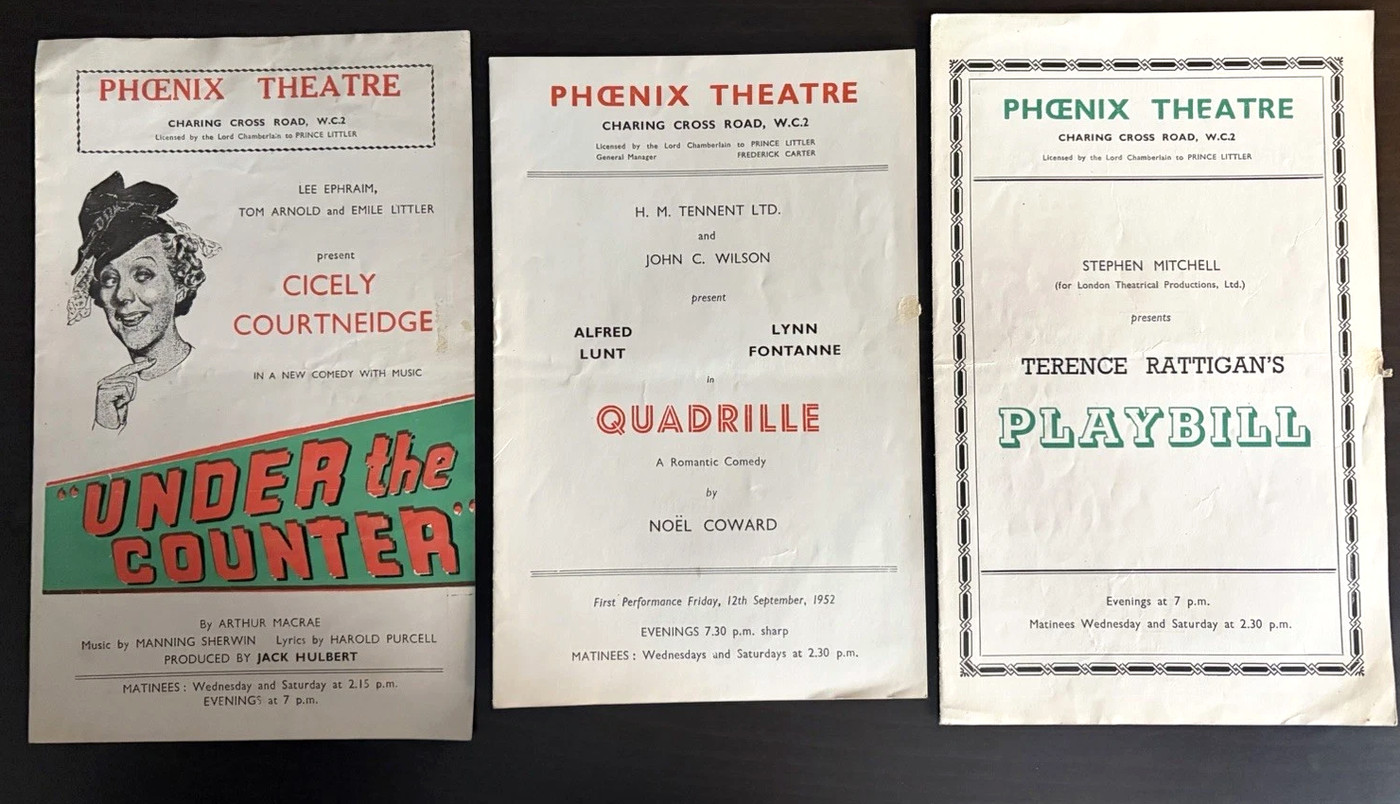
The Phoenix Theatre bundle is a particularly good reminder that a programme is part of the event before anybody has taken a seat. The covers announce Charing Cross Road, W.C.2, as firmly as they announce the plays. One names Cicely Courtneidge in Under the Counter; another sets Alfred Lunt and Lynn Fontanne at the centre of Noël Coward’s Quadrille. The third is an unfilled playbill, patiently waiting for a production to be inserted. Together they move between celebrity, management, address and blank possibility.
I like the difference in their designs. Under the Counter makes an immediate visual claim with its red lettering, green panel and drawn portrait. Quadrille is almost severe by comparison: names and title arranged with a formal calm. Yet both cover the same useful ground. They tell a person where they are, whom they have come to see and how the evening will be framed. The date on the Quadrille programme—its first performance on Friday, 12 September 1952—suddenly makes the paper more precise. This is not simply a Noel Coward programme. It belongs to one opening night in one theatre.
The audience is in the details
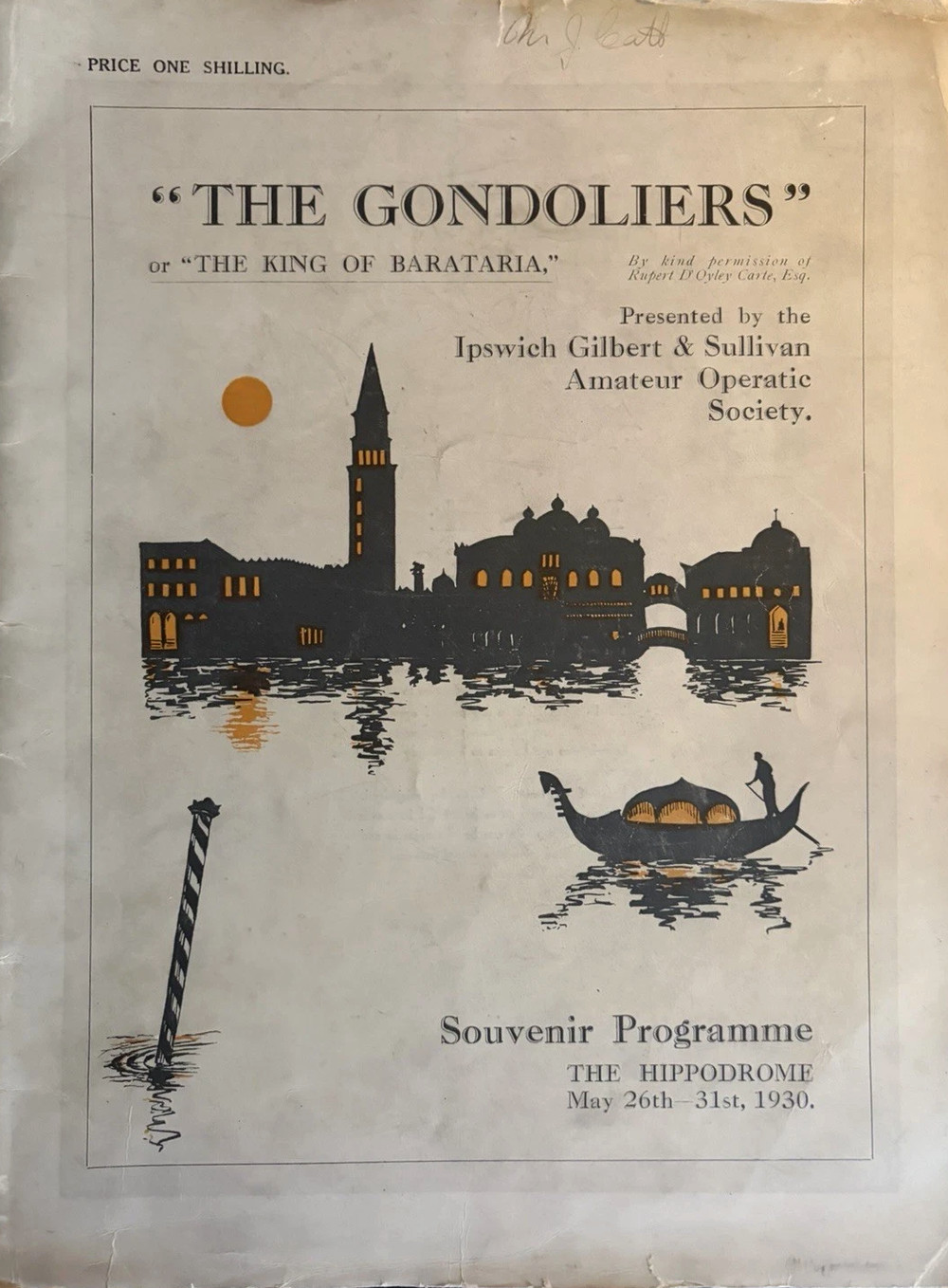
The Ipswich programme for The Gondoliers brings the audience closer still. Its cover states the price—one shilling—and gives a faint pencilled ownership note at the top. Inside, the Ipswich Gilbert & Sullivan Amateur Operatic Society calls the performance its “first amateur production”, staged at the Hippodrome from Monday 26 May 1930 for five nights, with a Saturday matinee. There is something very satisfying about that level of specificity. The programme does not ask us to imagine an abstract provincial theatre; it gives us the dates, the local society and the timetable by which people arranged to attend.
The ticket prices are equally revealing: orchestra stalls, pit stalls, dress circle, pit and gallery, all set out with an extra charge for a reserved Saturday seat. They are not decorative detail. They describe the room as it was organised, with different parts of an audience expected to enter at different prices and from different social positions. A programme cannot tell us exactly who sat where, what they made of the music, or whether the performance succeeded. It can show the framework within which such an evening took place.
That is why local and amateur programmes deserve as much attention as metropolitan ones. They record effort that might otherwise disappear: rehearsal, printing, ticketing, the decision to hire a hall and perform a work that already had a public life far beyond Ipswich. The cover’s little Venetian scene is not merely an illustration. It is the local society’s way of giving its production a visual world before the first note was heard.
When the advertisement belongs to the show
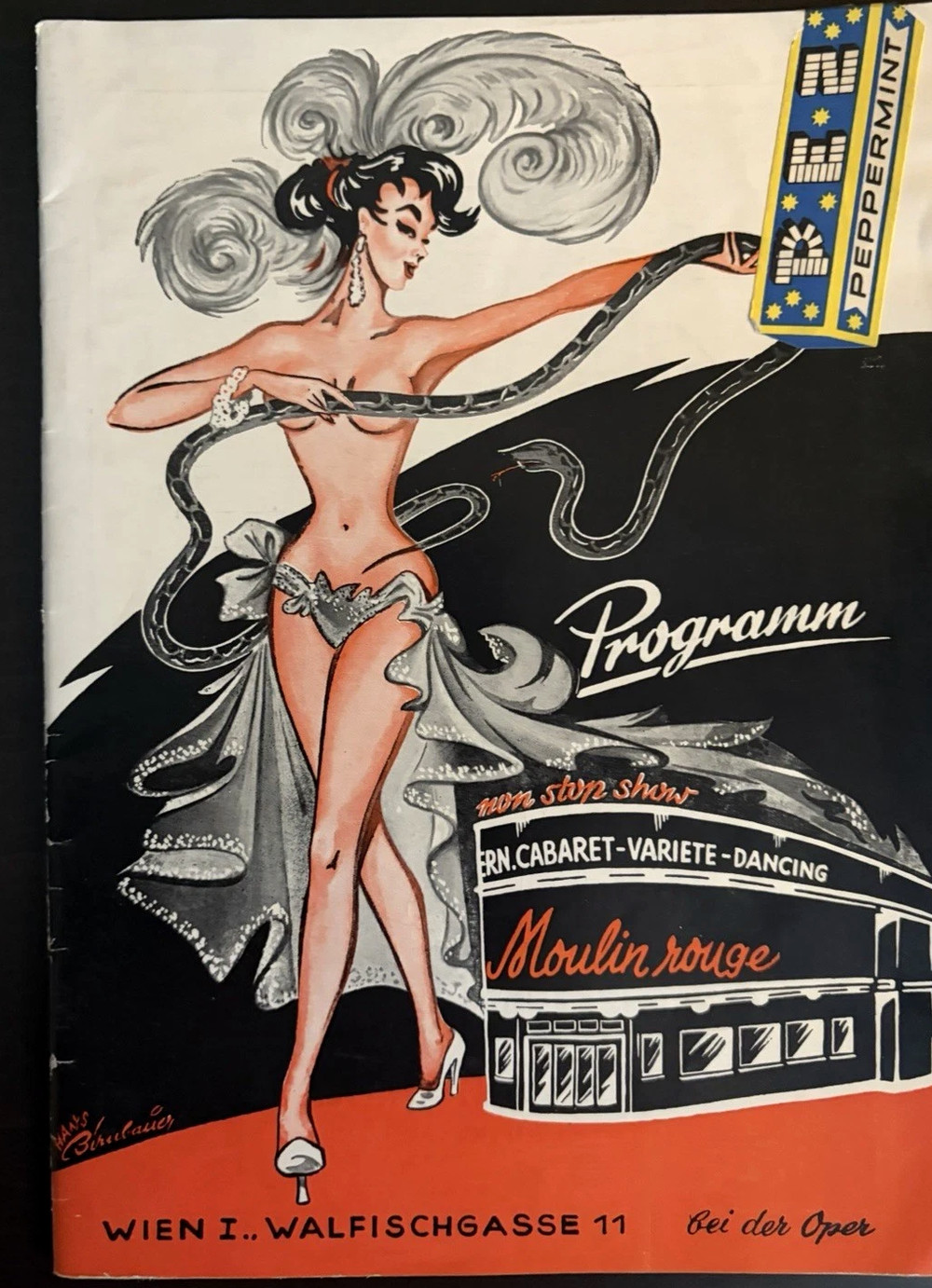
The Vienna Moulin Rouge programme, listed as dating from around 1960, has a different sort of energy. A dancer, a serpent and a bold black sweep carry the eye down to the venue: Wien I, Walfischgasse 11, near the Opera. The wording promises cabaret, variety and dancing. At the upper edge is an advertisement for PEZ Permint. It is a wonderful example of the way programmes can preserve several histories at once. It records a venue and an entertainment, but also the commercial world that helped pay for the printing.
The PEZ advertisement belongs to the programme’s commercial setting and contributes to the cover’s modern tone. The cover tells us what sort of experience was being sold: music and spectacle, certainly, but also fashion, appetite, modernity and a city night out. The sponsor sits inside the design rather than apologising for its presence. A collector who looks only for the featured performer may miss that wider picture.
What I look for in a theatre programme
There is no single rule for collecting programmes, but I find it useful to begin with a few straightforward questions. Is the venue and production identified clearly? Is there a date, a cast list or a printer’s detail? Are the advertising pages still present? Has somebody written a name, an annotation or the price paid? And, perhaps most importantly, does the object feel complete enough to describe the evening it was made for?
Condition needs to be read with the same patience. Creases, softened corners and staples have their own history. They can matter greatly if pages are missing or detached, but they should not automatically be treated as failures. Theatre programmes were made to be held in a darkened auditorium, folded into a coat pocket and carried home. A clean copy has one kind of appeal; a lightly used one may preserve the fact that it actually did the work it was printed to do.
What keeps me returning to them is that they make theatre tangible without pretending to preserve the performance itself. The actor has gone, the curtain has fallen, and the audience has dispersed. But this thin printed paper still remembers an address, a price, a time, a hierarchy of seats and a particular design of anticipation. Before the curtain rises, it is all promise. Afterwards, it becomes evidence.
Bibliographical note
This editorial is based on three original items listed by RUSTY PECHA: the Phoenix Theatre programme bundle, the 1930 Ipswich Hippodrome souvenir programme for The Gondoliers, and the Vienna Moulin Rouge programme. The observations are grounded in the visible covers and printed details of those copies. The University of Bristol Theatre Collection describes programmes and playbills as records of theatre both onstage and offstage, while the V&A Theatre & Performance Archives provides wider context for the preservation of performing-arts history.
See the originals: Phoenix Theatre programmes, Ipswich Gondoliers programme and Vienna Moulin Rouge programme.