
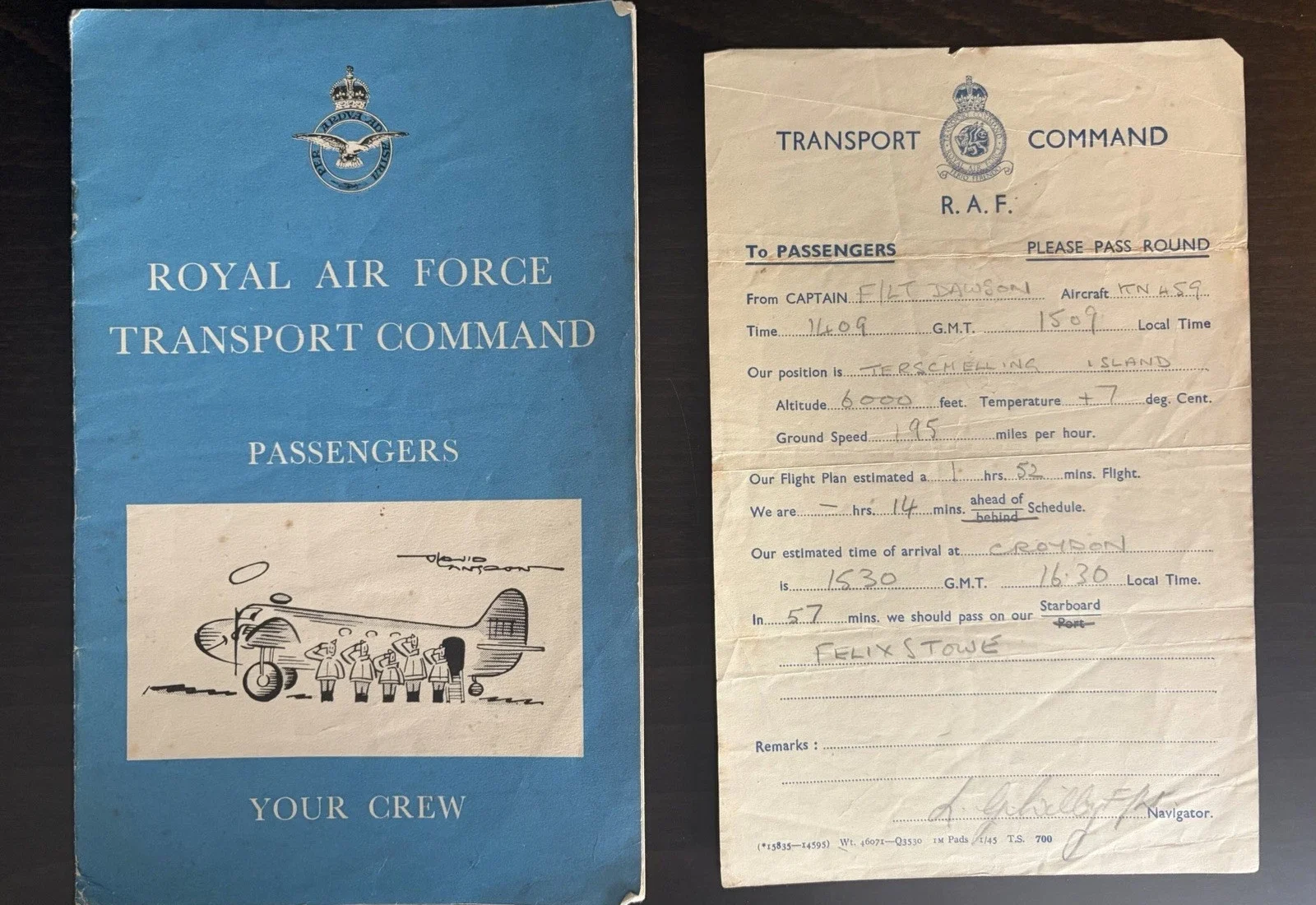
I first put the RAF booklet aside because its blue cover was enough to catch the eye. It has the neat, purposeful look of a thing made to travel: a small passenger guide entitled Your Crew, practical rather than grand. Then I noticed the handwritten sheet that came with it. Suddenly, the booklet was no longer simply a wartime printed souvenir. It had acquired a companion that recorded a particular aircraft, a position over the North Sea, a height, a speed and an expected arrival at Croydon.
That small pairing is what made me think about aviation paper more generally. Some documents are made to help a passenger through a journey; others are made so that the journey can be remembered afterwards. The RAF material belongs to the first world. The British Caledonian and Dan-Air covers that follow belong to the second. Put together, they show two very different ways in which a flight becomes something one can keep in a drawer.
A passenger’s view of Transport Command
The RAF booklet is modest in scale, but its subject is not. It introduces the people around a passenger and gives the sort of practical guidance that makes air transport feel human: not just an aircraft and a destination, but a crew, a routine and the small preparations needed before leaving the ground. I like that it was printed for somebody travelling, not for a historian looking backwards. Its purpose was immediate. That is exactly why it now has such a quiet pull.
The larger history sits behind it. The RAF Museum records that Transport Command was formed in March 1943 to conduct RAF transport operations in Britain and overseas. The Dakota became one of the aircraft most closely associated with Allied transport work. Those facts give the booklet a setting, but the object itself is more intimate than any broad account of the war. It asks us to imagine a passenger reading a few useful pages while waiting to fly.
The note that makes a route visible
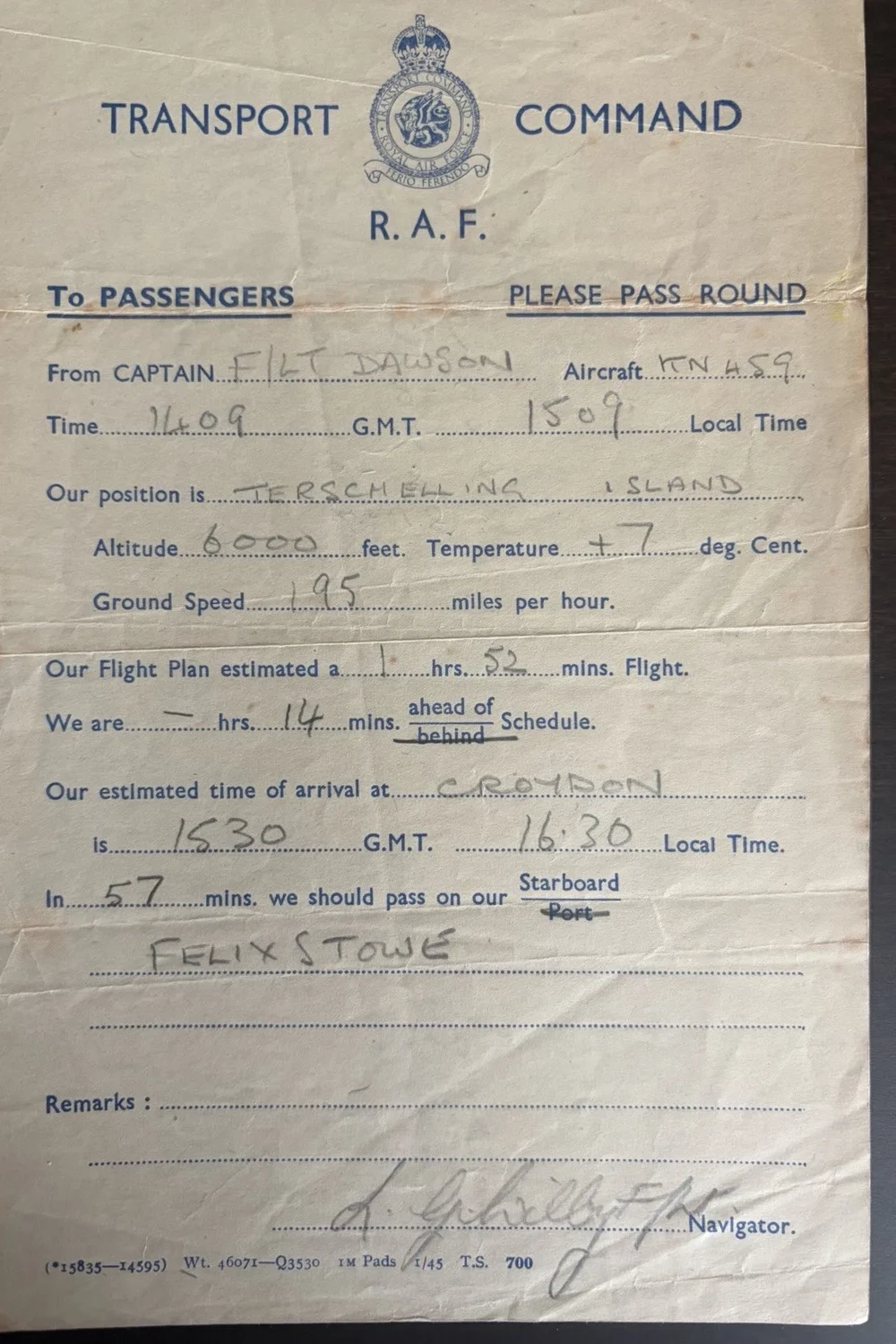
The surviving sheet is only a fragment of the journey, but it records several exact details. It is listed as dating from around 1945 rather than as a complete flight log. The aircraft is identified as Dakota KN459. Terschelling Island is given as the position; the height is 6,000 feet; the ground speed is 195 miles per hour. Croydon is written in as the intended arrival, with times supplied in GMT and local time.
It is the mixture of printed form and handwriting that I find compelling. The form promises order, while the pen makes the journey feel present. This was not a carefully designed commemorative cover; it was a working note, completed in the course of travel. Even the place name has a particular force. Terschelling is not an abstract direction on a route map but a point reached over the water, written down because it mattered to the people making the flight.
A scheduled service becomes a souvenir
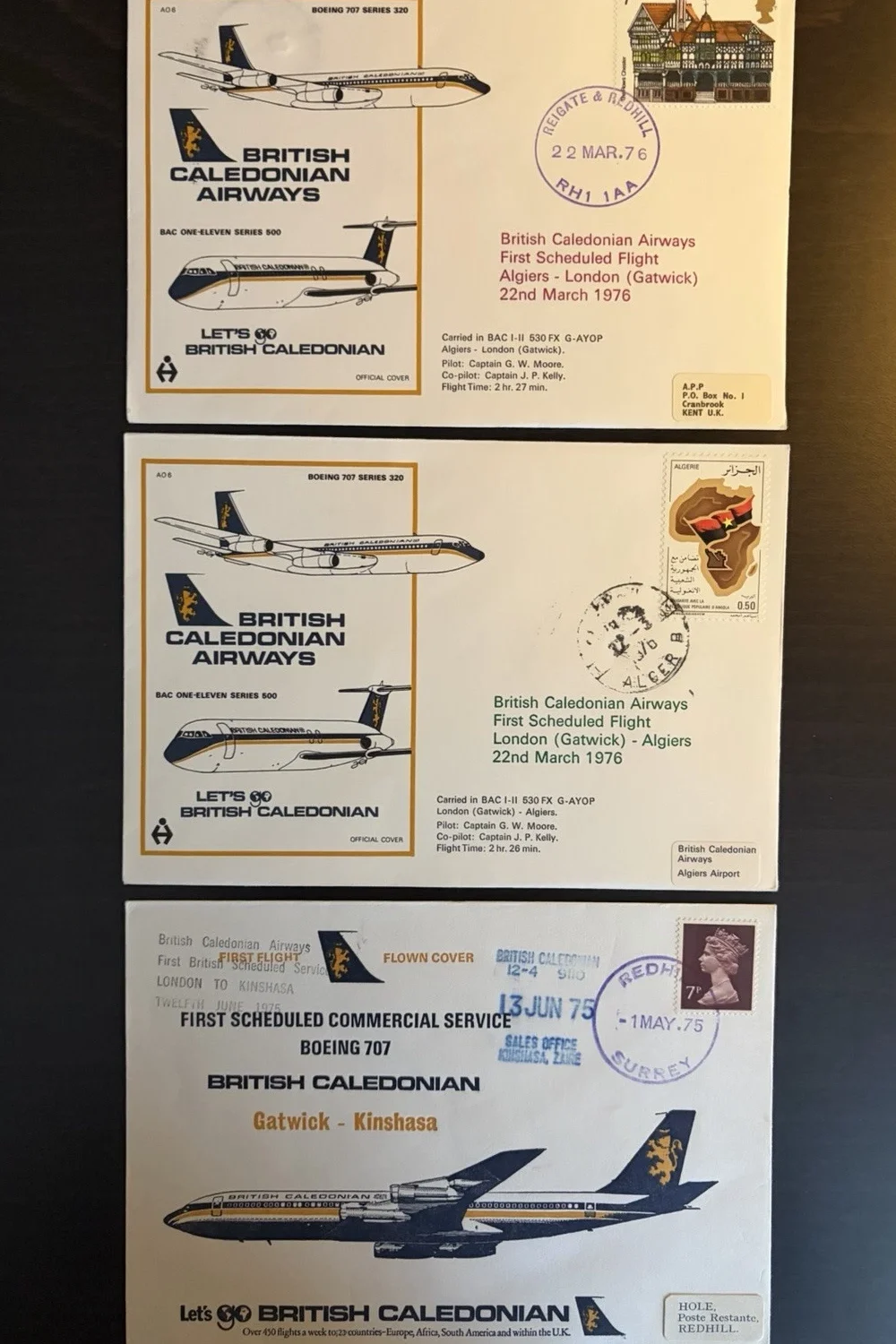
The British Caledonian covers take us into a different mood altogether. Here the flight is deliberately marked out as an occasion. One records the first scheduled service from Algiers to London (Gatwick) on 22 March 1976; another the outward Gatwick–Algiers service on the same date; a third celebrates the Gatwick–Kinshasa service in June 1975. The aircraft illustrations, stamps and cancellations are not incidental. They work together to say: this route began, on this date, and somebody thought that fact was worth preserving.
I enjoy the contrast with the RAF note. There is still a route and still an aircraft, but the emphasis has shifted from the private practicalities of a journey to a public record of a service. A first-flight cover is almost a small ceremony in paper form. It lets a postal cancellation do some of the dating and places the airline’s own design beside the evidence that the cover travelled through the post.
Airlines, routes and the postal edge
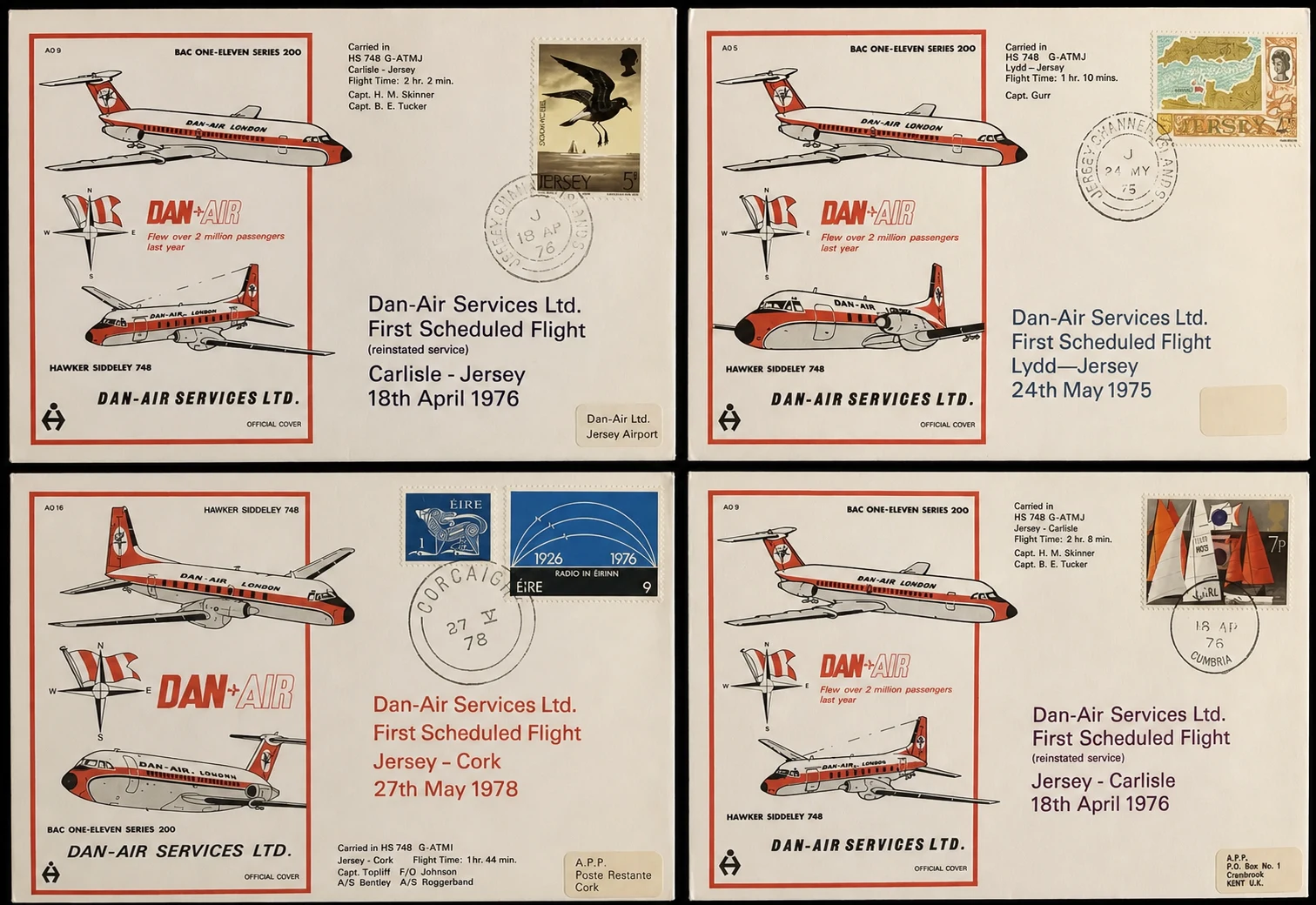
The Dan-Air covers make the same point in a more colourful way. The illustrated aircraft are part of the design, but so are the places: Lydd, Jersey and Carlisle, each made to sound like a waypoint in a new chapter of scheduled travel. One cover is dated 24 May 1975 for the Lydd–Jersey service, another 18 April 1976 for the reinstated Jersey–Carlisle service. It is easy to think of a route as a line on a timetable. These covers remind me that a new or restored service was also an event—one that could be stamped, cancelled and posted.
There is a useful collecting lesson in that. Aviation ephemera is often strongest when several kinds of information survive together: the airline’s name and design, the aircraft named or pictured, a date, a route, and postal evidence that fixes the item to its moment. None of those details needs to be rare on its own. Together, they give an ordinary piece of paper its particular identity.
What I look for in aviation paper
When I come across a booklet, a flight note or a first-flight cover, I begin with a few simple questions. Can the route be identified? Is there a clear date? Does the document name, show or otherwise connect us to an aircraft? If it is a cover, do the stamp and cancellation support the journey being celebrated? And is the object complete enough to make its own story intelligible?
Condition matters, but it should be read in proportion to the object. A neatly preserved first-flight cover is attractive because the design and postal markings can be read clearly. A used booklet or working note may show creases and handling because it was actually carried. I would rather describe that honestly than treat every sign of use as a defect. These things were made to accompany movement. A little evidence of handling can be part of the reason they still feel alive.
A route remains in its paperwork
What stays with me is the difference in scale. The RAF note gives a few measurements from a single passage through the air. The airline covers announce routes that were meant to become part of a public network. Yet all of them reduce flight to something that can be held in the hand: a name, a time, a place, a stamp, a pencilled line. The aircraft have long since gone on, but the paper still knows where it was supposed to be.
Bibliographical note
This editorial is based on three original items listed by RUSTY PECHA: an RAF Transport Command Your Crew booklet with a Dakota KN459 flight note, British Caledonian first-flight covers for the Algiers and Kinshasa services, and Dan-Air first scheduled-flight covers. The reading above is grounded in the visible printed and handwritten details of those copies. For wider historical context, the RAF Museum’s 1943 timeline records the formation of RAF Transport Command, and its Douglas Dakota collection note outlines the aircraft’s extensive Allied and RAF service.
See the originals: RAF Transport Command booklet and Dakota flight note, British Caledonian first-flight covers and Dan-Air first scheduled-flight covers.