
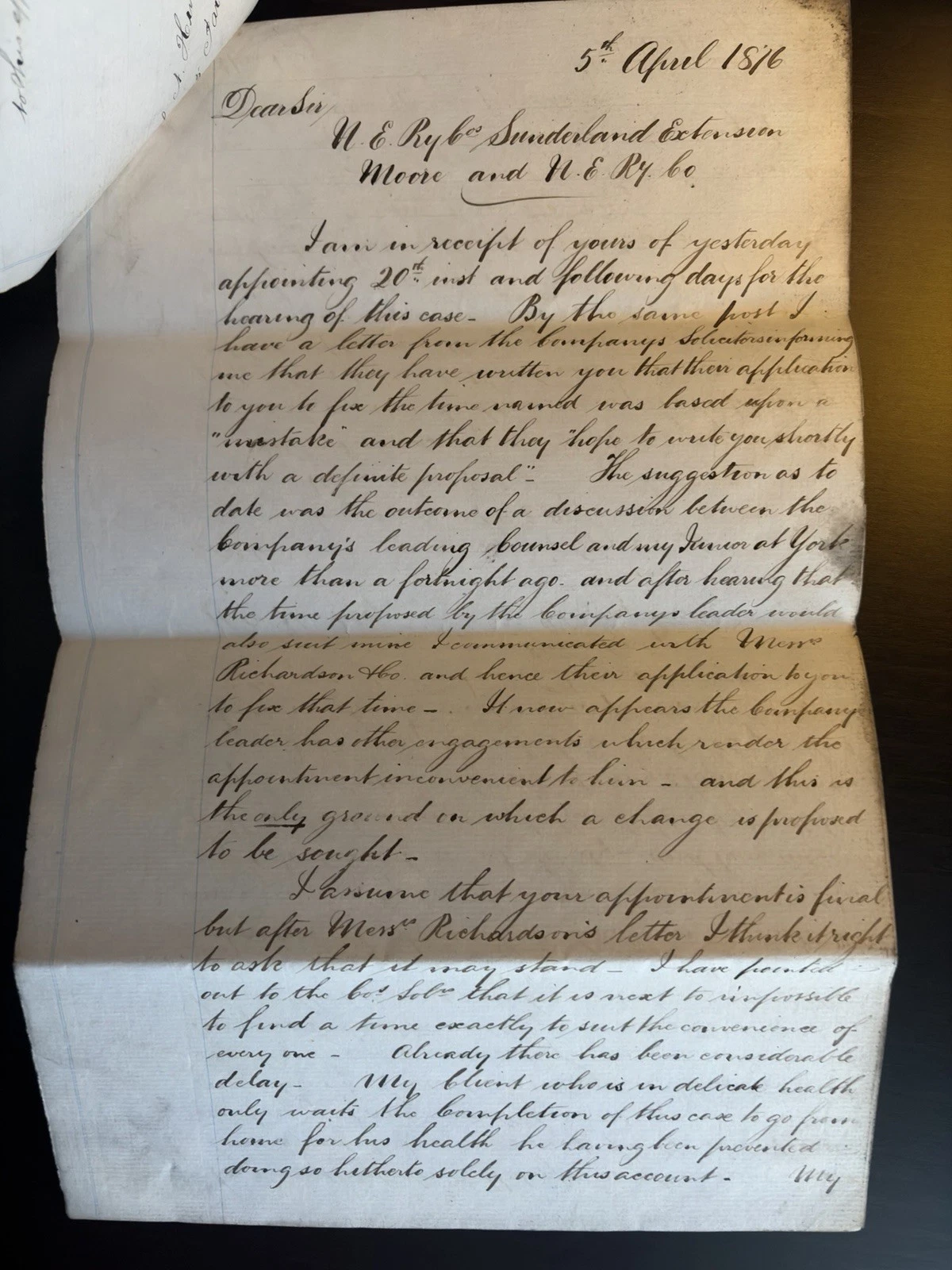
The surviving file opens on 5 April 1876 with a letter written for a client in a dispute headed “N.E. Ry Co. Sunderland Extension, Moore and N.E. Ry Co.” It set out why a hearing should not be moved. The hearing had been fixed for the 20th and the following days. The Easter-vacation date had already brought counsel, an arbitrator and witnesses into the same narrow window. The client, the letter adds, was in delicate health and hoped to leave home once the case was over.
The request to change the appointment came from the railway side. Its leading counsel had another engagement. Four days of correspondence survive from the ensuing collision between a large company’s legal timetable and the arrangements required of everyone else. What the letters preserve, unusually clearly, is the working pressure of trying to keep a formal dispute moving.
A case held together by a date
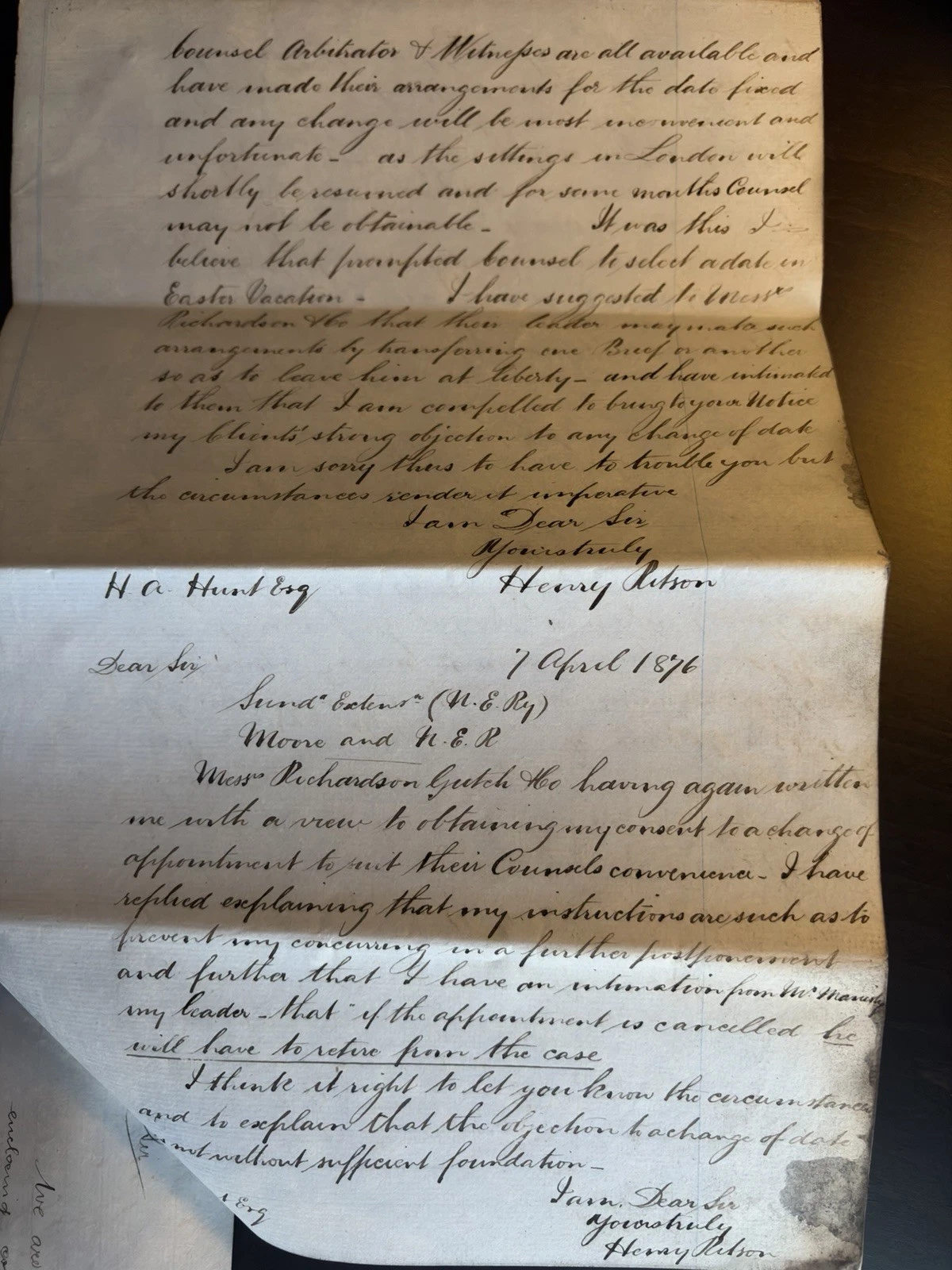
The file opens with an objection, not a claim. The 5 April letter says that an earlier suggestion of a mistake had turned into a request to accommodate the railway’s leading counsel. Its writer stresses that the date had been chosen after the leaders had been consulted. The continuation turns the hearing into a chain of commitments: counsel, arbitrator and witnesses had made arrangements around Easter.
Henry Wilson then wrote on 7 April to Henry A. Hunt, saying that he could not concur in the postponement. He had been told that his own leader would retire from the case if the appointment were cancelled. The stakes were practical, but they were not trivial. To lose the date was to risk losing the assembled professional team as well.
Copies, a telegram and an indefinite delay
Across the country, Richardson, Gutch & Co. of York wrote to Hunt on behalf of the railway side. Their 7 April letter explains that the dates had been settled after discussion between counsel, and says that the later discovery of the company leader’s unavailability was the only reason for proposing a change. Hunt’s 6 April reply presses a pointed alternative: if the solicitors could not brief another leading counsel, then—and only then—postpone.
The correspondence carries its own office machinery. Hunt’s letter includes a copied telegram; the York letter and Hunt’s letter survive again as copies. These were not decorative duplicates. They made a rapidly moving exchange portable: a London address, a York firm and a Sunderland recipient could all work from the same account of what had been said and what was now proposed.
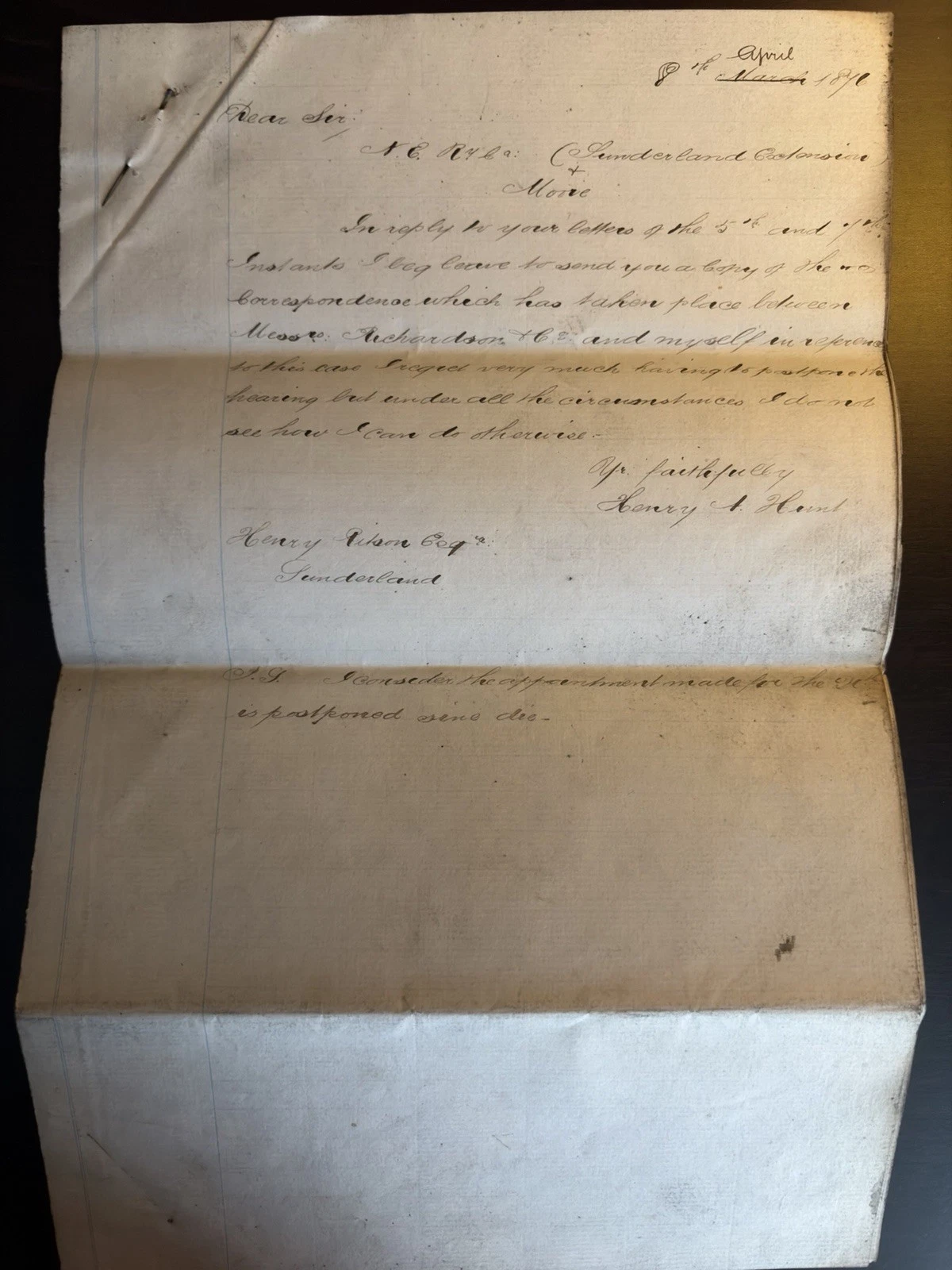
By 8 April Hunt was sending Wilson copies of the exchanges. He regretted having to postpone the hearing, but said he could see no other course. The postscript gives the result in two Latin words: the 20 April appointment was postponed sine die—without a new date.
Where the railway enters the room
The North Eastern Railway’s Sunderland works form the institutional horizon of the file because the correspondence itself gives the matter that heading. Separately, contemporary statutory material shows that the company was authorised to make a line from Monkwearmouth station to the Durham and Sunderland branch at Bishopwearmouth in 1871, and its parliamentary plan survives in Durham archives. Those records set the contemporary railway context; the heading is the correspondence’s own description of the case, while the letters keep their focus on the hearing’s immediate practical problem.
There is a more precise historical point in that restraint. Railway history is often told through Acts, plans and finished structures; this correspondence shows a scheduled railway arbitration depending on counsel, professional witnesses and a hearing date capable of coordinating people in different places. The names of the claim and the claimant remain spare, while the effort needed to convene the hearing becomes remarkably full.
Why this correspondence matters
The surviving letters make an administrative act visible as a human arrangement. An Easter hearing looked fixed until one barrister’s diary changed. That change reached an unwell client, a reluctant representative, an arbitrator, witnesses, York solicitors, a London correspondent and Sunderland. Copies and a telegram turned their separate constraints into a file.
That is the value of this small legal archive. It shows what a railway dispute required before any resolution could be heard. The extension’s name sits at the top of the letters, but the correspondence keeps our attention on the people whose time, health, travel and professional obligations had to be aligned before institutional power could proceed.
Sources and context
The letter sequence and quotations are transcribed from the preserved April 1876 correspondence. The North-eastern Railway Company’s Act 1871 authorises the Monkwearmouth–Bishopwearmouth railway, and The National Archives catalogue describes the associated Durham plan, Q/D/P/305. Durham catalogue records also document Richardson & Gutch acting for the North Eastern Railway in earlier property transactions; that confirms the firm’s wider railway practice.