
The things that make up ordinary life are often the least theatrical. A school magazine, a booklet kept beside the cot, a game brought down after tea: each was made for a particular moment, used without ceremony and then put away. None needed to announce itself as history. That is precisely why it now deserves attention.
These three objects are modest, but they hold different kinds of instruction. One speaks to a mother; one speaks for a school; one sets out rules for a game. Together they offer a small cross-section of the ways paper entered daily life—not as an archive in advance, but as a useful companion to care, belonging and leisure.
Advice made domestic
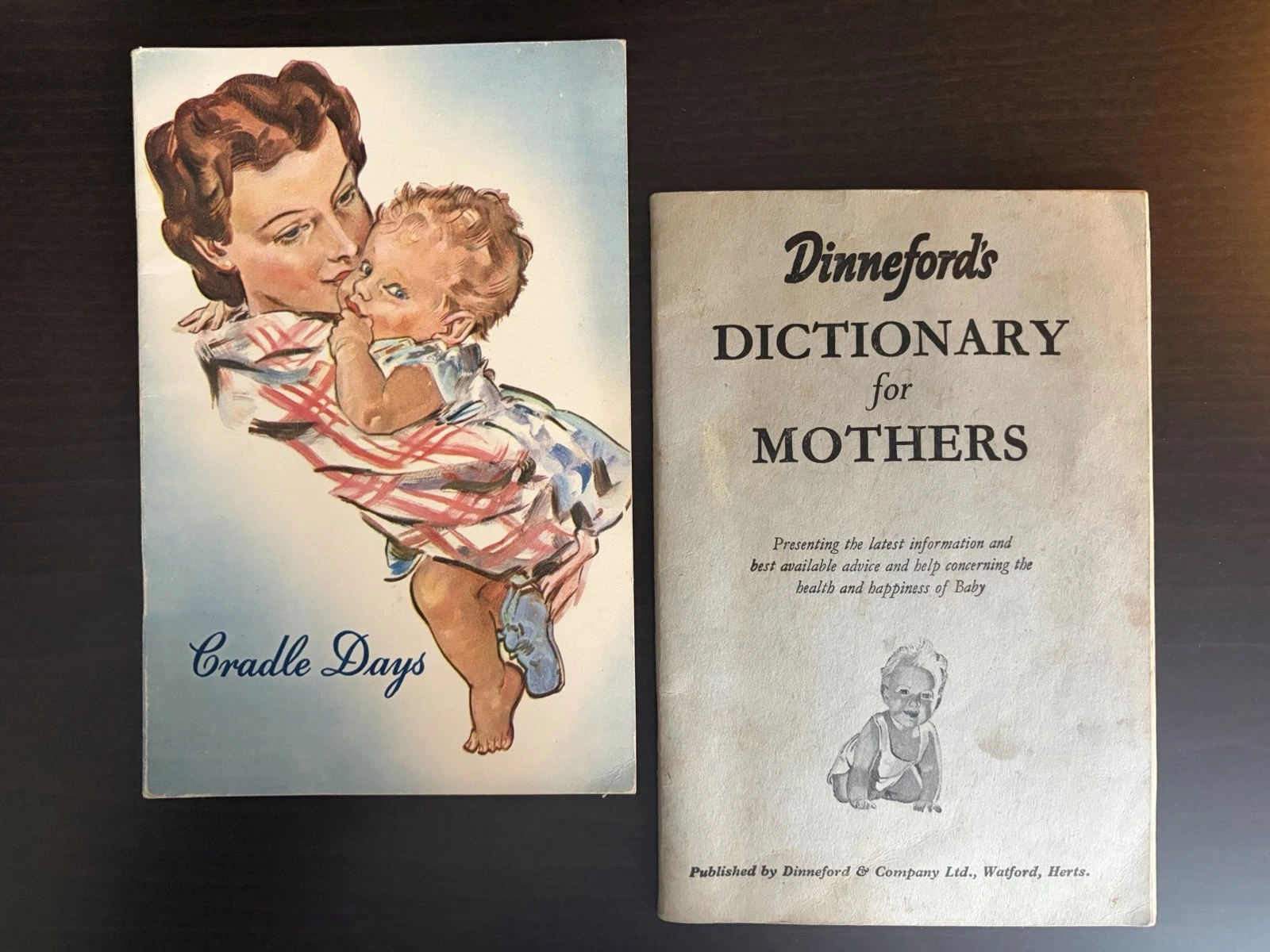
The pair of baby-care booklets is the most immediately intimate of the three. Cradle Days and Dinneford’s Dictionary for Mothers sit side by side with a surprising confidence in their covers: a mother holding a child, a calm title, a small printed image of a baby. They make care appear legible, manageable and available in a few folded or stapled pages.
What interests me is not whether every line of advice would now be followed. It is the form in which that advice arrived. The booklet belongs to a world in which manufacturers, publishers and family life met on the same piece of paper. The domestic reader was offered practical guidance, but also a particular picture of what good care looked like. Such objects are useful social documents precisely because their certainty is so visible.
The value of a household booklet is not only in what it says. It is in the assumption that a private concern can be ordered, explained and kept within reach.
The copies themselves do not give us a family’s story, and it would be wrong to invent one for them. They do, however, preserve a style of address: warm, instructive and neatly designed for a reader who was expected to turn to paper when a question arose.
A school in print
The Harrow College for Girls magazine, issued for Christmas 1948, is quieter in appearance. Its pale cover, printed simply with the school’s name, the word “magazine” and the date, has none of the urgency of the baby-care booklets. Yet it carries a different kind of instruction: the steady work of making a school visible to itself.
A school magazine is not the same as a pupil’s diary. It does not promise an unfiltered account of a particular day, or of a particular girl. It offers an institutional voice—edited, selected and arranged. That distinction makes the small publication more interesting, not less. The cover alone tells us that the school considered its year worth gathering into print, and that Christmas provided a natural moment for reflection.
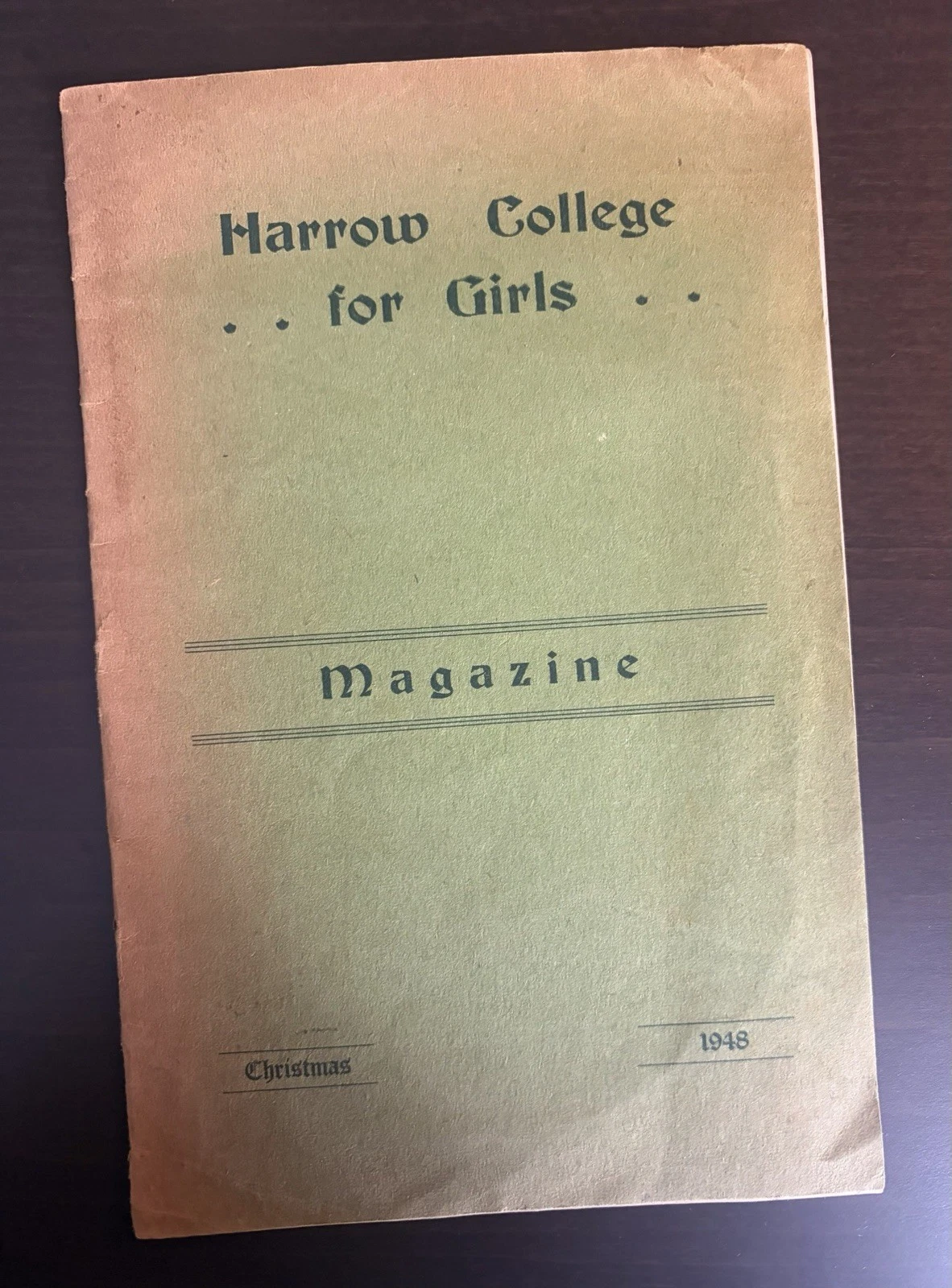
I am drawn to the restraint of it. This is not paper that attempts to impress a stranger at a glance. It assumes a community already exists: pupils, families, staff and former pupils who would recognise the name and understand why the issue mattered. The magazine’s survival lets us glimpse that quiet network of expectation.
Leisure in a small red box
Waddington’s Lexicon brings the article back into the home. The card game is housed in a red book-form box, with the title and the phrase “The Game of Skill” printed in gold. It is a pleasing piece of design, but its purpose was practical: to be taken from a shelf, opened, played, argued over and returned.
The book-shaped case is an especially good example of how ordinary objects borrow authority from other forms. It suggests a volume before it reveals a game. That small visual decision turns leisure into something slightly more serious, perhaps even improving. But the worn edges are what I like most. They restore the object to use. The box was not designed to remain pristine; it was designed to be handled.
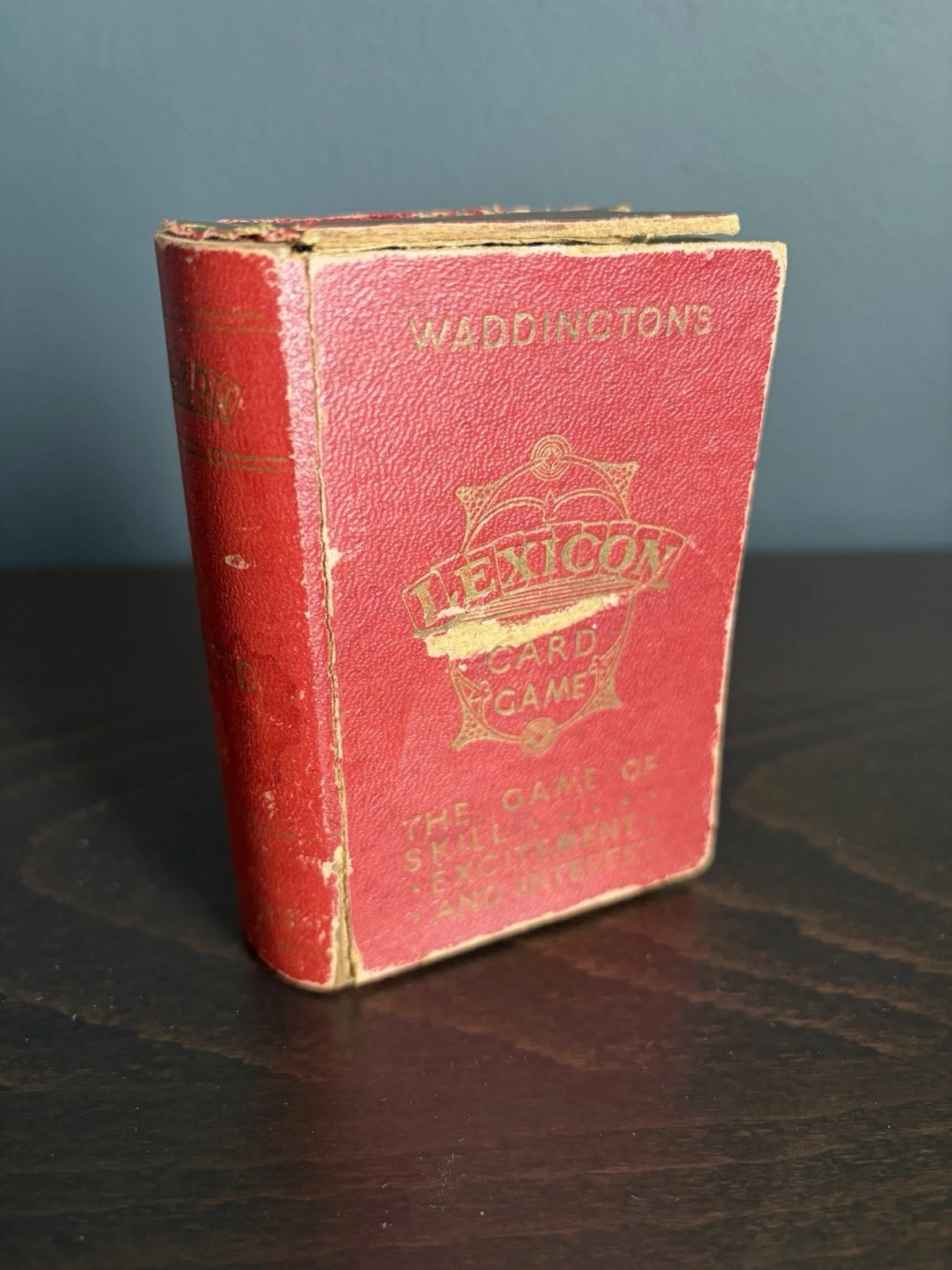
It is tempting to make too much of a game like this. A box cannot tell us who played it, who won or whether a particular family enjoyed it. What it can show is the design of an invitation. Its book-shaped box, compact rules and reusable cards were designed for shared play at home.
What survives in the object
None of these things was rare by intention. They were made to circulate: advice was handed out, magazines were issued, games were sold in quantity. Their interest now lies in the survival of the ordinary. The paper retains not only typography and illustration, but a sense of the practical situations in which those surfaces mattered.
That is what makes everyday ephemera approachable. We do not need to recognise every publisher or decode every technical term before we can begin. We can look at the cover, the wording, the wear, the size of the object and the audience it addresses. The questions are small, but they are often enough to open a larger history.
Collector’s note
With ordinary printed material, begin with use. Who was expected to read, hold or return the object? Then look for the date, publisher, price, instructions and signs of handling. Product claims and advice should be read as period language rather than modern fact; school publications should be distinguished from personal testimony; games should be assessed for the completeness of their contents as well as the condition of their boxes. The ordinary is most revealing when it is allowed to remain specific.
Bibliographical note
This editorial considers three original objects: a pair of 1950s baby-care booklets, the Harrow College for Girls Magazine for Christmas 1948, and a c.1935 Waddington’s Lexicon card game. Statements about their dates, printed titles, presentation and visible condition are based on the copies shown and their accompanying listing records.
The Lexicon listing has ended, but the article remains as a record of the photographed object. For related books, games and paper, browse RUSTY PECHA’s current finds.