

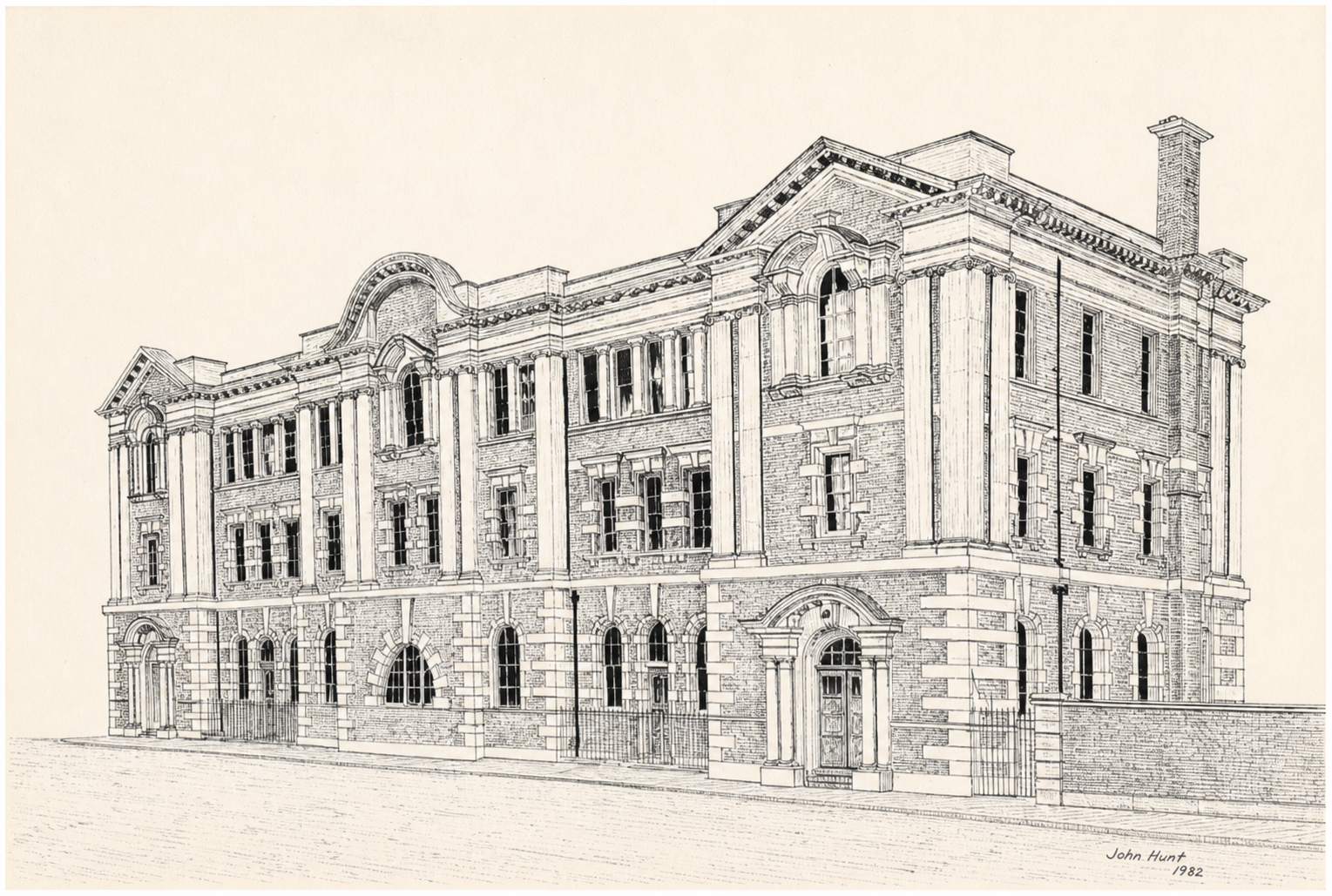
At the lower-right corner of the sheet, beneath an empty stretch of pavement, two small lines read “John Hunt” and “1982”. The inscription is easy to miss. Most of the paper has been given to a building: three high storeys, long ranks of windows, a curved pediment at the centre and darker side bays that bring the façade forward at either end. Hunt’s name sits where a passer-by might have stood.

The street is almost vacant. There are no postal workers, customers or traffic to explain what the architecture did. Instead, brick courses, stone dressings, window bars and ironwork accumulate mark by mark. The emptiness makes the façade the event: an attempt to hold a complicated public building still.
A building held still
The sheet now sits behind glass, a grey-green double mount and a moulded frame. That enclosure is part protection and part limit. An unattributed note on the backing makes a claim about the drawing: “ORIGINAL PEN AND INK / DRAWING BY JOHN HUNT”. The sheet has not been examined out of its mount, so its concealed edges, reverse and exact medium remain beyond view. What can be said securely is simpler: this is a framed black-line architectural drawing, signed “John Hunt” and dated “1982”.

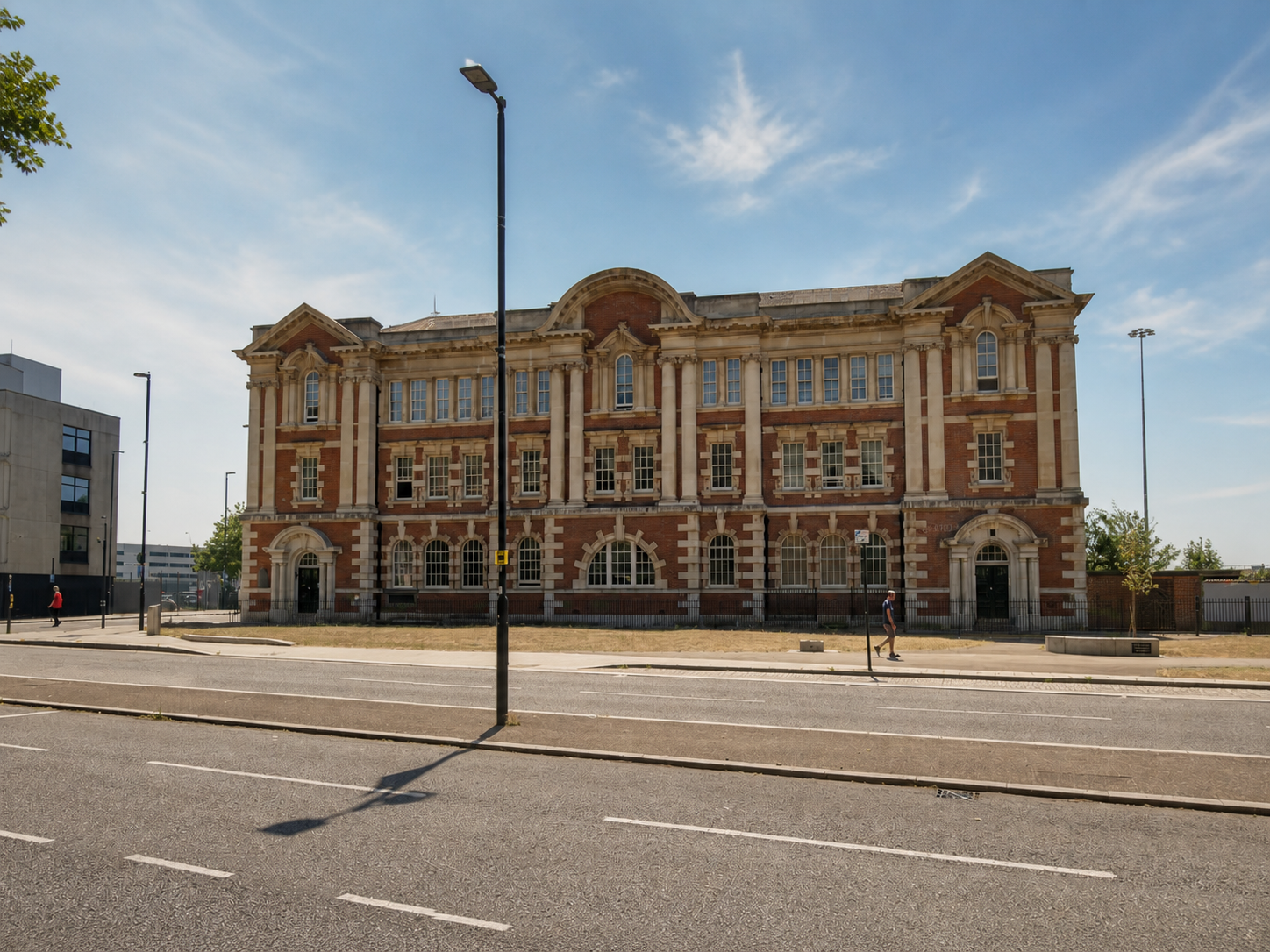
Historic England lists the Post Office Building on Platform Road at Grade II and describes a three-storey red-brick-and-stone composition with a curved central open pediment, projecting bays, pilasters, engaged columns and round-headed ground-floor openings. Those features are the structure of the drawing. The brickwork is not a generic texture laid over a convenient outline; its patient hatching helps each window, arch and change of plane occupy a particular place.

Southampton’s own archive identifies a Docks Branch Post Office at the site and says it housed both post and telegraph offices. A specialist postal-history study gives one focused case: in 1906, a postcard arriving by ship was cancelled at the branch and transferred onwards aboard another vessel. The drawing presents immobility, but the institution it depicts belonged to a system organised around movement: mail arrived, was cancelled and moved on.
When the view learned to travel
Beside the framed sheet is a smaller version of the same image. The postcard preserves the angle of the façade, the empty foreground and the reproduced “John Hunt / 1982” inscription. It also adds something the drawing does not need: “SOUTHAMPTON DOCKS POST OFFICE” across the upper-left corner. Comparison makes the relationship visible without requiring a production story. Whatever steps lay between them, the card repeats this composition.


Reproduction changes the view’s work. The title fixes the building to a name. On the reverse, an address field and stamp box prepare the card for movement, while a vertical line reads “© Southampton and District Philatelic Society No.1”. A final line credits “J. Hunt”. The singular view has become a piece of structured paper: named on one side, addressable on the other and supplied with an institutional voice.


This particular example appears unused. There is no address, message, stamp or postmark, so it cannot testify to a journey through the mail. Its blankness is nevertheless revealing. Even without handwriting, the card had already converted an architectural image into a possible act of correspondence. It made the building portable even if this copy never travelled under its own stamp.

One independent record brings the name, date and subject into the same narrow frame. The Southampton and District Philatelic Society’s archive index records a 1982 item catalogued as “Print” under the title “Hunt, John - Southampton Docks Post Office”. That entry does not call the object a postcard, identify a printing process or connect its record to this physical sheet. It corroborates a 1982 catalogue association between John Hunt, this subject and a print, but no more.
A caption with a moving address
The postcard’s reverse tries to remove a different kind of uncertainty. In a short block of text it gives the building a chronology: land purchased from “L.S.W.R.” between 1897 and 1901; an opening as a post office in 1905; closure on “29/4/67”; and later use by “British Telecom”. These are clearly the card’s claims. They are not, however, the only account in the record.
Historic England’s legacy description says the building was erected in 1902 by “Hawke” as a Custom House and remained one until 1965. Southampton City Council’s conservation appraisal instead calls it the “Post Office Building, former Cunard Offices (1899) and now Admiralty House”. Another council archive record distinguishes the Docks Post Office and the Customs House as separate buildings in the same 1976 view. The dates and original functions cannot be compressed into a single confident sequence.
The disagreement does not make the postcard worthless as evidence. It changes the question. Rather than treating the reverse as a miniature authority, we can read it as a compact act of local remembrance: a society credit, a building name and an administrative succession fitted into the space beside an address. The front carries a stable-looking façade; the back demonstrates how unstable the explanation of that façade can be.
Even the phrase “British Telecom” catches a moment of institutional change. BT’s archive records that the telecommunications business received that distinguishing name in 1980 and became a public corporation separate from the Post Office on 1 October 1981; The National Archives independently gives the same 1981 separation. The drawing bears the date 1982, but the card carries no separate issue date. If the card followed the drawing closely, “British Telecom” would have been newly current; the surviving object cannot establish that interval.
The useful failure of the tape
Turn the frame over and another history appears, less official but more tactile. The backing paper is wrinkled and torn. A white hanging cord crosses a large, dark rectangle of adhesive; the postcard has a yellowed border of its own. Those corresponding traces are consistent with former attachment, but they cannot say when the card was fixed there or by whom. The handwritten assertion of originality is equally limited: legible, relevant and unattributed.


The degraded adhesive has not erased the relationship. Instead, it makes the act of keeping visible. The traces suggest that, at some point, someone placed a small reproducible image behind the larger framed one, close enough for comparison but normally hidden against a wall. Read cautiously, what survives resembles a rudimentary object file: image, claim and material trace held together without becoming a complete provenance.
By 2012, the building had changed again. Southampton’s conservation appraisal described it as the visual termination of the view south across Queen’s Park, while SeaCity Museum’s Titanic Trail marked the former Docks’ Branch Post Office on Platform Road and described the building as converted flats. Those are dated records, not a claim about the building’s present use. Together they show how a former working institution had become both a landmark and an image through which the city told its dockside history.
The walk past
I live in Southampton, two minutes’ walk from this façade, and pass it most days. The street view on the left is the building as it meets that ordinary route; beside it, Hunt’s drawing returns the same place to a slower, more deliberate act of looking. That proximity does not settle the building’s history, but it changes what the drawing brings back into focus: an everyday landmark whose image can become familiar enough that we stop seeing the claims attached to it.
 |
 |
References
- Southampton City Council Libraries — Docks Branch Post Office catalogue record
- Historic England — Post Office Building, Platform Road
- Southampton and District Philatelic Society — archive index
- BT Archives — BT and predecessors
- The National Archives — referenced source
- SeaCity Museum — Titanic Trail, 2012