
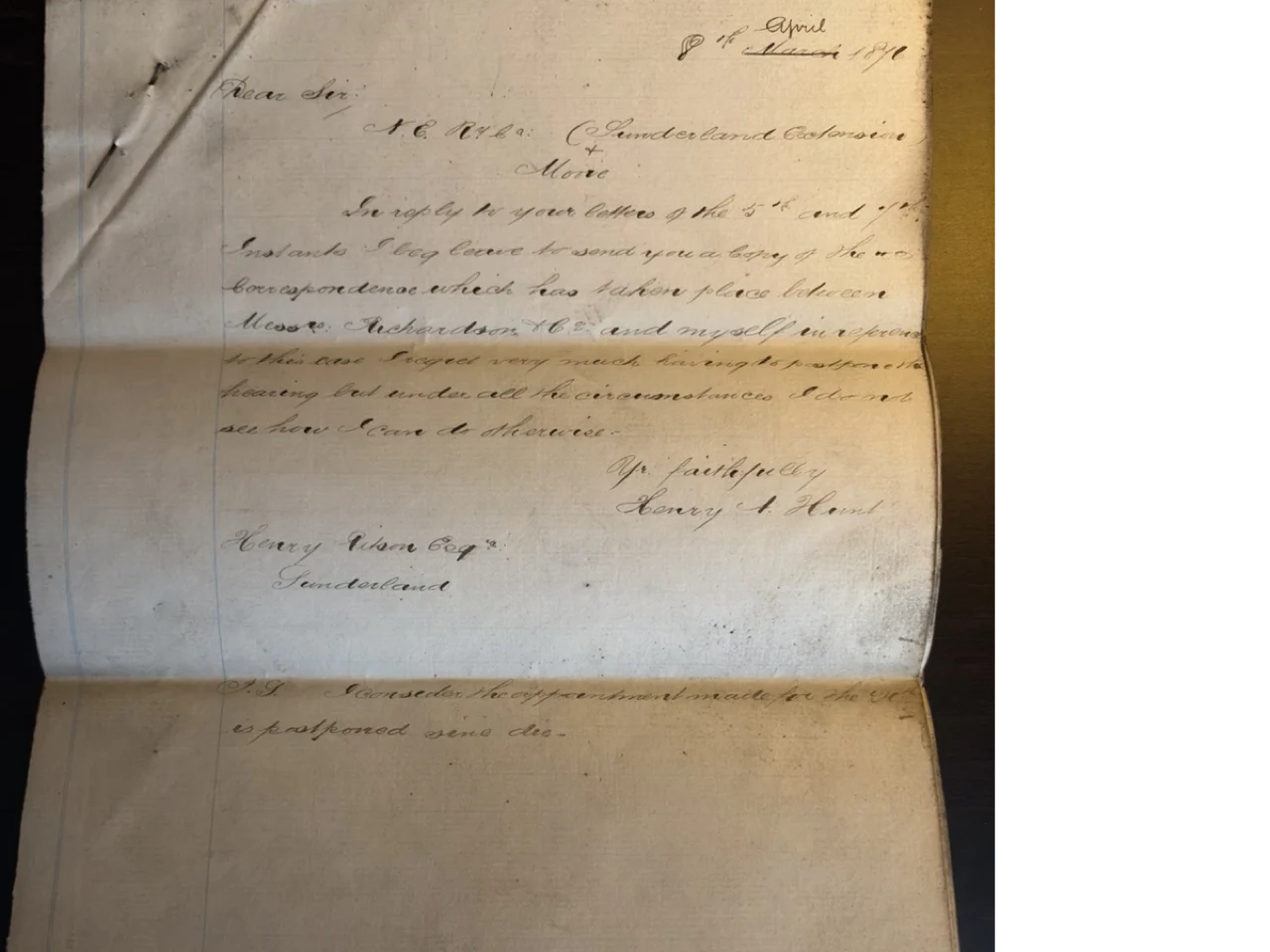
On 5 April 1876, a hearing in N.E. Ry. Co. & Moore had been fixed for the 20th and the following days. The surviving letter protests against changing the date. Its writer says a client was in delicate health and wanted the matter finished before leaving home; its continuation lists the people already committed around Easter: “Counsel, Arbitrator & Witnesses”.

The case does not begin with this sheet, and the bundle does not let us finish it. It gives Moore no forename, address, occupation, property or outcome. That restraint is part of the story. The sheets record the apparatus built around a person whose identity they withhold.
A hearing becomes a file
The 5 April letter is the first act visible here. It argues that a date already arranged should stand. The next sheet is dated 6 April: Henry A. Hunt writes from 45 Parliament Street to the railway’s York solicitors, Richardson, Gutch & Co., and a copied telegram records the proposed postponement. On 7 April, their York reply disputes the account of counsel’s availability and asks for a more convenient appointment. The second version of that reply is a copy, not a second exchange.
By 8 April, Hunt was sending the accumulated correspondence on. His covering letter says that postponement was unavoidable; the postscript records sine die. A 10 April copy preserves Hunt correspondence and telegram material. It should not be read as a fresh hearing or a new stage in the case. The sequence is small but exact: an appointment, resistance to moving it, a negotiation over who could attend, then a copied record of an indefinite postponement.
Two watermarks belong beside this correspondence but do something different. One reads HOOPER & SON / LONDON / 1874. It dates the paper’s manufacture or supply before the 1876 letters; it does not date the dispute, identify its author, or reveal Moore. The other watermark is too uncertain to name. Treating those photographed sheets as material evidence keeps paper history separate from legal procedure.
The broader Sunderland chronology is useful only at its proper scale. A North Eastern Railway deposited plan of November 1873 included work at Monkwearmouth and Bishopwearmouth, including the diversion of Union Street, under the 1874 Additional Powers Act. The archive’s late-1876 compensation records name other Union Street and Union Square owners and occupiers. In 1879, the Monkwearmouth Junction bridge linked the former terminus to the new Central Station. Those records explain a landscape in which railway works generated property and compensation paperwork. They do not prove that Moore owned a particular parcel, appeared in those awards, or had a claim about the bridge.
A rule book becomes working practice
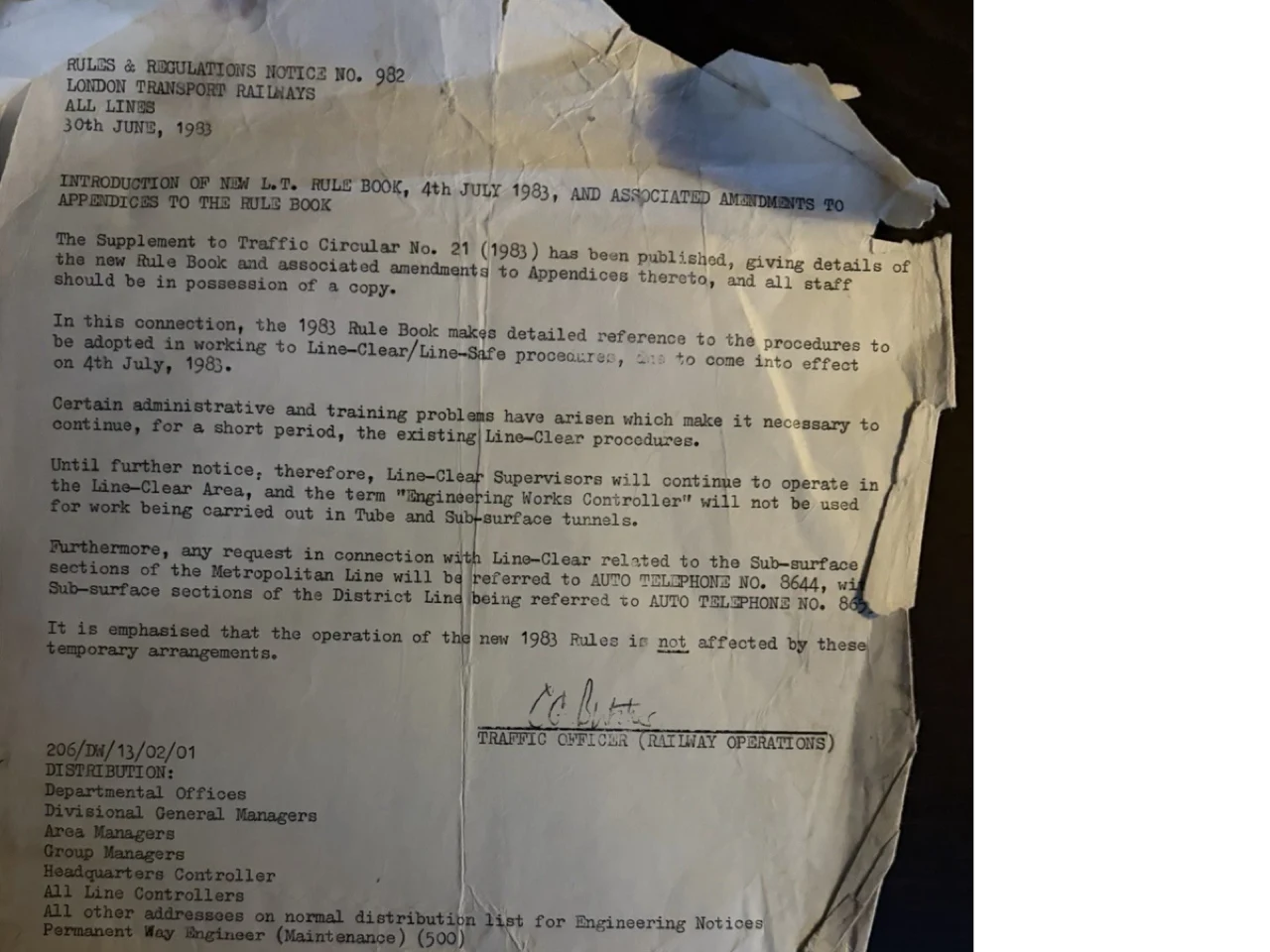
The London Transport papers have their own, later sequence. Notice 982 is dated 30 June 1983, four days before a new Railway Rule Book was to start on 4 July. It announces the start but retains existing Line-Clear arrangements temporarily because administrative and training problems had not been resolved. The paper was made to manage a beginning that could not yet be carried through in every detail.
Notice 1014 followed on 23 January 1984. It replaced Notice 1013 and set out arrangements for engineers’ trains, controllers, specified areas and possessions. On 9 February, Notice 1017 introduced Line-Safe arrangements for open sections after the close of traffic. It also says that staff responsible for the work still needed a fuller understanding of important aspects. The visible pages establish the stated transition; an obscured preceding page does not allow a fuller notice to be reconstructed.
Notice 1026, dated 4 April, then amended Rule M12. It narrows a Specified Area and requires personal Line Controller authorisation for a movement outside it. The surviving group next turns from procedure to circulation. The 3 September supplement to Traffic Circular 32 orders named Appendix 2 pages out and replacement diagrams in, while recording an 8,000-copy print run. Its New Cross and New Cross Gate diagram is not the Line Clear / Line Safe network map.
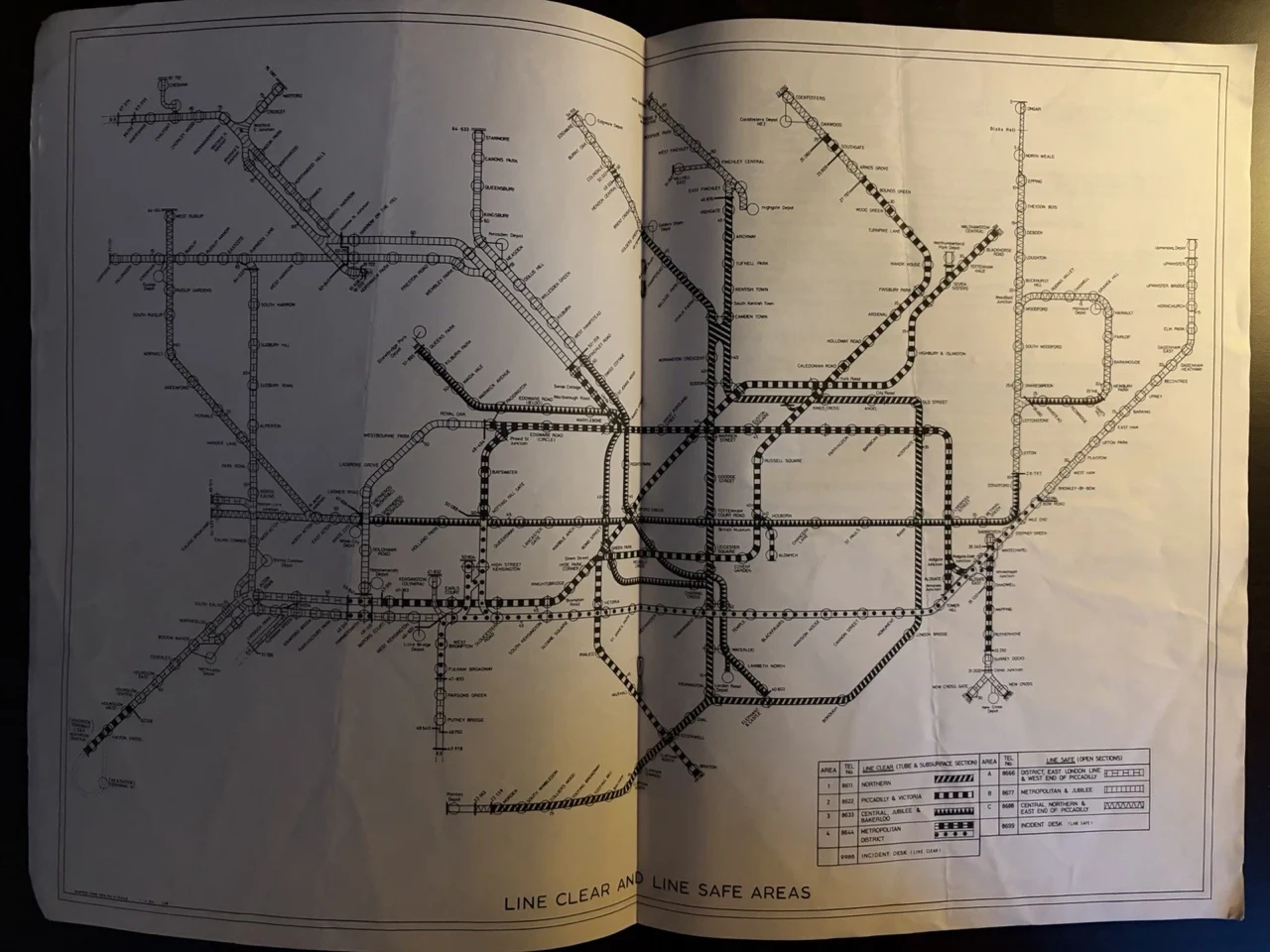
The later 1984 first supplement to Traffic Circular 39 explains and amplifies Engineering Hours procedures. Its photographed page is numbered 1209; without a cover or archive record, the exact issue date remains unverified. It carries the foldout headed “Line Clear and Line Safe Areas”. The map identifies places in the system. The notices in this group establish the conditions and responsibilities that governed work there.

What these groups preserve
The Sunderland correspondence and the London notices are not one continuous history. They were made more than a century apart for different institutions and different problems. Their relation lies in the work their individual documents perform. The first group holds a hearing in suspension: people had to agree a date before a case could proceed. The second holds a rule book in revision: instructions, changes, pages and diagrams had to reach those who would act on them.
That is why the papers matter as documents rather than souvenirs. A bridge and a network map show outcomes. These sheets retain the decisions that came before: when a hearing could be held, how a postponement travelled, when a new rule took effect, which pages were to be replaced, and where responsibility was drawn on the network. Moore remains unidentified. The record is valuable precisely because it refuses to turn that missing person into a certainty.
References
The Durham Record Office’s deposited-plan catalogue records the 1873 North Eastern Railway works, while its compensation records identify other 1876 Union Street claimants. Historic England documents the 1879 Monkwearmouth Junction bridge. The Signalling Record Society rule-book archive corroborates the 1983 introduction and the 1984 Engineering Hours supplement.