
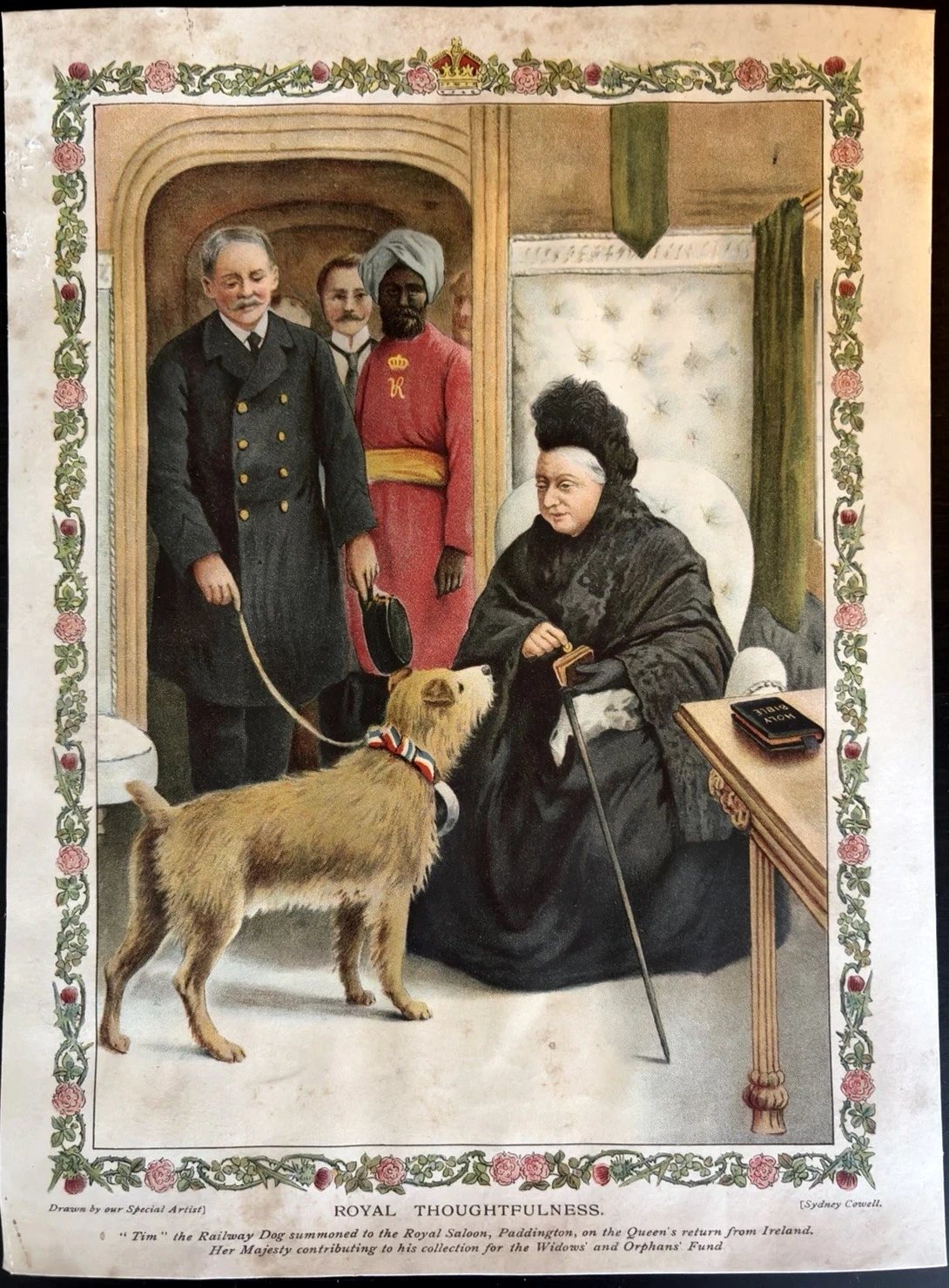
I have always had a weakness for dogs in old photographs and prints. They bring an immediate warmth to objects that might otherwise seem formal or distant. This sheet has that effect before I have read a word: the dog looks towards the seated Queen, the lead curves through the composition, and the whole encounter feels unusually intimate for a royal image.
I am also, unapologetically, drawn to Queen Victoria. What interests me here is not only the presence of a monarch, but the way the print makes royal kindness visible. It gives a small act—a coin placed in a collection—to the scale of a public scene, and asks the viewer to see generosity as part of the machinery of everyday life.
Tim enters the royal saloon
The caption beneath the image supplies the essential drama: “Tim” is described as the railway dog summoned to the Royal Saloon at Paddington, with Her Majesty contributing to his collection for the Widows' and Orphans' Fund. The wording is matter-of-fact, but the picture is carefully staged. Tim stands in the foreground, larger than any of the people around him, while the Queen's attention and the small coin in her right hand make the donation legible even at a distance.
Researching Tim changed the object for me. He was not an invented mascot but one of the railway dogs who collected money for families connected with the railway. An account from the Museum of Aquarium and Pet History describes him as an Irish terrier at Paddington who met Queen Victoria and received a sovereign from her; it also records more than £800 raised for the Great Western Railway Widows and Orphans Fund. Those details give the dog an institutional history as well as an endearing face. Read the account of Tim and the railway collecting dogs.
A royal scene with ordinary witnesses
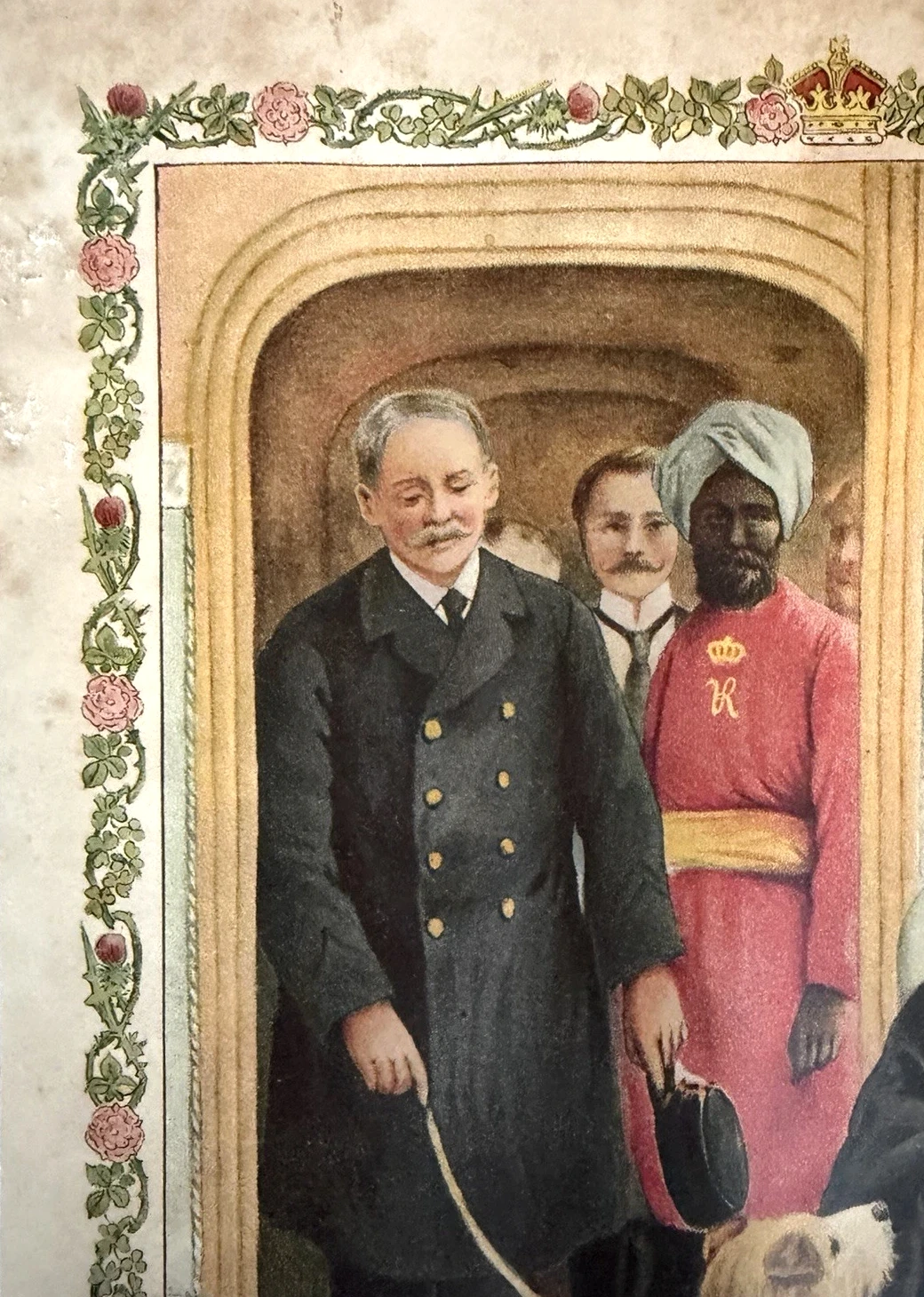
The other figures deserve attention. At left, a man in a dark double-breasted coat holds the lead and looks down towards the dog. Behind him are a second European-looking figure and a man in red dress with a turban and a gold monogram. The image does not give us their names or jobs, so I do not want to turn clothing into a false identification. What it does show is a carefully composed group: the handler, the attendants and the Queen are held together by Tim's lead, while the railway setting remains just outside the frame.
That arrangement is part of the print's royalism. Victoria is not presented alone in an abstract palace interior. She is shown receiving a working animal and its handler, making a contribution in front of witnesses. The royal gesture gains meaning because it enters a public institution—the station, the railway fund, the passing crowd—and because Tim gives the institution a face.
From a railway fund to a continuing responsibility
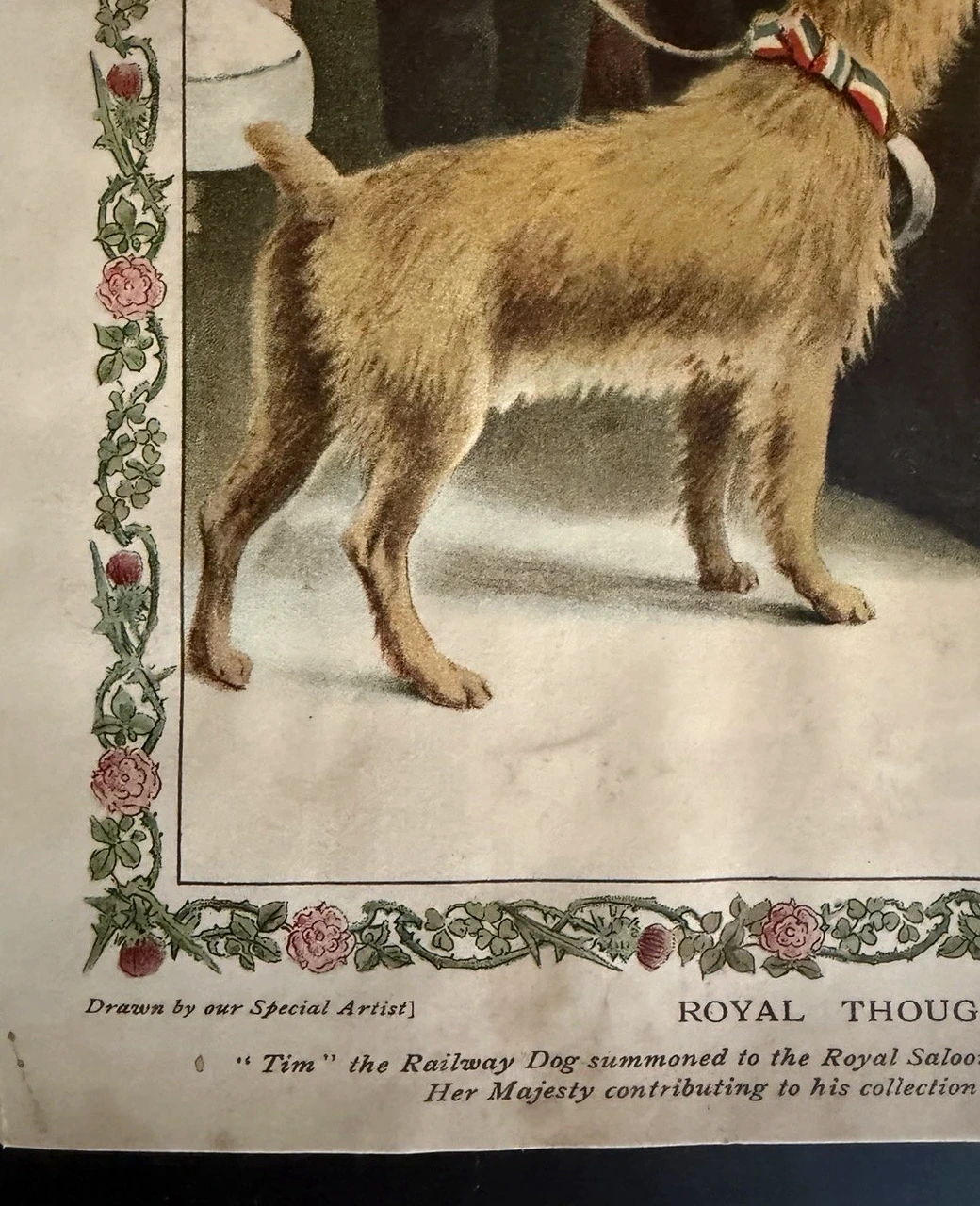
The print names the cause as a Widows' and Orphans' Fund, a reminder that railway work was inseparable from risk, bereavement and mutual aid. I have found descriptions of several overlapping Great Western Railway welfare schemes rather than a simple single institution that can be traced forward without qualification. It is safer to read the object as evidence of a period when railway communities organised care through dedicated funds, collections and familiar public figures such as Tim.
There is, however, a living continuation of that responsibility in the wider railway world. The Railway Benefit Fund—whose own history reaches back to 1858—now supports current, former and retired railway people and their families with confidential advice, non-repayable grants, a legal helpline and other practical help. I have not found evidence that it is the legal successor to the specific fund named on this print, so the connection is thematic rather than genealogical. The purpose is recognisably related: railway work creates a community, and that community accepts an obligation to look after its people. See the Railway Benefit Fund's current work.
The day before the end
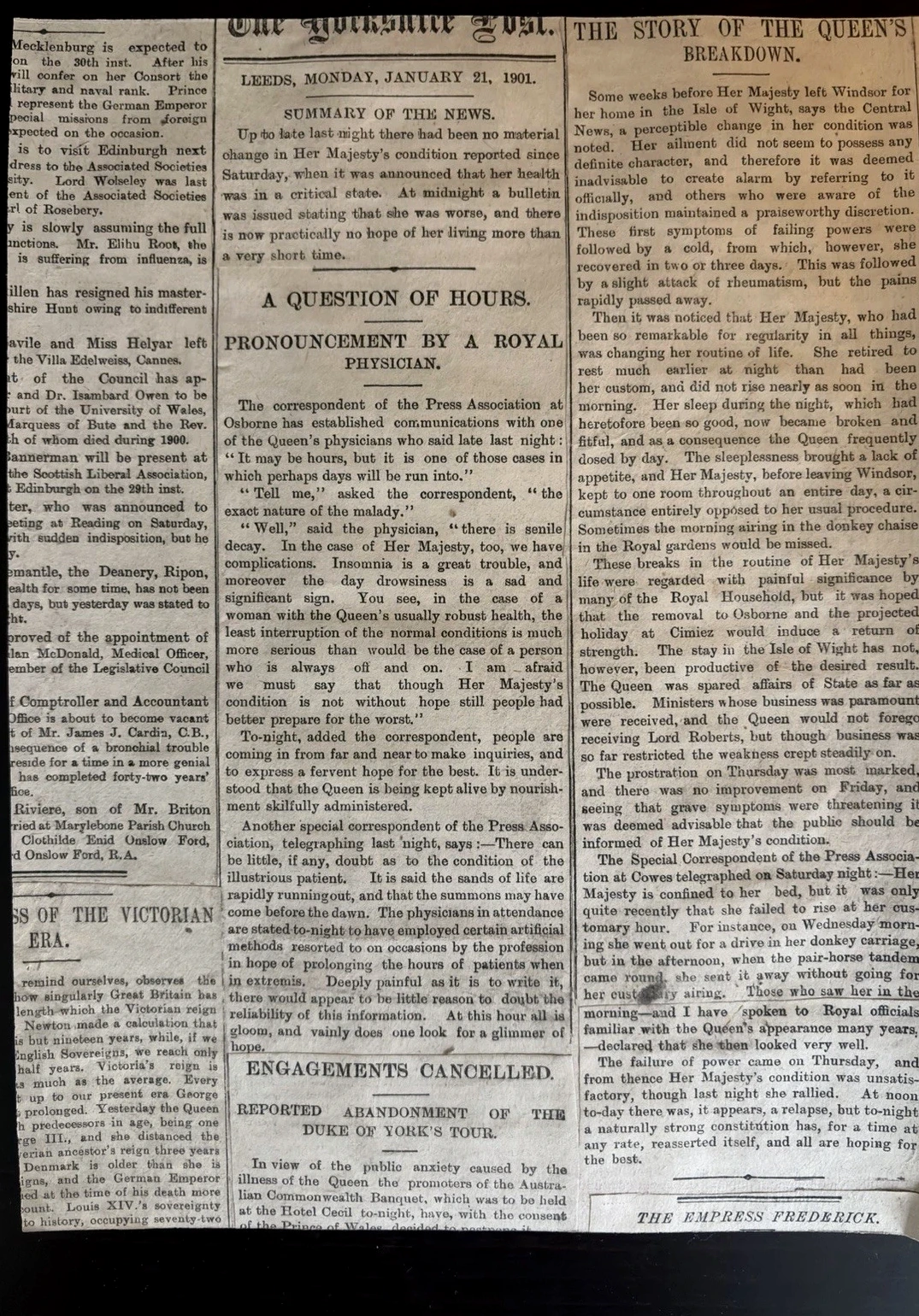
The paper on the reverse is the detail I keep returning to. It is not merely old backing paper: it is dated Monday, January 21, 1901, and reports that there was “practically no hope” of the Queen living much longer. Victoria died at Osborne House on January 22. The print's front invites us to look at a royal act of kindness; the paper behind it records the public anxiety that surrounded the final hours of her reign.
That juxtaposition is almost too exact. A sentimental image of the Queen giving a coin to a dog sits against the day when newspapers were trying to measure the time left to her. It does not prove that the sheet was assembled on that date, and I would not claim that the backing has a documented connection to the original print. But it is an extraordinary piece of physical evidence: two versions of Victoria's public image, one composed for affection and one for breaking news, held together by the same object.
How I have read the object.
The print itself supplies the title, the caption naming Tim and the Widows' and Orphans' Fund, and the artist credit “Sydney Cowell”. Period records place Cowell among the illustrators working for The Idler and for popular books in the 1890s, a world of commissioned images designed to make stories, personalities and public events immediately legible. That does not give us a complete biography, or prove that this print was made for a particular publication, but it places Royal Thoughtfulness within the active culture of commercial illustration at the end of the Victorian period.
The wider account of Tim and the Railway Benefit Fund's present work provide context, but I have kept the current charity link as a parallel rather than claiming an unproven institutional succession.
I began with the dog because that is where my eye went first. I stayed because the image makes kindness, railway work and royal representation occupy the same small space. The coin is tiny; the story it carries is not. In the end, what I value most is the way the sheet lets a beloved animal bring a distant sovereign back into the reach of ordinary feeling.
The complete print and its newspaper reverse can be examined in the original RUSTY PECHA listing.