
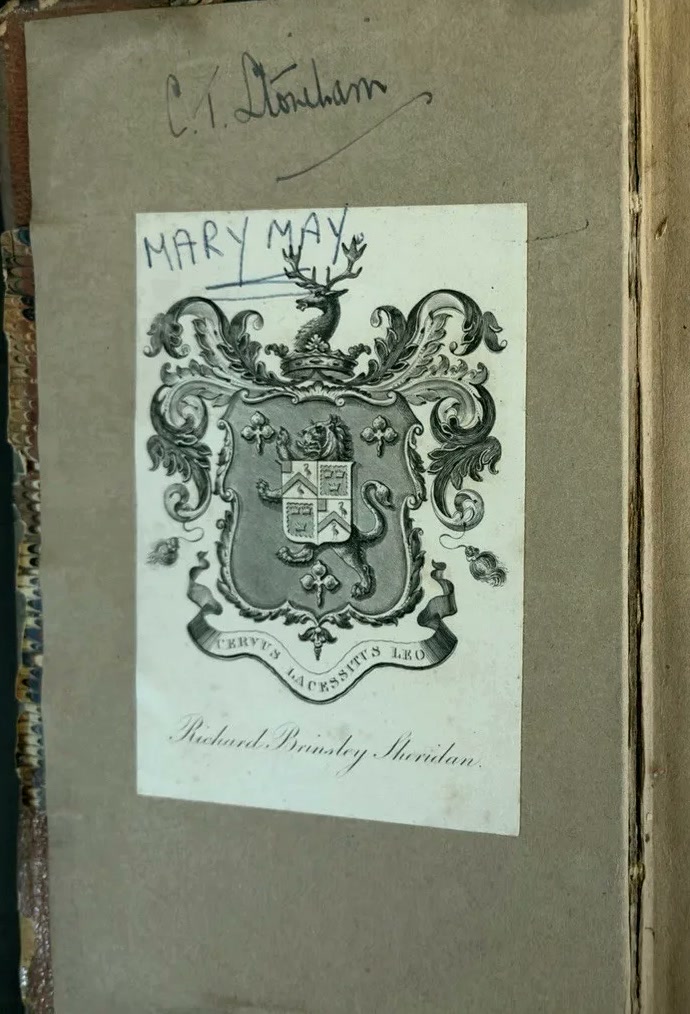
A name with theatrical force sits low on this book’s front pastedown: Richard Brinsley Sheridan. Above it rises an engraved coat of arms and the motto Cervus lacessitus leo—the hunted stag is a lion. It is tempting to let that inscription settle the question. Yet the volume itself supplies a firmer starting point. Its title page places it in Paris in 1857, issued by Librairie de L. Hachette et Cie, and presents not a playwright’s library book but a compact nineteenth-century doorway into the court of Louis XIV.
That distinction changes the question. The celebrated dramatist died in 1816, four decades before this edition appeared. The bookplate may belong to a later bearer of the same name, or to another branch of the family; the surviving book does not decide which. What it does preserve is a set of visible marks: an editor’s selection from a vast memoir, an armorial label, blue-ink writing across it and a pencilled name above it.
Making Saint-Simon portable
The title page calls the book Louis XIV et sa cour: portraits, jugements et anecdotes, “extracts from the authentic memoirs of the duc de Saint-Simon”, covering 1694 to 1715. The phrasing turns a vast memoir into a compact nineteenth-century volume.

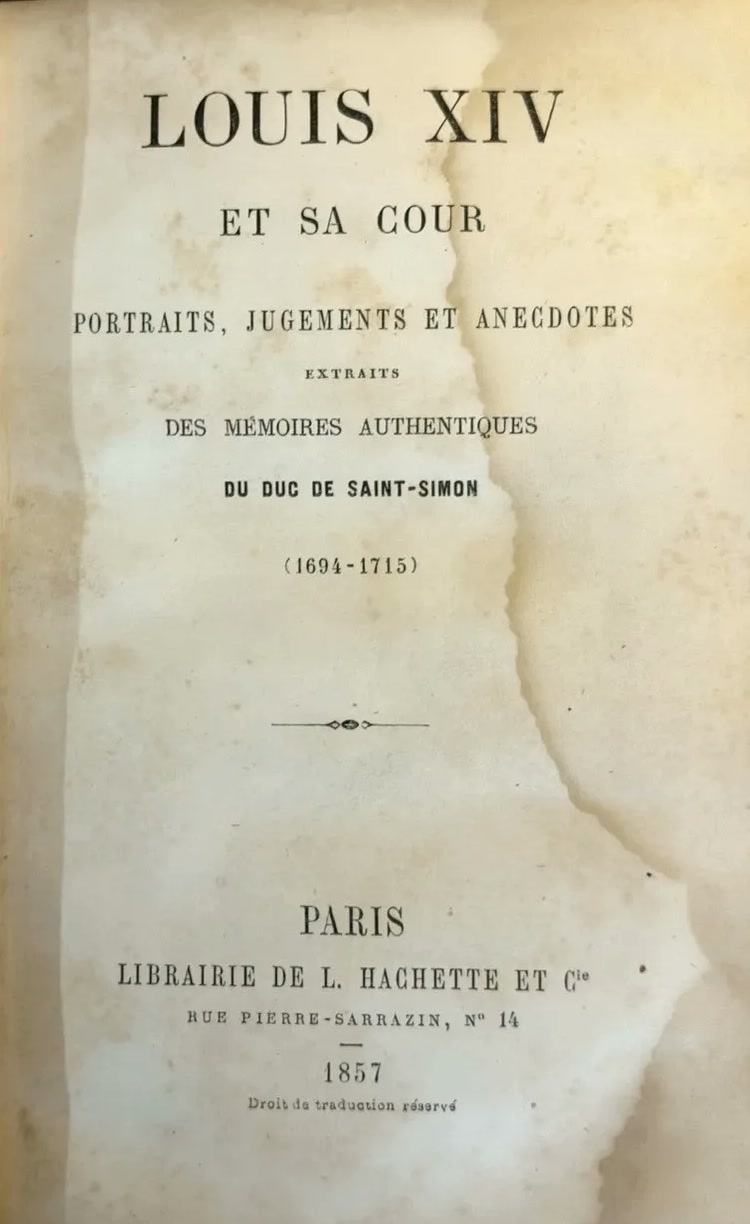
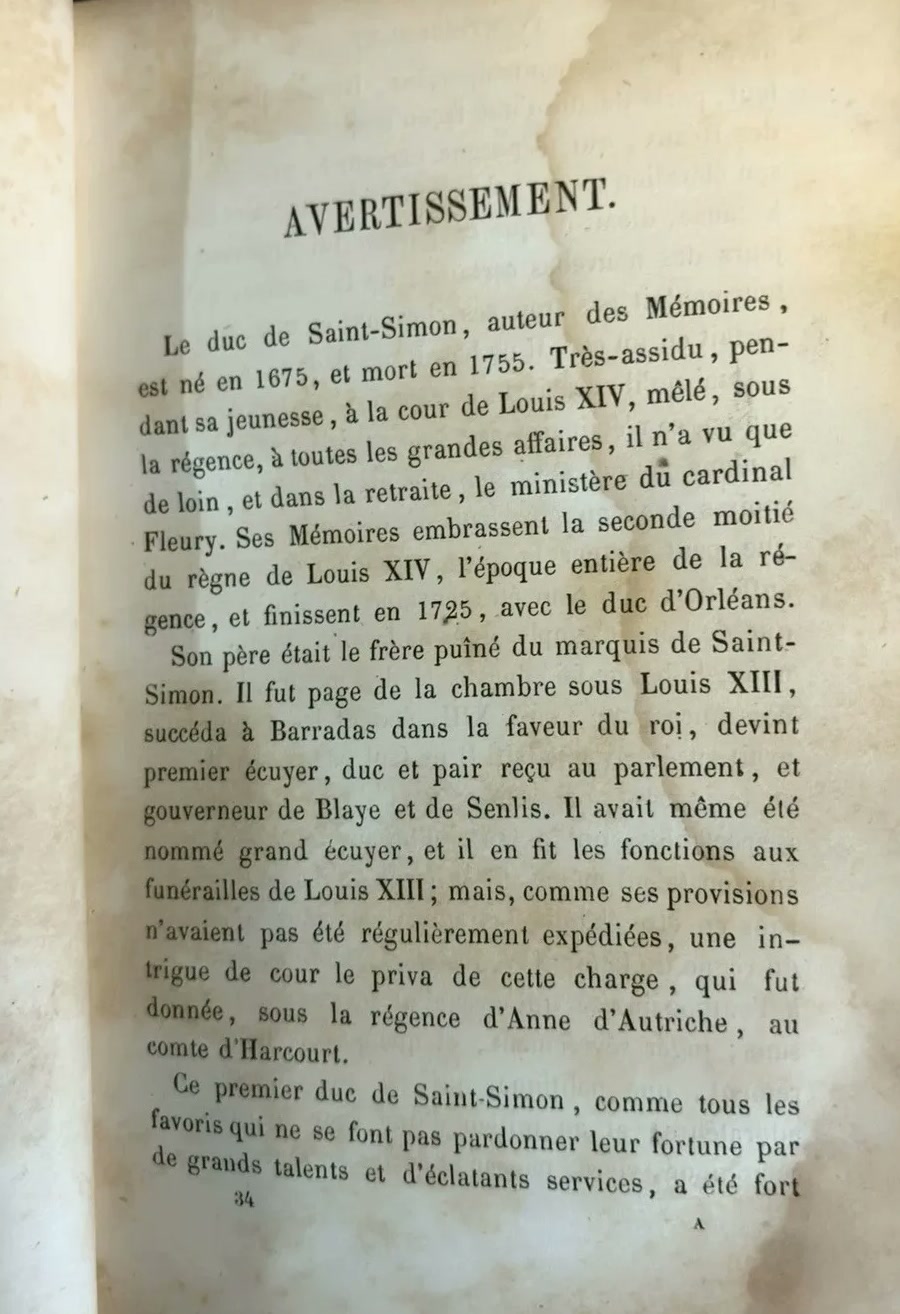
Saint-Simon wrote about court life after the events he described, and the nineteenth century produced substantial printed editions of his memoirs. The Hachette edition catalogued for 1856–58 is one bibliographical landmark. This photographed 1857 Hachette volume identifies itself more narrowly, as a selection of portraits, judgements and anecdotes: a single book made from a much larger body of memoir writing.

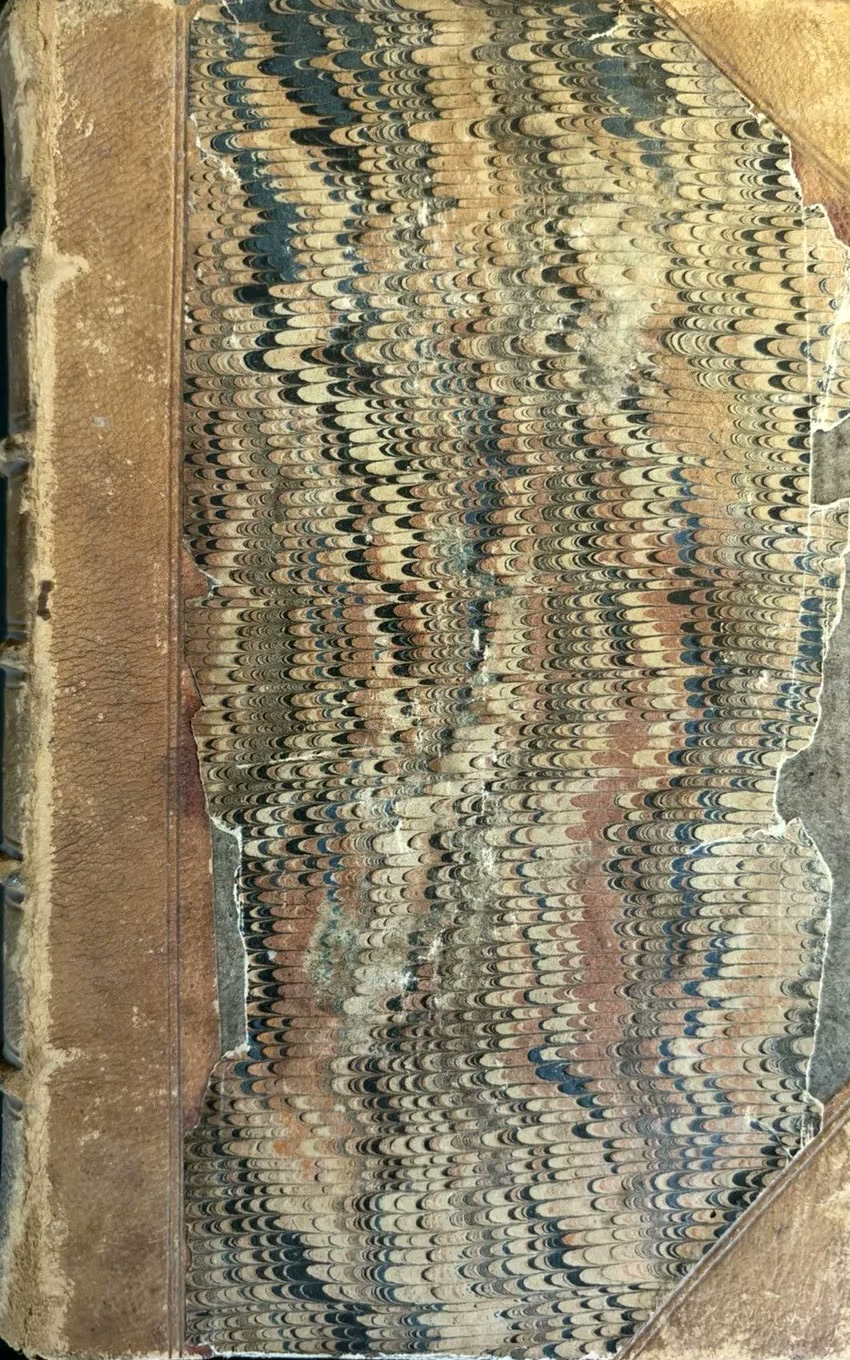
Its leather spine is rubbed almost to plain brown, its marbled boards are scraped and torn at the corners, and water has travelled through the preliminaries in broad, irregular tides. These visible features are not ornaments added to an otherwise stable book. They ask the reader to keep physical evidence alongside the engraved name rather than treating the bookplate as a complete account of the volume.
The name is not the provenance
The bookplate is handsome and specific: an armorial device, the Sheridan motto and the engraved name below. But it does not carry a date, address or other identifier. The famous Richard Brinsley Sheridan cannot have owned this 1857 Paris edition, and the plate alone cannot establish which later Richard Brinsley Sheridan placed it here. The book offers further, rather than simpler, evidence. “MARY MAY” crosses the plate in blue ink; a pencilled name appears above it.



None of those marks cancels the others. Together they show why a bookplate is not a conclusion but a beginning. A family emblem can identify a claim of ownership; it does not, by itself, give a date, a reader, or the route by which a particular volume changed hands. The plate is especially instructive because it keeps the engraved name visible alongside blue-ink writing and the pencilled name above it.
This is also why the book’s damage changes the reading. The staining, worn boards and split-looking joints have not preserved a pristine object. They make the physical volume harder to reduce to its bookplate alone. Its value as evidence lies less in a claim to celebrity than in the coexistence of printed bibliographical facts and unresolved marks.
Reading the surviving copy
Saint-Simon’s court is remembered for its elaborate hierarchies, but this particular copy asks for a quieter kind of reading. The title page records a publisher and date. The bookplate records an armorial name. The inscriptions are visible but unresolved. Each is precise enough to notice; none is sufficient to turn the book into a settled personal relic.
That is enough to make the volume more than a container for a famous court. It preserves a nineteenth-century printed selection from Saint-Simon and a group of visible marks on one surviving copy. The most responsible reading keeps those things together without pretending that the engraved name has solved them.
Sources
The title-page and opening-note transcriptions are from the photographed volume. For the publication history of Saint-Simon’s memoirs, see the Centre de recherche du château de Versailles bibliography and the catalogue record for the 1856–58 Hachette edition at Google Books.